home I index I latest I glossary I introductions I e-mail I about this site
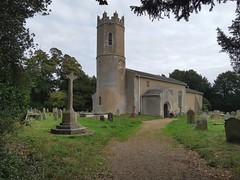
St Andrew, Raveningham



Follow these journeys as they happen at Last Of England Twitter.
St Andrew, Raveningham The woods and copses sprawl into
the Yare marshes in this quiet south-eastern backwater of
Norfolk. The settlements here must have been among the
very first places that Saxon farmers stopped and said to
themselves yes, this is the place, here we'll stay. And
so they did, creating the manors which the Normans would
divvy up among themselves. This quiet landscape
occasionally gathers to the surprise of a spectacular
country house, and one such is Raveningham Hall which was
built in the late 18th Century for the Bacon family. Near
the middle of the Hall Park, near to the famous restored
gardens,sits the church, and to reach it you cross the
wide expanse of parkland, the object of interest for the
pedigree herd of Sussex cattle who on this bright October
day seemed content just to graze, whisk their tails,
shake their heads and snort occasionally. There is a
glimpse of the front of the Hall from the fenced path
which leads up to a churchyard which has a surprising
number of 19th and early 20th Century headstones given
how small and sparsely populated the parish is.
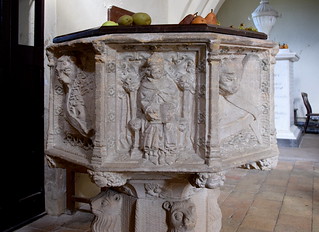
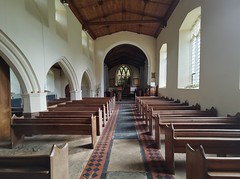
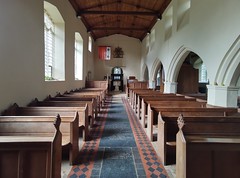
Presumably many of them once worked for the Hall. The church is open every day, and you step into a simple interior, perhaps a little gloomy on a sunny day, with two grand structures at the west end. One is a fine 15th Century font. On the panels of the bowl, which appears to be unrestored, the evangelistic symbols alternate with figures representing the Holy Orders of the church. A pope sits on a throne in the panel facing the door. Across from it at the west end of the low north aisle is the imposing block of a memorial to Major Edward Hodge, who died on the eve of the Battle of Waterloo in 1815. He was married to Maria, eldest daughter of Sir Edward Bacon. When I'd last visited the memorial had been set awkwardly behind the south doorway, but since then it has been moved, and you can now read all four sides. Hodge was, we are told, a Pious Son, Affectionate Husband, and Tender Father, the only Son of his Mother, and she was a Widow, the valedictory style of the previous century giving way nicely to the sentimentality of the new one.
Despite the north aisle this feels
a narrow church, perhaps because of the low arcade, and
the chancel beyond appears almost tunnel-like from the
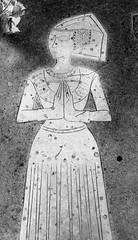
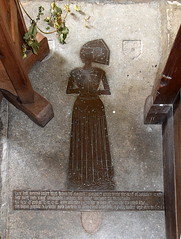
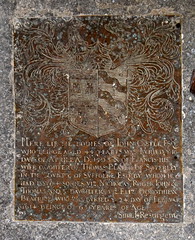
west end. The floor of the chancel is home to several
notable brasses, the best known of which is to Margaret
Castyll who died in 1483. Her inscription makes
interesting reading. It tells us that Here lyth
bureyd under thys ston of marbyll Margaret, sum tyme the
wyff of Hounfrey Castyll, late wyff unto Rauf Wyllughby
squier for Kyng Rychard the thyrd's body.
Simon Knott, October 2021 Follow these journeys as they happen at Last Of England Twitter. |



|
|||||||||||||||||||||||||||||||||||||||||||||||||||||||
home I index I latest I introductions I e-mail I about
this site I glossary
Norwich I ruined churches I desktop backgrounds I round tower churches
links I small
print I www.simonknott.co.uk I www.suffolkchurches.co.uk