home I index I latest I glossary I introductions I e-mail I about this site
St Andrew, Quidenham
| St
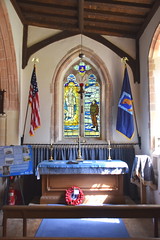
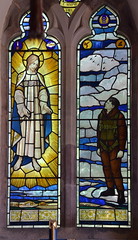
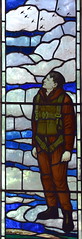
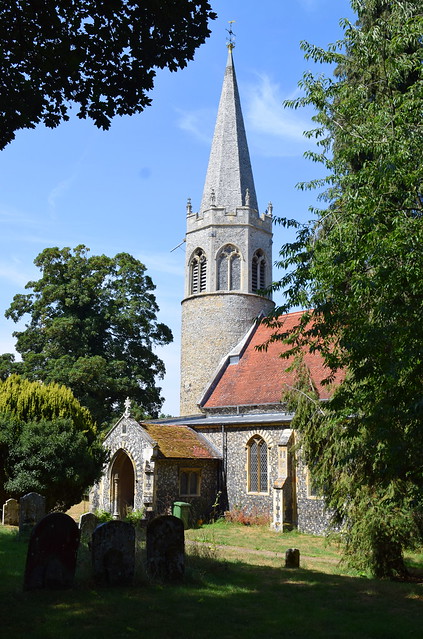
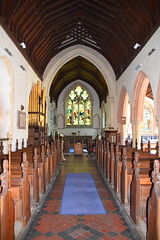
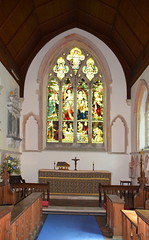
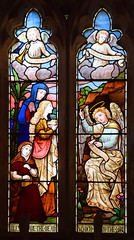
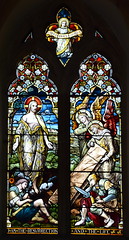
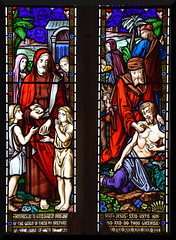
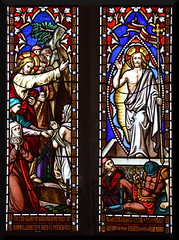
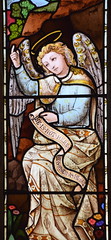
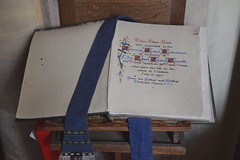
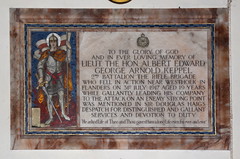
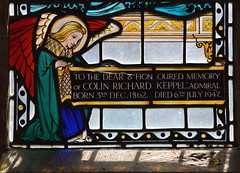
Andrew, Quidenham Quidenham is a small village to the south of Attleborough, known throughout East Anglia because it is home to two significant institutions, the Carmelite convent and the Children's Hospice. St Andrew's Saxo-Norman tower has been augmented in an elaborate fashion, a tall early Perpendicular bell stage topped off with the drama of a spire. It goes to make the church appear larger than it actually is, particularly if you approach from the south and see the 19th century aisle on this side. The buttresses on this aisle have flushwork monograms set into them. It is easy to assume that they are Victorian conceits, but I wondered if Mortlock might be right in suggesting that they are genuine medieval features reused from elsewhere. I wondered even if they were perhaps from the base course of a square tower at another church. There is an aisle, but there is no clerestory, and consequently St Andrew is rather dark inside. However, it is not gloomy, because the windows are filled with richly coloured glass of the late 19th and early 20th centuries. Those at the east and west ends of the aisle are lighter, creating a space which is less dark than the nave. Around the walls, memorials, as well as several of the windows, remember members of the Keppel family of Quidenham Hall. The most memorable is probably the 1947 American war memorial window in the aisle by Michael Farrar-Bell, depicting a WWII airman looking up at a vision of Christ.
The window
near it of Christ summoning the disciples is the better
of the two, and also dated 1947. Was it part of the same
commission? Other glass here by the O'Connors is good,
although Heaton, Butler & Bayne's east window is
perhaps not their best. Overseeing all this colour is an
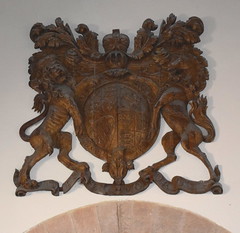
austere carved Stuart royal arms above the tower arch. |
Simon Knott, August 2018
Amazon commission helps cover the running costs of this site.
home I index I latest I introductions I e-mail I about
this site I glossary
Norwich I ruined churches I desktop backgrounds I round tower churches
links I small
print I www.simonknott.co.uk I www.suffolkchurches.co.uk