| |
|
St Mary
Magdalene, Pulham Market
 |
|
The
two large villages known as the Pulhams sit to
the east of the main road between Ipswich and
Norwich, and Pulham Market's name tells us that
the citizens of the earlier of the two, Pulham St
Mary, established a trading centre a mile or so
distant on the road which grew into a second
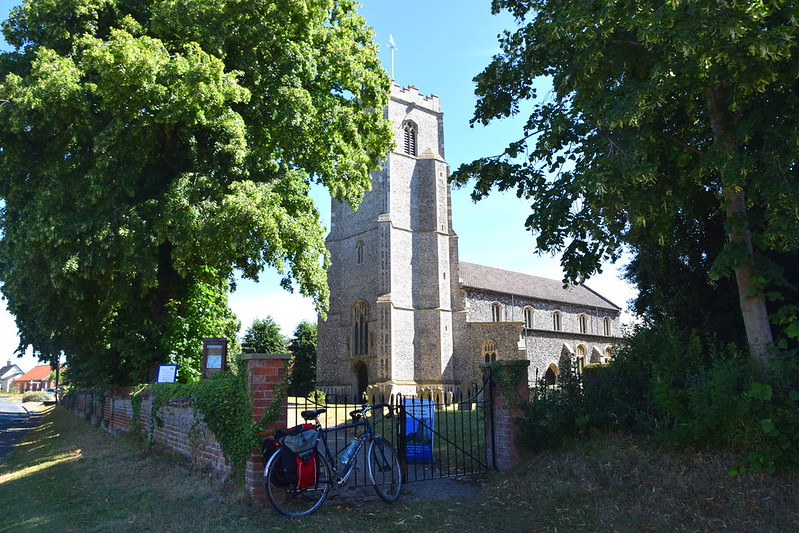
village. The centre of Pulham Market is a
satisfying piece. The village green is wide
without sprawling, and two old inns face each
other across it. Behind one is the church, with
its powerful 15th century tower. The inns, and
many of the other houses, date from the 18th and
even 17th centuries. Chocolate box scenes like
this are rarer in East Anglia than you might
think, and no one would seriously think of Pulham
Market as a town today. But the green was the
former market place, and as the name suggests
this was a market town from the 12th century
until well into the 17th century.
There
was a railway station, but the line has now gone,
and the main Ipswich to Norwich road now bypasses
the village. For most people, their abiding image
of the Pulhams will be the old workhouse, now
converted into flats with a garden centre
surreally in front of it, on the A140 to the west
of here.
|
St Mary
Magdalene is a big church, a town church. Externally, it
is hard to see anything that is not late-medieval, and
this building would look quite at home in the centre of
Norwich, perhaps somewhere along St Benedict's Street.
Entering into the spirit of the the thing, the Victorians
treated St Mary Magdalene to an overwhelming restoration
in the 1870s. They don't seem to have touched the
structure much, and just about all the money, £1,800,
went on internal furnishings. Pevsner quotes this amount
from Kelly's Directory with one eyebrow raised, because
it is about £350,000 in today's money, which is not much
to pay for rebuilding an aisle or a tower, but buys an
awful lot of Minton tiles and pitchpine benches at a time
when, it is worth recalling, labour was very cheap.
The
niches that flank the west window and door of the
tower appear to have their original statues in,
albeit too worn away to be certain. It appears to
be an Annunciation scene. As at Pulham St Mary,
there is a grand early 16th century porch - not
as ornate as the one in the sister village, and
on the north side this time. A curiosity is that
the large east window of the porch lights
directly into the west end of the north aisle.
This would seem to suggest that the porch
predates the aisle, but it is so late that it is
hard to think that there would have been time to
build it before the Reformation set in. As we
will see inside, the arcades have little to offer
on the subject. Perhaps the window was an attempt
to lighten what is a fairly dark interior. Today,
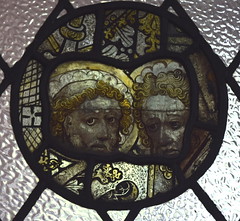
some panels of medieval glass have been reset
among frosted quarries, better than it sounds but
difficult to photograph without through light.
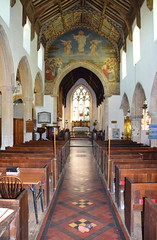
You step into a large, slightly anonymous
interior, a town church. And then, the surprise
of those arcades. The most western bay of the
south side is rounded, and then it leaps away
eastwards with pointed arch. The north arcade
columns are fuller, with four shafts each, and
may postdate the porch, or may not. A pleasing
mixture, which lightens the sense of an
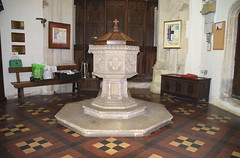
off-the-shelf design. The font, at the west end,
may help explain some of the cost, as it is a
fabulously ornate Victorian piece, somewhat in
the style of that at Norwich St Lawrence, with a
castellated rim. |
|
 |
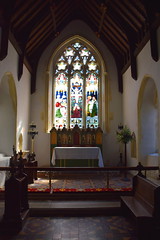
As well as
the big 1870s restoration, throughout the 19th century,
and well into the 20th, fabulous money was being spent
here on glass of the highest quality. The very earliest
is in the east window, and yet this is still as late as
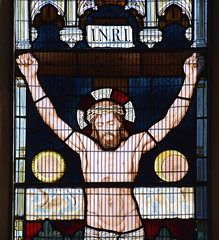
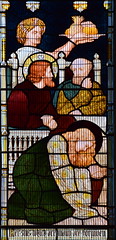
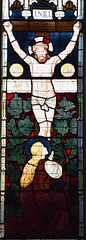
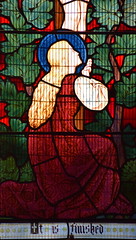
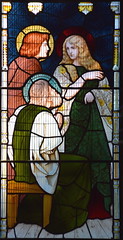
1873. The work of Henry Holiday for Heaton, Butler &
Bayne, it depicts three scenes in the life of St Mary
Magdalene. In the centre, she sobs at the foot of the
cross. On the north side she washes the feet of Christ,
and on the right she returns to the upper room to tell
the disciples that the tomb is empty.
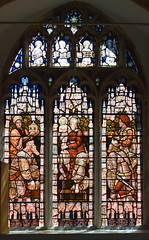
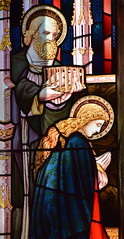
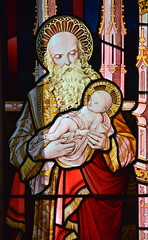
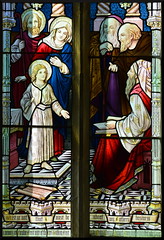
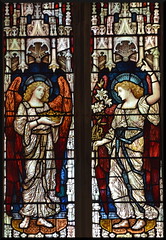
The best
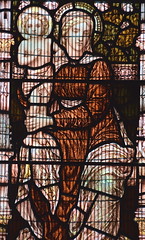
of the rest of the glass is in the south aisle. An oddity
is the east window here, an Adoration of the Magi scene
which appears to be the work of Henry Holiday for Powell
& Sons, but instead of the pre-Raphaelite colouring
you might expect it has been rendered in sombre browns.
Birkin Haward thought it was 'dreary', and it isn't
helped by the nature of the stone guard on the outside.
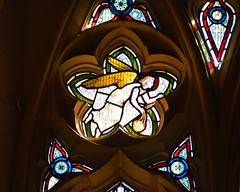
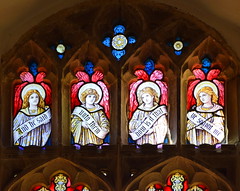
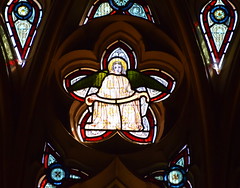
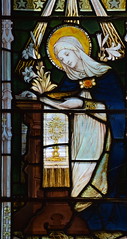
The lovely Annunciation scene to the south of it is a
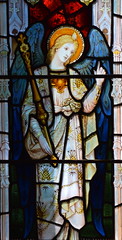
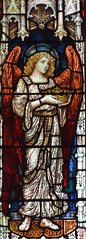
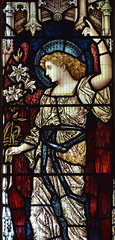
later work of the same workshop, while the angels at the
west end appear to be another Henry Holiday design,
probably for Powell & Sons.
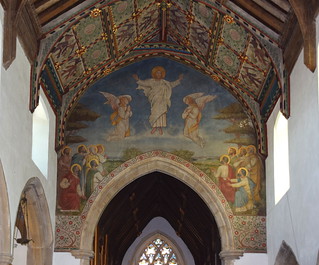
The most striking feature of the Victorian restoration is
the vast mural above the chancel arch, depicting the
Ascension, an awkward subject. In medieval times, it was
conventional to portray it as the gathering together of
the Apostles, who pray and look upwards, prefiguring
Pentecost. Christ's feet in the clouds above would remain
to remind us of the incarnational nature of the story.
The Victorians preferred to show the whole body of
Christ, with the Disciples marginalised. Perhaps they
were uneasy with the Catholic feel of the traditional
iconography. Whatever, it is hard to show a man ascending
with dignity, even the Son of Man, or especially so.
Should he flap his arms? Should he look downwards at his
followers, or upwards at his destination? As so often,
Pulham's Ascension looks like nothing so much as a robed
figure trampolining. Thankfully the restored canopy of
honour in the roof to the west of it, shows the
Victorians doing a much better job of seeming
convincingly medieval.
Simon Knott, August 2018
|
|
|