home I index I latest I glossary I introductions I e-mail I about this site
St Nicholas, Potter Heigham



Follow these journeys as they happen at Last Of England Twitter.
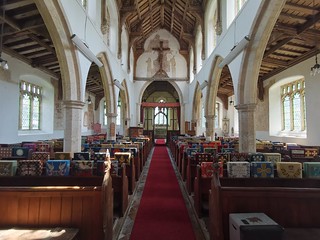
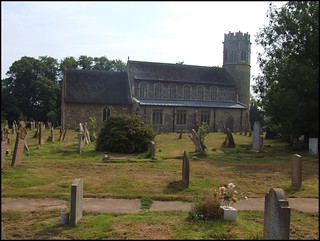
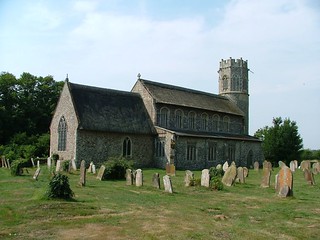
St Nicholas, Potter Heigham Potter Heigham is a busy working village in the touristy heart of the Norfolk Broads, the busy Cromer to Great Yarmouth road running through it, but the parish church is set away from all this on the edge of the village overlooking the fields. It is an attractive sight, the wide, neatly thatched roofs topping off the nave with its tall clerestory and the more rustic chancel huddled at the east end. This is substantially a church rebuilt at the end of the medieval period, and bequests to the work continued into the 1530s. The bell stage to the round tower is 15th Century, and it is elegantly decorated with flushwork and crowned with battlements. Brick was used to good effect to pick out the large clerestory windows and the niches on the porch. In the central niche is the figure of a woodwose, probably from the tower parapet of another church. Most likely the tracery in the nave windows and clerestories has been renewed. You step into a building which has the impression, perhaps not surprisingly, of unusual height. There is hardly any coloured glass, allowing the light to fall on the old wood and stone, and to reveal number of intriguing details, for Potter Heigham church is one of the most interesting of all in this part of Norfolk. The first that you see on entry is the county's only brick font. It is likely to be early 16th Century, so contemporary with the substantial renovations of this time, and as Francis Bond pointed out it appears to have been encased in cement at some point. It is set on a Maltese cross base and is lead-lined, and there are banded details which have eroded, but that may have been trefoils. Were they carved, or were the bricks moulded for this purpose?
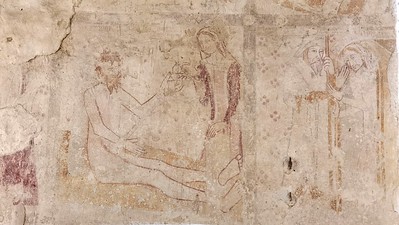
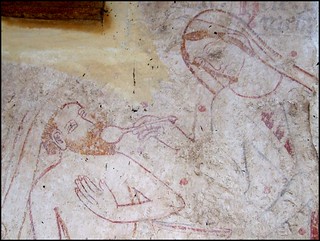
Clay for bricks must have been easily available from nearby Hickling Broad, and given the name of the parish, which remembers it as the site of a Romano-British pottery, for other purposes as well. But Brick fonts are surprisingly rare. There is another at Polstead in Suffolk, but it was entirely rebuilt in 1961. Further south, there's one at Chignal Smealy in Essex which is broadly contemporary with the Potter Heigham font. Turning east into the nave, the view is dominated by the early 20th Century rood set on the original rood beam above the surprisingly slight chancel arch. There are shadows of the former rood behind it, the ghosts of the Blessed Virgin and St John at the foot of the crucifixion. Along the aisles there are surviving wall paintings, and probably there were once more. The clearest and perhaps most interesting is that towards the east end of the south aisle depicting the Seven Works of Mercy. The best of these scenes are the two at the bottom showing Visit the Prisoner, who lies with his wrists tied with a bar and his feet in stocks, and Welcome the Stranger, who appears at the door in the garb of a pilgrim. Above them the scenes of Feed the Hungry, the hungry man given a large of loaf of bread, Give Water to the Thirsty, and Comfort the Dying, where the figure in the bed has water tipped from a spoon into his mouth, are also easily discernible.
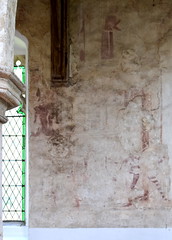
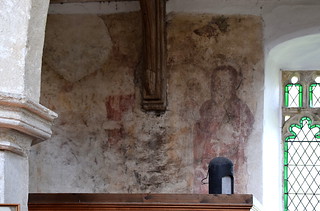
Directly across the church from the Works of Mercy scenes, there is a sequence of scenes of the life of the Blessed Virgin and her son that leads from her conception to his Resurrection. Not much is discernible, but at the very top we see St Anne meeting St Joachim at the Golden Gate in Jerusalem. His figure has been destroyed by a beam supporting the later aisle roof. Next, St Anne welcomes the Blessed Virgin back from the Temple of Acolytes. These events are not in the Bible, but they appear in the apocryphal gospels of James and Pseudo-Matthew, the last of which was very popular with the laity in the late medieval period, giving accounts as it did of Mary's early life and the Christ child's miracles. At the bottom of the sequence, the striped legs are those of one of the people whipping and mocking Christ before his Crucifixion. Further west in the same aisle are the figures of St Christopher and St Anthony.
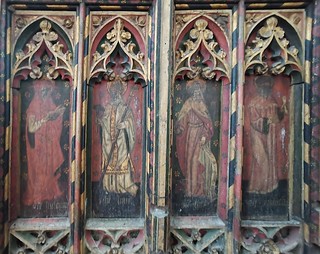
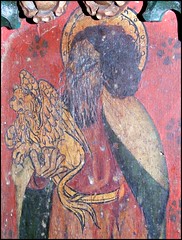
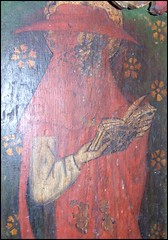
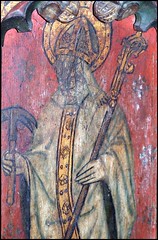
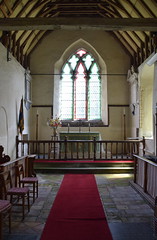
The disproportionate slightness of the chancel arch in relation to the width and height of the nave can be explained by the fact that the chancel is still essentially on the same plan as its 13th Century predecessor, which in turn is probably as narrow as the Norman chancel that preceded it. Most likely the late 15th Century rebuilding consisted largely of replacing the windows. This means that the rood screen dado is relatively small, with just four panels on each side. They are a mixture of the Evangelists and Latin Doctors, with one curious exception. On the north side of the screen are St Mark holding a lion, St Augustine, St John (his poisoned chalice scratched out as well as his face) and St Gregory. On the south side are St Jerome, St Eligius holding a hammer, St Luke with a little ox at his feet and St Ambrose. The inclusion of St Eligius begs two questions. First of all, why is he here? Most likely he was the choice of a patron or donor, and given that he was the patron saint of metalworkers and farriers it might be another indication of the industrial activity of Potter Heigham on the eve of the Reformation. The other question concerns the disruption to the alternating sequence of Evangelists and Latin Doctors, for if that had been consistent it should have been St Matthew in this position and not St Eligius. This suggests that there may once have been other figures, perhaps on parclose screens or the rood loft, and there we might have found St Matthew.
As often in this part of Norfolk there are surprisingly few memorials for such a large church. William Bower died in 1806. His quietly elegant memorial tells us that he after having for many years discharged the duties of Husband, Parent & Neighbour with affection, tenderness and integrity Departed this life Beloved and Respected. The White family contributed seventeen corpses to the chancel floor in the late 17th Century. A single ledger stone remembers them, and recalls that they were Lovers of the Church, Loyal to their Prince, True to their words, Just in their dealings, Kind to their Neighbours and Charitable to the Poor. The Whites were not alone in reminding us of their loyalty to Church and Crown during the years of schism. The grandest memorial here is to Robert Myhill, Clerke Vicar of this Towne. Curtains fringe the tablet which is flanked by scrolls and foliage with a curious scattering of skulls and bones below below. His inscription tells us that he built the vicaridge and suffered much in the Oliverian times for his loyalty to his Prince. He died in the 1660s, the Crown and Church restored, but we don't know exactly which year. The date was February 22nd, which was before the New Years Day of that time on March 25th. It was conventional to show both years in such cases with the last digit in fractional form, for example 166½ for a date in what we would now think of as February 1662. However, the final character has been left uninscribed here. In 1798, Leonard Flaxman was buried immediately to the east of the chancel under a solid-looking brick tombchest with a stone slab top, so he must have been a man of some substance. His inscription reminds us that Our life hangs by a single thread which soon is cut and we are dead. Then boast not reader of thy might, alive at noon and dead at night. Simon Knott, September 2021 Follow these journeys as they happen at Last Of England Twitter.
|
|
|||||||||||||||||||||||||||||||||||||||||||||||||||||||
home I index I latest I introductions I e-mail I about
this site I glossary
Norwich I ruined churches I desktop backgrounds I round tower churches
links I small
print I www.simonknott.co.uk I www.suffolkchurches.co.uk