home I index I latest I glossary I introductions I e-mail I about this site
St Michael, Plumstead
Follow these journeys as they happen at Last Of England Twitter.
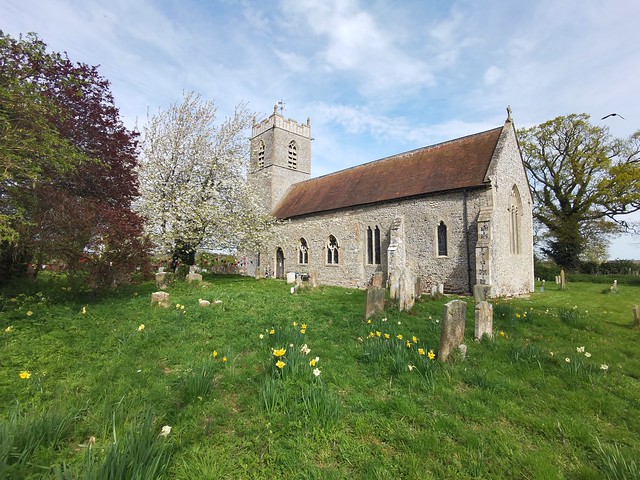
St Michael, Plumstead Another handsome
little church huddled in the lost lanes of north Norfolk,
its narrow churchyard fronting the village street. It is
a mark of just how big Norfolk is that this parish is not
confused with Great Plumstead and Little Plumstead, both
much larger and way off on the other side of Norwich. The
village is sometimes known as Plumstead St Michael. As
often in Norfolk, a 12th Century church was augmented
with a new chancel at the start of the 14th Century, the
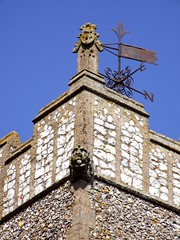
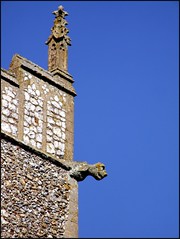
tower coming later and last of all, surmounted by elegant
flushwork and pinnacles.The church was once bigger, and
if the south side looks a little odd it is because a
three bay aisle has been demolished, and the arcade
filled in. Mortlock was perhaps a bit harsh on the 19th
Century mock-Dec windows which replaced the arcade. To my
mind they have the kind of quirkiness which is the charm
of the churches in this part of East Anglia.
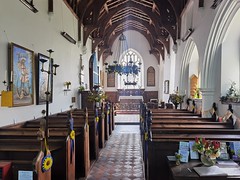
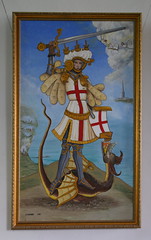
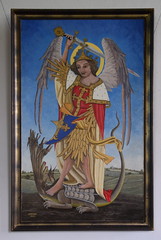
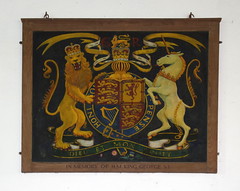
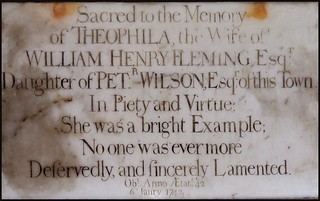
There are several unusual features in the nave. On the north wall are two spirited paintings based on the figures of St George and St Michael on the screen at Ranworth over in the Broads. They are signed JF Durdin and dated 2000 and 2010. They are really very good. Another curiosity is the set of Royal Arms for George VI, which I think may well be unique in East Anglia. There are a fair number of sets for his daughter Elizabeth II, but I do not recall seeing one for her father before. The inscription suggests that it was made in 1952, for it tells us that it is in remembrance. Along the wall from it is a sweet little memorial written in charming lettering for Theophilia Fleming, the daughter of Peter Wilson Esquire of this Town. She died in 1743 at the age of 42, although the memorial gives the date as 6th Janry 1742/3, as this was in the days when the New Year began on March 25th. The English calendar changed from this practice to the current one just ten years later. Her inscription records that in Piety and Virtue she was a bright Example. No one was evermore Deservedly and Sincerely Lamented. What more could any of us wish to have said of us? Simon Knott, May 2022 Follow these journeys as they happen at Last Of England Twitter.
|
|
|||||||||||||||||||||||||||||||||||||||||||||||||||||||
home I index I latest I introductions I e-mail I about
this site I glossary
Norwich I ruined churches I desktop backgrounds I round tower churches
links I small
print I www.simonknott.co.uk I www.suffolkchurches.co.uk