home I index I latest I glossary I introductions I e-mail I about this site
St John, Ovington

Follow these journeys as they happen at Last Of England Twitter.
| St John,
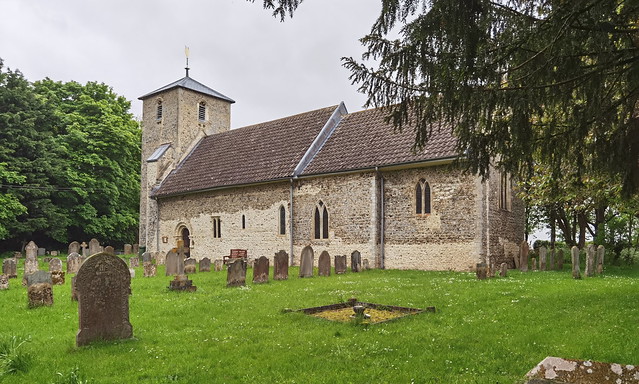
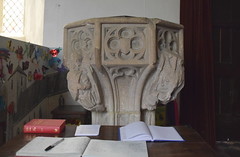
Ovington Comfortable and pretty villages straggle into each other in the parishes north of Watton, and Ovington is one of them. Its church of St John the Evangelist sits on a rise above the main street. Set behind the village hall is this fine little Norman church with a low tower attached, set in a rising graveyard. There is no porch, and the Norman doorway, one of the best in this part of Norfolk, appears all the grander against this humble little building. There is a triangular-headed holy water stoup set into it on the eastern side, presumably set there at the time of the 19th Century restoration, and you step down into what is inevitably a narrow and rather crowded space. Despite the window tracery this is clearly a fully Norman church, the thickness of the walls showing that the later windows were cut directly into them without any rebuilding. Ovington's most memorable feature is the 14th Century font, the like of which I've not come across at any other church in East Anglia, for, prominent at angles of the octagonal bowl are projecting symbols of the four evangelists, a winged man for St Matthew, a winged lion for St Mark, a winged bull for St Luke and an eagle for St John. They have all been beheaded, an act which must have needed some considerable violence. The font is said to have come from the parish church at nearby Watton at the time of the 19th Century restoration of the church there. There is hardly any coloured glass, which is probably a good thing given the size of the church, just an unobtrusive Crucifixion in the east window by Heaton, Butler and Bayne and a pleasing lily in the lancet window on the north side. An unremarkable place then, in a pleasant if hardly memorable village, but it does hold a special place in 20th Century history because it was identified by Arthur Mee as one of England's thirty-one Thankful Villages, those that got all the boys back alive that they sent to the slaughter of the First World War. Record-keeping was usually in the hands of the Anglican parish church, and we now know that records kept by parishes were fairly patchy, sometimes missing the lost sons of families which had moved away during the conflict, and some parishes were unable to record all the deaths of non-churchgoing families. At least one parish in Suffolk even excluded the names of those from non-conformist families from its church war memorial. Since Arthur Mee's time we know that George Goodrick, son of the landlord of the Cock Inn at Ovington, was gassed on the Western Front in 1918 and died here in Ovington in November of that year. He was buried in Watton non-conformist burial ground. Even so, Ovington was the only Thankful Village that Mee identified in the whole of Norfolk. Simon Knott, June 2021 Follow these journeys as they happen at Last Of England Twitter. |



|
|||||||||||||||||||||||||||||||||||||||||||||||||||||||
|
|||||||||||||||||||||||||||||||||||||||||||||||||||||||
home I index I latest I introductions I e-mail I about
this site I glossary
Norwich I ruined churches I desktop backgrounds I round tower churches
links I small
print I www.simonknott.co.uk I www.suffolkchurches.co.uk