| |
|
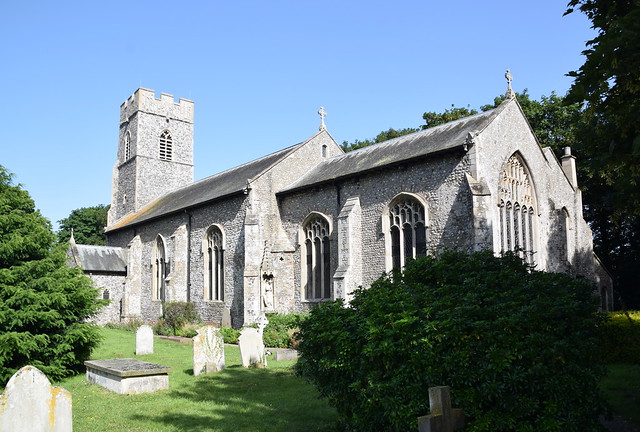
St
Martin, Overstrand
 |
|
Like
several churches in this part of the world, St
Martin was in a very bad state by the 19th
century, with only part of its nave still in use
for worship, and the decision was made to rebuild
it. It seems to have been a north Norfolk fashion
to rebuild on a new site, and so when Christ
Church was erected in the churchyard beside St
Martin in 1867, St Martin was left as a
picturesque ruin, as shown in the watercolour on
the left kindly lent to the site by Michael
Huggins. However, change was already in the air,
for in 1883 the journalist Clement Scott had
eulogised this area in an article written for the
Daily Telegraph, and the legend of Poppyland, a
dreamlike English idyll, was born.
The north Norfolk coast became a popular holiday
destination, thanks to Scott's writing and the
opening up of the area by the railways. Perhaps a
characterless Victorian church did not fit in
with Scott's vision of what Poppyland was, and
what people might find there. The medieval parish
church at neighbouring Sidestrand had been
rebuilt on a new site in an entirely medieval
round-towered style, and so it was that Christ
Church was demolished, and the ruin of St Martin
restored to something approaching its former
glory. The architects were Cecil Upcher and AJ
Lacey, and the church was opened on the eve of
the First World War.
|
The
reconstruction coincided with the pre-War triumphalism of
the Church of England, which was at that time at its
highest point in the national consciousness, but the
project demanded a rigorously vernacular style, and so
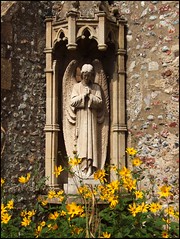
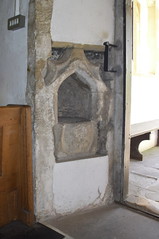
too many excesses were avoided. The guardian angel in his
niche on the south side is not a taste of things to come,
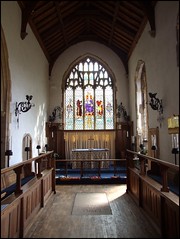
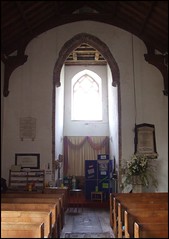
because you step into a relatively plain and simple
interior which is full of light from the clear glass
windows. The only colour comes from a vibrant east window
depicting Christ in Majesty with St Cuthbert and St
Martin accompanied by otters, dogs and ducks above scenes
of Durham and Tours cathedrals. It isn't signed, but I
wondered if it might be the work of John Lawson.
The aisle
and chancel are by Upcher & Lacey, the north doorway
surviving to create an unusual opening between aisle and
nave. Mortlock says the current south porch was
originally on the north side. Arthur Mee says that the
old font was found in a garden.
Although Overstrand is in many ways still a remote
backwater, the memorials and headstones here record links
to some of the 19th century's most significant
philanthropic families, including members of the Buxton
and Gurney families as well as Lady Battersea, who was
one of the Rothschilds.
Sir Thomas Fowell Buxton was the millionaire owner of
Truman's brewery. He married Elizabeth Fry's sister, and
as MP for Weymouth and the Isle of Portland he spoke
strongly in parliament for the abolition of all slavery,
even after the ending of the slave trade. It is said that
his advocacy of the extension of liberty in Africa
through the influence of legitimate trade under the
protection of Christianity inspired the Scottish doctor,
David Livingstone, to go to Africa as a missionary.
Tragedy haunted Buxton and his wife Hannah: four of their
children died during an outbreak of whooping cough in the
early spring of 1820. Buxton himself never came to terms
with his failure to eradicate slavery from Africa; he
died in 1845, and was buried here. His memorial is inside
the church, but he was also to be found on a recent
British five pound note, where he was the spectacled
figure standing to the left of his sister-in-law,
Elizabeth Fry.
|
|
|