home I index I introductions I e-mail I about this site
St Clement, Outwell



Follow these journeys as they happen at Last Of England Twitter.
| St
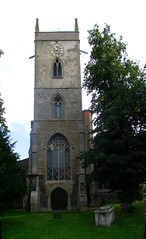
Clement, Outwell Here we are
out on the edge of Norfolk, most often the place where it
fades before disappearing completely. All along the
border are the marshes, the fens, the Breckland forests
and the Waveney river plain, a cordon sanitaire
protecting the county from the rest of civilisation. So
it comes as a surprise, in the south-west of the county,
to find three large settlements, Emneth, Outwell and
Upwell. They merge into each other and all but join to
the Cambridgeshire town of Wisbech. They line a stretch
of the Nene cut. The road that links them runs for just a
few miles across this corner of Norfolk, as it heads from
Wisbech to another Cambridgeshire town, Ely. The fenland
wastes cut them off from Norfolk proper, and it is as if
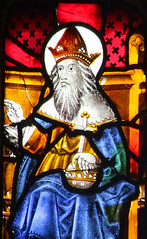
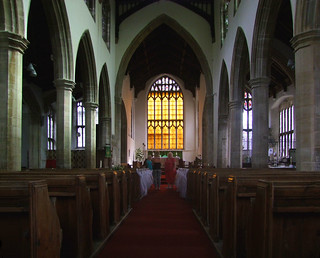
they are hiding from the rest of the county. Both aisles extend to flank the chancel, and in the north chancel aisle glass is a large early 16th century figure. He would not be out of place in Kings College Chapel. He appears to be one of the wise men from an otherwise lost Adoration of the Magi scene. Whoever he is, he gives us a hint of what is the great glory of Outwell church, for in the chancel and the south chancel aisle is a good collection of late 15th and early 16th Century glass, much of it not typically East Anglian in character.
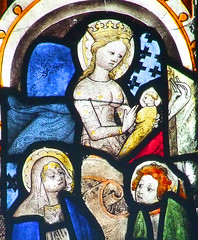
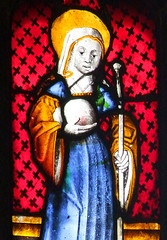
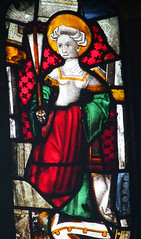
The glas was restored by King & Son in the 20th Century. The best of the earlier glass is a nativity scene with the midwife and St Joseph standing in the foreground, Blessed Virgin and child behind. This may not have been the original configuration, and Joseph's head is an interloper. Otherwise, the 16th Century figures of saints, mostly martyrs, is memorable. Set on red and light blue backgrounds they include St Agatha holding her breast, St Faith with a saw, St Ursula with an arrow, St Stephen holding stones, St Lawrence with a grid iron, a figure who is either God the Father or Christ at the Coronation of the Blessed Virgin, St Edward the Confessor and East Anglia's own St Walstan. On the north side of the crossing there is a large transeptual chapel. This chapel is one of the great treasures of Norfolk churches. Above the simple fittings is an exquisite hammer-beam roof, tiny and perfect. Stepping back into the aisles and the nave you can see that the roofs here are also medieval, probably by the same hands as those at Emneth, and feature angels holding instruments of the passion. There is also a wall plate with carvings of what appear to be mythological beasts. After the seemliness of the chapel
and north chancel aisle, the south chancel aisle is a
contrast, full of tables and junk, but I thought perhaps
not unsuited a building which is hardly the county's
tidiest church anyway, and at least it shows that the
place was being used. If anything, the untidiness
contributed to a continental feel. The roof here is
particularly interesting, because here are the best of
the angels and the wall plate. The roof in this aisle has
been restored at some point, because there is a 17th
century date carved near the entrance from the south
porch. On a shield it says '1624 RB RP', presumably the
initials of the two churchwardens. All in all then a quirky place, full of character and interest. And in the largely treeless surroundings of the Fens, St Clement's churchyard is an oasis. On a sunny summer day it is a lovely place, the idiosyncratic and slightly ramshackle building with its brick battlements and grinning gargoyles shaded and dappled by green. Simon Knott, May 2020 Follow these journeys as they happen at Last Of England Twitter. |


|
|||||||||||||||||||||||||||||||||||||||||||||||||||||||
|
|||||||||||||||||||||||||||||||||||||||||||||||||||||||
home I index I latest I introductions I e-mail I about
this site I glossary
Norwich I ruined churches I desktop backgrounds I round tower churches
links I small
print I www.simonknott.co.uk I www.suffolkchurches.co.uk