| |
|
St Mark,
Lakenham, Norwich A charming aspect to the city of Norwich is
that the parishes outside of the historic city walls are
still termed 'villages', even if, like Lakenham, they
have been a part of the urban area for centuries.
Lakenham lies to the south-west of Conesford, the
medieval southern suburb within the walls, and today
Lakenham is an inner-city area of Victorian terraced
streets and huddled shops. St Mark lies at the city
centre end of Lakenham, a chapel of ease to the medieval
parish church of St John in the heart of the old village
centre a mile or so away. However, its nearest medieval
neighbour is actually St John Sepulchre within the city
walls, barely 200 metres off, and when the suburbs
expanded and St Mark was built it spelt the beginning of
the end for St John Sepulchre and the other Conesford
churches.
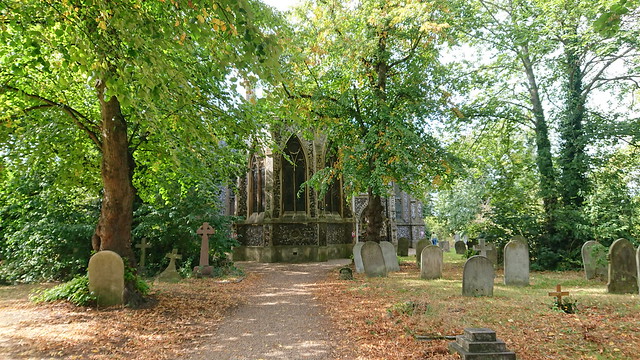
St Mark was an early work of the Diocesan Architect John
Brown. Built in the 1840s when the first great wave of
the Anglican revival was just beginning to make its way
from Oxford, its style, although ostensibly
Perpendicular, is largely pre-Ecclesiological, more
Carpenter's Gothick than Gothic Revival. The practice
came back twenty years later and added the apse. Before
this, the chancel-less church must have seemed very
blockish and Evangelical.
Externally then, St Mark was pretty much complete. But
what happened after was a succession of refurbishments
which added to rather than replaced what was already
there. Because of this, you step into a church which
really is quite unlike any other in Norfolk.
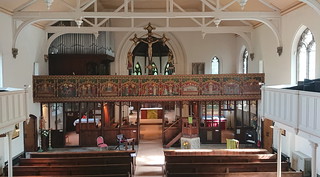
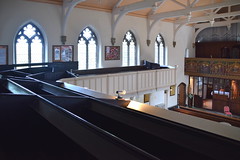
The 1840s gallery, which goes around three walls of the
nave, still has its box pews. On the walls below it,
however, are 20th Century stations of the cross, and the
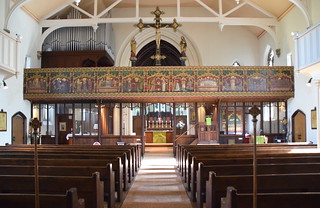
view to the east is of a fantastical rood loft, which
completely dominates the interior. The colourful apse
beyond seems distant, mystical. St Mark then is a curious
hybrid of the enthusiasm for building commodious churches
at the start of the century, and a yearning for mystery
and elaboration that arose as a response to the
Anglo-Catholic movement later in the Victorian period and
into the 20th Century.
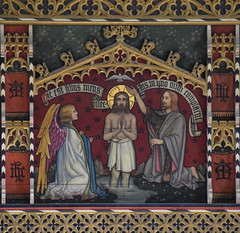
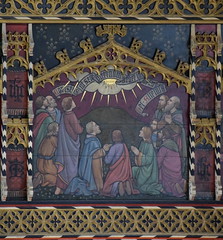
Without a doubt, the most important feature of the
interior is the rood loft and screen. It was installed
here in 1910 to the designs of George Bodley who had died
three years earlier, and then painted in 1913 to the
designs of the architect and artist Temple Moore. It is
painted in a rich, late medieval style, with something of
the Art Nouveau qualities of the late Victorian period
but with none of the contemporary morphing of the style
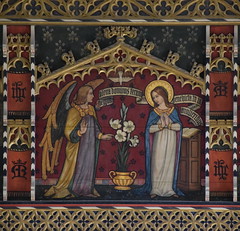
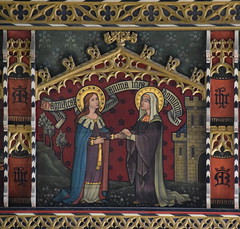
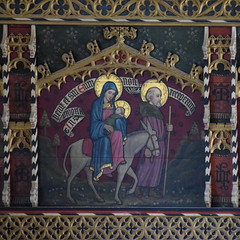
into the Jazz Modern of Art Deco. It depicts the Christ
story from the Annunciation to the Day of Pentecost. It
looks all of Bodley's work, which was presumably Temple
Moore's intention.
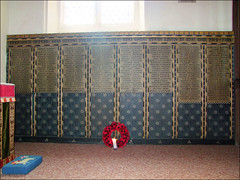
The near
contemporary south chapel echoes the decoration of the
roodloft, and is a memorial chapel to those local boys
killed in the First World War, a huge number of names it
seems, even if this is an inner-city parish. On the north
side, the chapel was laid out in the 1930s, very much in
the sober Art Deco classical style of that decade, and
instantly familiar from the fittings of nearby St Alban
and St Catherine in north Norwich. It works very well. It
is almost an anti-climax to step into the long apse with
its elaborate 1890s reredos and coloured roof, which seem
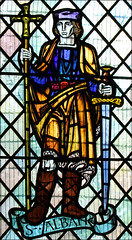
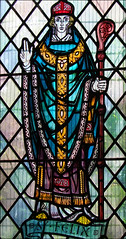
rather less singular. But there is a surprise behind the
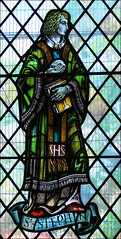
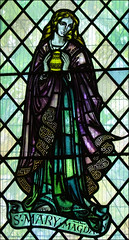
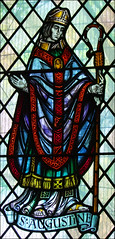
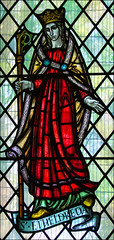
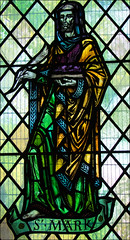
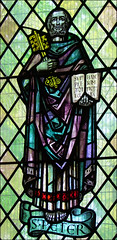
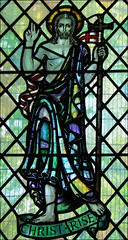
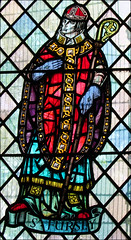
reredos, because here is an excellent range of figures of
King & Son. They were installed in 1954 to replace
earlier glass by Frederick Cole for Morris & Co,
blown out by the Norwich blitz.
One of the reasons for the continued elaboration of St
Mark is that it was, until well into the 1970s, one of
the highest and most militant Anglo-Catholic churches in
Norwich, a city well-known for its extremes of
churchmanship. Since then it has drifted back towards the
centre, but still retains the fixtures and fittings of
its former life. Another striking example is the set of
1930s Stations of the Cross, deep reliefs in an Italian
Renaissance style and made by the Kilburn Sisters
workshop.
One tiny detail that you might miss is the vestry in the
south-west corner. It retains the only 19th Century
window in the church, depicting Samuel and David beneath
a descending dove, and remembering two choirboys drowned
on an outing in the 1860s.
It is intriguing to imagine St Mark filled with incense
and plainsong chant, both used at daily Mass here into
the 1960s. Even more intriguing, perhaps, to imagine
watching Mass from up in the gallery, because here are
the surviving box pews from the 1840s, as if this was a
non-conformist chapel. They have done well to survive,
because there have been regular suggestions to remove
them over the last 150 years. Perhaps the installations
of treasures down on the ground floor made their removal
less of a priority. The nave itself was rebenched in the
early 20th Century, and it is intriguing to spot, on the
south side, that some of the benches and the wooden floor
beneath still bear the burn marks of the falling ceiling
when this church was firebombed in 1944. Apparently, the
parishioners stood bravely in the church with brooms,
beating out the burning timber as it fell from the roof
above.
And it is a good job they did, because this church is an
outstanding example of its kind. It has been threatened
with redundancy on several occasions in the last few
decades, but hopefully the Diocese of Norwich's benefice
system will save it for us. It was at one time used by
local Catholics for their Mass on a Saturday evening, and
they must have truly thought they were at home here.
My one doubt is that it is so rarely open, and thus
apparently little-known - Bill Willson's revision of
Pevsner in 1991 gives it just five lines, mentioning John
Brown but neither George Bodley nor Temple Moore at all.
Did he even know about them? If you read Wilson's review,
it would appear that he did not even go inside, and I'm
sure that Pevsner didn't either. But coming back in 2019
I was delighted to see that a huge amount of work had
gone into restoring the interior since my last visit
eight years previously, especially the WWI memorial
chapel with its unfeasibly large list of names.
|
|
|