home I index I latest I glossary I introductions I e-mail I about this site
St Andrew, Norwich
St
Andrew, Norwich
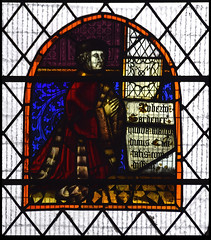
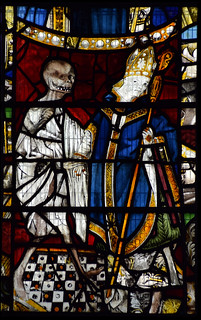
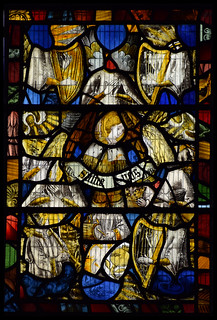
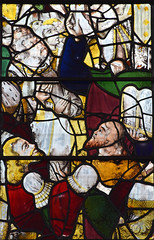
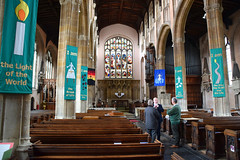
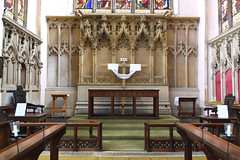
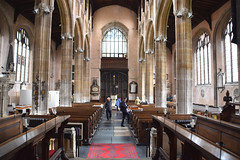
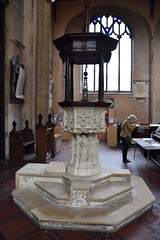
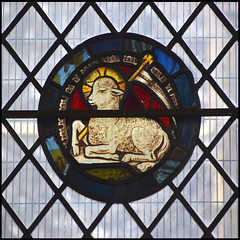
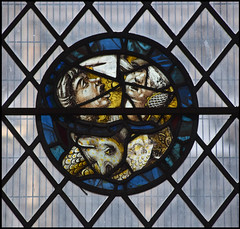
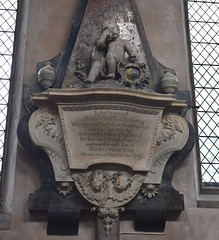
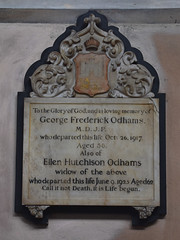
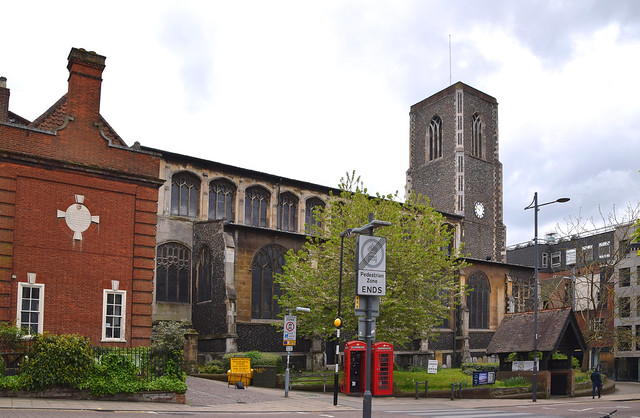
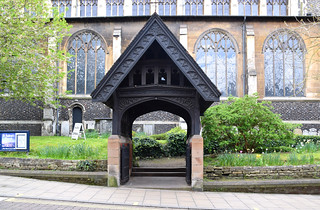
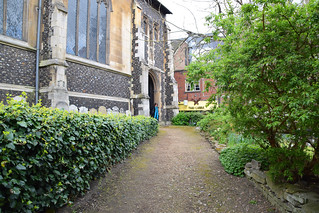
Entrance today is usually through a small porch set into the most westerly bay of the north aisle, although in fact the grandest entrance is through a south porch, now hidden from the street. The west doorway is blocked off by a room built beneath the tower, and always seems rather scruffy seen from the passageway which runs to the west of the church. We are in the full flight of Perpendicular architecture here, for although St Andrew is ostensibly a church of stone, there is very little of it in the construction, because the aisles, the clerestory and the chancel are virtually walls of glass. The way that the arcades fade into the east end, and a high window rises above them, may recall the smaller church at Shelton. The team that worked at Shelton are believed to have worked on the final stages of St Andrew. As with many of the Norwich city churches, St Andrew has been overwhelmingly Victorianised, and the interior is very much a 19th century idealised urban vision of what the late Middle Ages might have been like, refracted through the lens of St Andrew's muscular low church worship, a tradition it maintains. It was done well, and might best be described as sumptuous. I wonder who the architect was? It may have been Diocesan architect Richard Phipson, who made a bit of a hash of St Stephen, but he was on good form at St Peter Mancroft and was glorious at St Mary le Tower in Ipswich. Whoever it was, they left one of the most ornate 19th century fonts in Norfolk, and far off to the east a reredos to match. In between, the church unrolls before you. As at St Stephen there are massive 18th and 19th century memorials set between the windows of the arcades, but they are rather less oppressive here, perhaps because the church is bigger and there is more light. Set up in windows towards the west of the south aisle are some fine, large medieval panels, one of which comes from a Dance of Death. It shows Death dancing with a Bishop. Another is a composite of bits of angels. Some of them are musicians, and one of them is holding a scroll saying salve nos.
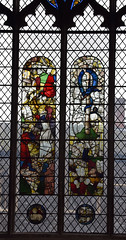
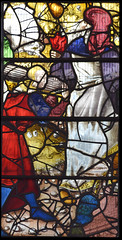
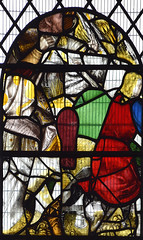
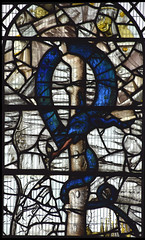
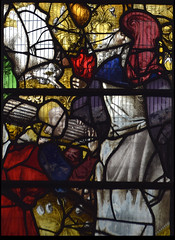
Perhaps even more interesting is the collection of 16th Century glass to the east. This will instantly recall for anyone who knows it the glass of the same period at Kings College Chapel in Cambridge. The glass there was made by Flemish glassmakers working in England, and it is fascinating to think that the same may be true here, especially given the role played by Flemish workshops in Norwich's proto-industrial revolution of the time. There are two panels of collected and reset fragments of scenes from the Books of Genesis and Exodus. At the bottom on the left, Isaac faithfully carries the bundle of sticks behind Abraham to the place where his father plans to sacrifice him, while above Lot flees the already burning city of Sodom. On the right, at the top the serpent slithers through the Tree of Knowledge, while below Moses descends from the mountain to meet his people.
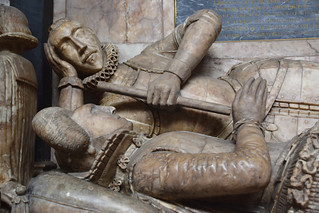
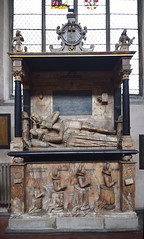
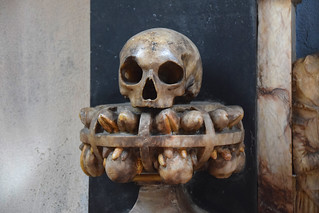
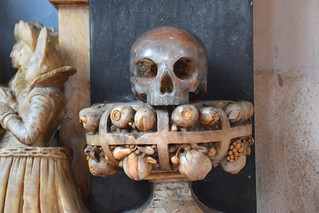
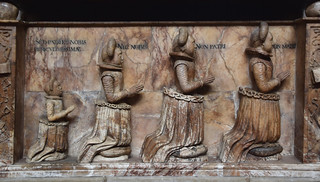
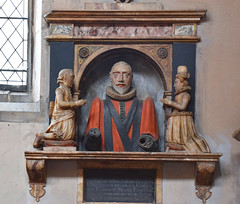
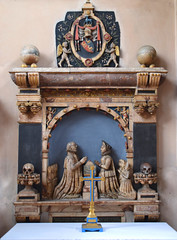
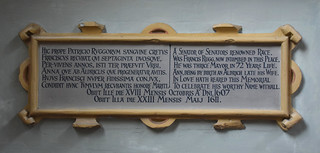
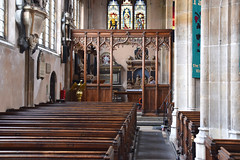
Another medieval survival is a scattering of brasses, one a pair of figures in the sanctuary to Robert Gardiner and his wife. He was mayor of Norwich on several occasions during the building of St Andrew, and died soon after its completion. His wife is particularly elegant - both figures are flatteringly young for their age of death. Whoever restored St Andrew in the 19th century relegated the large Elizabethan and Jacobean monuments to the north aisle chapel, where they are concealed by a Victorian screen. They are the grandest memorials in the city, and show several late 16th and early 17th century mayors of Norwich with their wives. The biggest is to Sir John Suckling and his wife Martha. Mortlock notes that he was James I's treasurer, and also observes that the figures look stiff and uncomfortable. His parents face each other over a prayer desk on the eastern wall, flanked by some delightfully ghoulish skulls mounted on cages of decaying fruits and flowers. In between the two there is a memorial to Francis Rugg, also three times mayor, who was a Senator of Senators renowned race. Robert Garsett, another mayor who died in James I's reign, is the most endearingly lifelike, despite the loss of both hands which may suggest for one moment that a cruel 17th Century punishment has been imposed upon him.
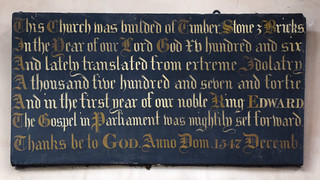
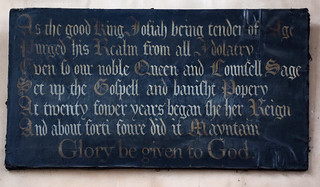
The theological temper of the dead mayors in the north aisle chapel may perhaps be gauged by two panels now on show at the south west corner. The first one, from the middle of the 16th century, reads: This church was
builded of timber, stone and bricks and the other, from the early 17th century, continues in similar vein: As the good King
Josiah being tender of age
I think that panels like the first one must have once been more common, and that this is a rare survival. It is a reminder to us that the Church of England nearly didn't exist at all, for if Edward VI had lived into adulthood and had gone on to impose all his ideas, then there would have been no more Bishops, no more sacraments, and we would all have become presbyterians. The second panel is even more interesting, for it was obviously placed by members of a puritan congregation after the death of Elizabeth, to flag up their concern that the incoming James I might have been more tolerant of those evil, treacherous, sulphur-breathing Catholics. Of course, they needn't have worried.
Simon Knott, March 2018
|
Amazon commission helps cover the running costs of this site.
home I index I latest I introductions I e-mail I about
this site I glossary
Norwich I ruined churches I desktop backgrounds I round tower churches
links I small
print I www.simonknott.co.uk I www.suffolkchurches.co.uk