| |
|
St
Andrew, North Pickenham North
of Swaffham, the landscape busies itself morphing from
the Breckland into High Norfolk. The fields roll and
climb, secretive woodlands lord it over the narrowing
lanes, and the 21st Century begins to fall away. The
villages turn in on themselves, quiet and introspective.
However, coming up from South Pickenham a mile or so off,
North Pickenham seems a sudden return to suburbia, a
large comfortable village with a pub. Just behind it, the
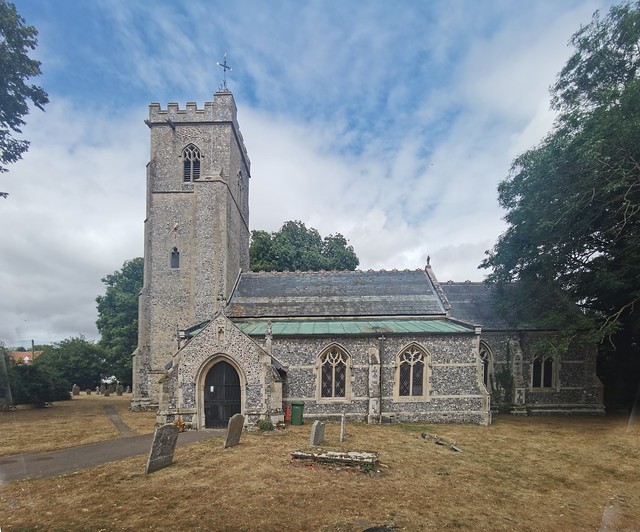
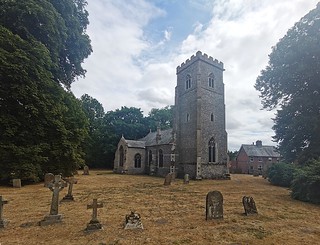
village church hides up a narrow alleyway and despite its
size you might easily miss it. Two or three substantial
houses keep the churchyard company, and the church itself
looks all of its almost complete rebuild of the 1860s. In
fact, much of the 14th century tower survives, but to all
intents and purposes this is a Victorian church, to such
an extent that Munro Cautley's great 1940s survey of the
medieval churches of East Anglia did not even bother to
mention it.
Perhaps this is one of the reasons that the church
appears little-known, and it is one of the very few
churches in this part of Norfolk which is kept locked
without a keyholder notice. This has always been the case
on my occasional visits. On one occasion a few years back
I found the churchwarden's name on the noticeboard, but
there was no address or telephone number. However, there
was also also a list of the electoral roll, and by
cross-referencing to this we found a house in the high
street. As it turned out the churchwarden was very
friendly, and happily gave us the key, and I wondered why
there had been no proper notice, or why the church was
not kept open. I commend this approach to you if you
visit, but coming back in 2022 I remembered enough of
what I had seen before, and I didn't feel the need to
repeat the exercise.
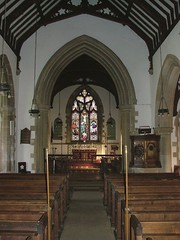
But on that earlier occasion I stepped inside. While
there is little evidence left of the medieval life of
North Pickenham, this a good example of a quality
Anglican parish church rebuild of the 1860s. The smell of
polished wood, the clean surfaces everywhere, showed that
it was loved and cared for today just as much as when it
was built, although it is likely that the churchmanship
has come down a peg or two since those days. In contrast
with the rustic, pastoral church across the fields at
South Pickenham, this is a church with an air of
gravitas, of money well spent, a serious church on God's
earth. Everything is done well. It reminds me of town
churches on the south coast of England, churches built in
the growing seaside and retirement resorts of the late
19th Century, still with a sense of that old-fashioned
life, a comfortable, confident urban feeling. It was with
some surprise that I looked out of the clear glass of the
north transept window to see Norfolk's fields and woods
rolling beyond.
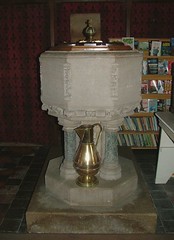
The colonnaded octagonal 1860s font is typical of those
displayed at the Great Exhibition of a decade earlier.
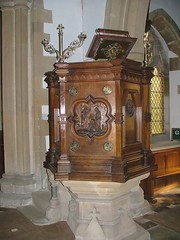
The pulpit is striking, inlaid with medallions of the
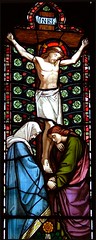
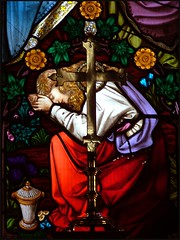
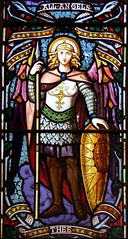
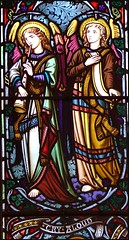
Evangelistic symbols, but best of all is the glass. It
appears to be almost all the work of the O'Connors, who
were at the height of their powers in the 1860s. The
exception is the glass in the west window, which is by
William Wailes and is probably the best in the building,
but it is now cut off from casual visitors by the glass
screen and locked door in the tower arch. All in all a
church surprisingly full of atmosphere, albeit of a 19th
Century kind. It is a place to come and experience what
the Anglican revival and full confidence of the 1860s
meant to a rural parish with money to spend, and it is
obviously a building full of life today, if only we were
allowed to see inside it.
Simon Knott, October 2022
Follow these journeys as they happen at Last Of England
Twitter.
The photographs below were all taken in
2007.
 
|
|
|