home I index I latest I glossary I introductions I e-mail I about this site
St Mary, North Elmham



Follow these journeys as they happen at Last Of England Twitter.
| St Mary,
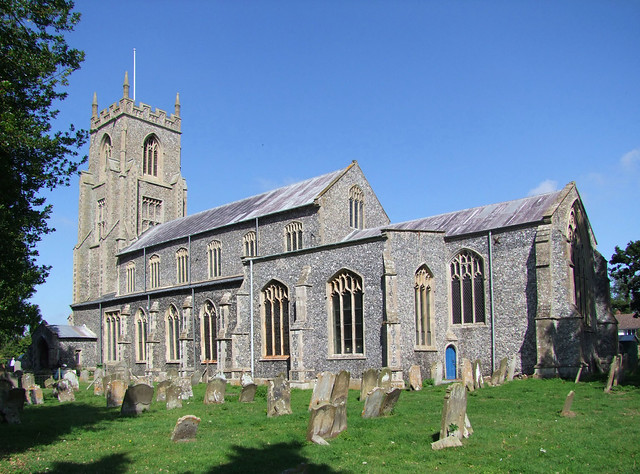
North Elmham North Elmham was
one of the early sites of the Bishops of East Anglia, and
there was a cathedral here for more than a hundred years
at the start of the last millennium. In 1073 the see was
moved to Thetford, and then to Norwich, where both
Bishops with jurisdiction over Norfolk churches, Catholic
and Anglican, have their cathedrals today. No trace
survives of the North Elmham cathedral, which was almost
certainly a wooden building. The Normans probably moved
the see away from here because this little village in the
Wensum valley was simply too remote from their great
castles at Thetford and Norwich. Even sleepier today, the
graveyard of St Mary is home to wandering sheep and their
lambs, and it feels a long way from anywhere. But as if
to make up for it, St Mary is a one of those huge
Perpendicular churches that Norfolk does so well, as
solid and buttressed example of the best that15th Century
builders and craftsmen could do, and as big as a small
cathedral.
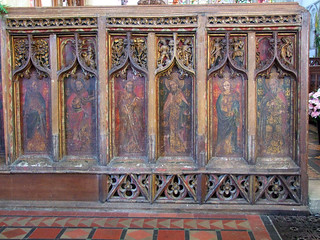
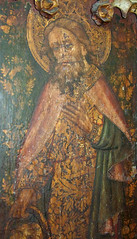
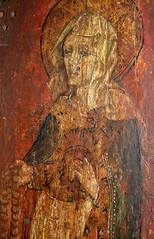
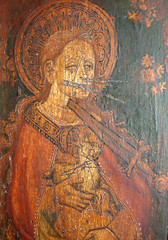
There are 24 panels in all, of
which 17 have figures on. After two blank panels at the
far north are St Benedict and St Augustine. Then, after a
missing figure, (indeed, the whole panel is missing) come
St Thomas on his own with a spear, St Bartholomew with a
sword-like flencing knife and St Jude with a boat, St
James the Less with a fuller's club and St Philip with
his loaves, and lastly St John the Evangelist with the
poisoned chalice and St Paul with a sword. Over on the
south side are St Barbara with her tower and St Cecilia
with her floral wreath, St Dorothy with her flowers and
St Sitha with her beads, St Juliana with a dragon on a
chain and St Petronilla with a book and a large key, St
Agnes pierced through the neck holding a lamb and and
finally a figure identified as St Christina, shot through
with arrows, who appears to have been an amalgam of St
Catherine and St Sebastian. The last four panels are
missing. Clearly, the complete range should include five
more disciples and perhaps the other Doctors. It is
notable that the men are all on one side and the women on
the other, as often found on very late screens.
The restoration of the chancel must have come after that of the nave, I think. It is less restrained, and the pointy stone reredos is a jarring moment. A church in the Anglo-Catholic tradition might just get away with it by dressing it up, but I got the impression that in recent decades worship at North Elmham has been rather Low Church in character, and as a result the east end feels a bit bleak. But all in all North Elmham is one of those reassuring places, with a sense of permanence and a confidence in its own story. A lot has happened here. Less happens today, and that's no bad thing. Simon Knott, December 2020 Follow these journeys as they happen at Last Of England Twitter. |






|
|||||||||||||||||||||||||||||||||||||||||||||||||||||||
|
|||||||||||||||||||||||||||||||||||||||||||||||||||||||
home I index I latest I introductions I e-mail I about
this site I glossary
Norwich I ruined churches I desktop backgrounds I round tower churches
links I small
print I www.simonknott.co.uk I www.suffolkchurches.co.uk