home I index I latest I glossary I introductions I e-mail I about this site
All Saints, North Barsham


Follow these journeys as they happen at Last Of England Twitter.
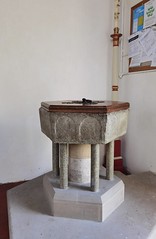
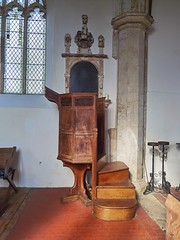
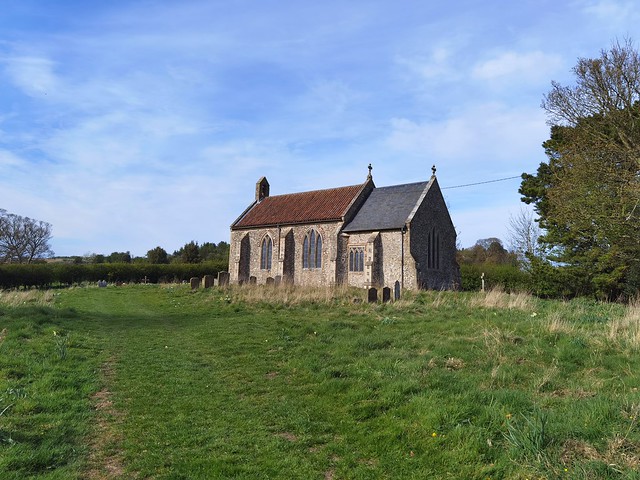
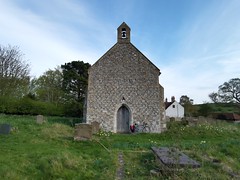
All Saints, North Barsham A tiny building set memorably on a rise above cottages and a farm. I hope I can convey to you quite how fond I am of this little church. I first came across it about thirty years ago. It was a few weeks after Easter, and I had arrived at the National Shrine of Our Lady about an hour before the midday Pilgrim Mass. I decided to go for a walk in the late spring sunshine, and so I wandered out of the shrine grounds, along a little lane which runs beside a field that always seems to be full of the most beautiful sheep. In the other direction was Walsingham itself, but I knew that walk better than almost any other. Instead, I headed southwards, and followed the lane under the disused railway bridge. I ambled on through high verges of Mary's Lace, and after a few hundred yards I came into this little hamlet, with its flint walls and red roofs. A track led behind the farm into the open churchyard, and there sat All Saints. I had to look twice to make sure that it was not a domestic building. I remember stepping inside, into the silence. I had left behind the crowds at the National Shrine, which can be one of the busiest places in rural Norfolk in the pilgrimage season, and now as the door closed behind me there was a deeper silence, the breeze and the birdsong also disappearing. Just for one moment I stood absolutely still, and all I could hear was the sound of my own breathing. And so, coming back here nowadays it always seems a special place to me. There's not much to it, and it was probably once longer to both east and west, although as Pevsner notes it was already reduced to its present size by the time of Ladbroke's 1820s drawing. The bellcote came later in that century, and the overall feel is of an early 20th Century rescuing of a much older building. Everything inside is neat and seemly, and, as you would expect in this area, Anglo-Catholic in tradition. There are some older survivals. The font, for example, which is a curious thing. It is one of the 13th Century arcaded Purbeck marble bowls, familiar from hundreds of other churches, but when you look closely, you notice that it is hexagonal. The pulpit seems to be a mixture of early 17th Century and later work, and it looks very handsome in this simple setting. You might think it almost deliberately pressed against the south wall to obscure the contemporary memorial to Philip Russell, its mawkish reliefs including a skull, crossed bones, and what appears to be an hour glass made out of bones. Mortlock climbed into the pulpit to record the inscription, which tells us that Russell spunne out his thred of time in ye dimention of 66 years, and that after it was finished his examinated body went to ye common mother of us all. Simon Knott, May 2022 Follow these journeys as they happen at Last Of England Twitter.
|
|
|||||||||||||||||||||||||||||||||||||||||||||||||||||||
home I index I latest I introductions I e-mail I about
this site I glossary
Norwich I ruined churches I desktop backgrounds I round tower churches
links I small
print I www.simonknott.co.uk I www.suffolkchurches.co.uk