home I index I latest I glossary I introductions I e-mail I about this site
All Saints, Narborough


Follow these journeys as they happen at Last Of England Twitter.
| All
Saints, Narborough Narborough
is a big, busy village in the west of the county,
although not as busy as it used to be now that the A47
bypasses it. It's parish church of All Saints was largely
rebuilt in the 15th Century, and then extensively
restored in the 19th Century. Thus far, then, a similar
story to hundreds of other churches, but All Saints is
more interesting, indeed more quirky, than many of its
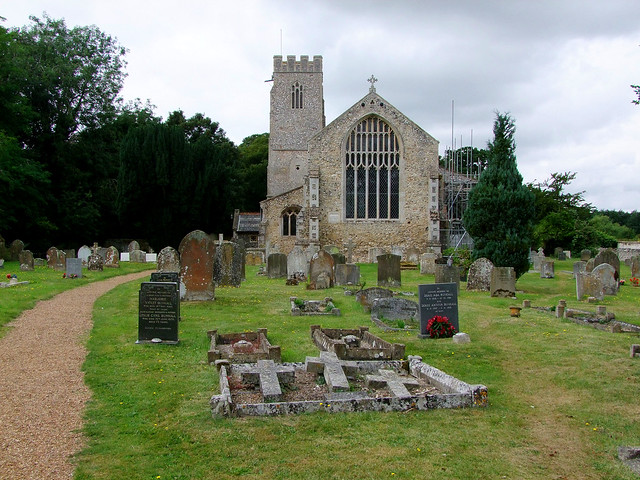
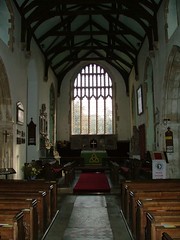
contemporaries. For a start, there is that singular view
from the east. Two aisles that are wilfully different;
that on the north side is high, that on the south is low,
running the full length of the building. On a south
facing buttress are the numbers of a sundial. The elegant
tower sits oddly at the west end of the south aisle, but
has no connection with the nave, the west wall of which
is level with the eastern face of the tower. A dumpy
vestry was fitted into the space here in the early part
of the 20th Century.This creates a curious effect as you
enter the church by the south doorway, since you are
coming in at a corner. Once past the font, the church
opens up before you.
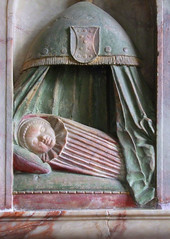
Below this window is a small niche
with a demi-effigy of a woman wearing a wimple and
holding a heart. This is claimed to be one Dame Agatha of
Narborough, as the later faux-Latin inscription above it
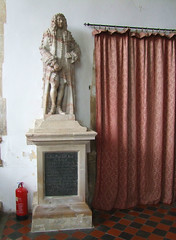
suggests. But as far as memorials go this church is
dominated by the Spelman family. Several Norfolk landed
families seem to have made a good living from the law
over the centuries, but perhaps none more than the
Spelmans, who kept their hand in for at least four
hundred years. They are here in the form of their
brasses, the pre-Reformation ones on the floor, the
post-Reformation ones reset on the wall, including the
only brasses in Norfolk that depict a figure in judge's
robes. But most dramatic of all are the memorials in the
chancel. Simon Knott, May 2021 Follow these journeys as they happen at Last Of England Twitter. |








|
|||||||||||||||||||||||||||||||||||||||||||||||||||||||
|
|||||||||||||||||||||||||||||||||||||||||||||||||||||||
home I index I latest I introductions I e-mail I about
this site I glossary
Norwich I ruined churches I desktop backgrounds I round tower churches
links I small
print I www.simonknott.co.uk I www.suffolkchurches.co.uk