home I index I latest I glossary I introductions I e-mail I about this site
St Mary Magdalene, Mulbarton

Follow these journeys as they happen at Last Of England Twitter.
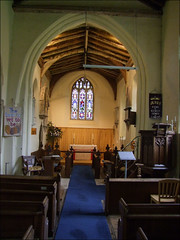
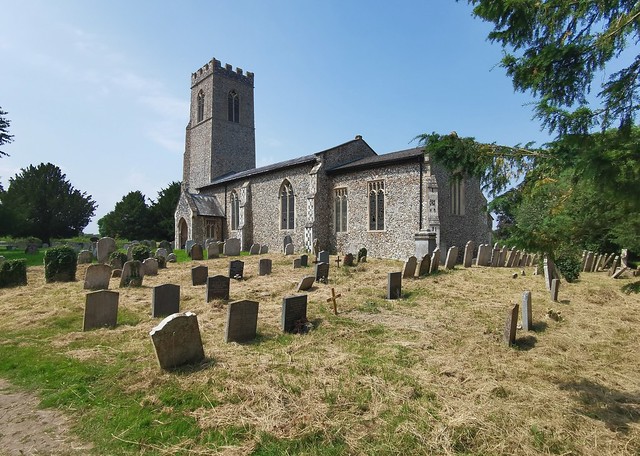
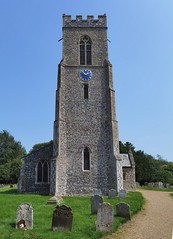
St Mary Magdalene, Mulbarton St Mary Magdalene sits beside the common on the edge of this large suburban village to the south-west of Norwich, its disproportionately tall tower rearing dramatically up above the open spaces. There was a bequest in the 1390s for a new bell, often a good clue to the date of the completion of a tower, and it probably followed the rebuilding of the nave and preceded the rebuilding of the chancel. This must have been a long, narrow church before diocesan surveyor Richard Phipson came along in the 1870s and added the north aisle, and even now it feels rather a tightly constrained space to step into. The aisle is almost as wide as the nave, resulting in the chancel feeling offset in one corner. The furnishings are almost entirely of the 1870s and are presumably Phipson's, replacing the box pews that were here before as the Church of England responded to the changes in fashion and worship promoted by the ecclesiological movement, but it had been fashionable earlier in that century to fit coloured glass into church windows for decorative purposes. There were few English workshops producing stained glass in those Georgian decades, and so it was often bought from dealers like JC Hampp in Norwich who specialised in medieval English glass, and later glass collected from churches and monasteries on the continent. However, here it seems that a new rector arriving from Martham brought some of the glass from that as yet unrestored church with him, and it is set here at Mulbarton in the chancel. It is quite likely that none of it came from this church originally. Most of it is 15th Century English glass, with a few pieces of continental glass of the 16th and 17th Centuries.
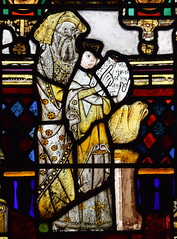
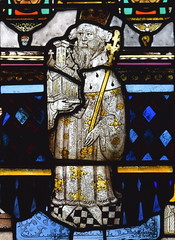
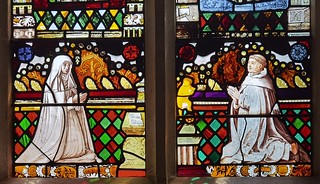
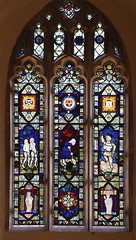
Most memorable among the English glass are two panels, the first of Adam and Eve scurrying along in their fig leaves, and then Adam, exiled from Eden, puts his back into digging with a spade. This second image is one of a pair, the other being Eve spinning, for when Adam delved and Eve span, who was then the gentleman? But Eve is still twenty miles away at Martham. Some of the glass is composite, and what must have been an exquisite image of St Anne showing the Blessed Virgin the scriptures that foretell what is to happen to her has been given the head of an Old Testament prophet or patriarch, and her daughter the head of an angel and a crown. Another dramatic figure, Powers from the Orders of Angels, bestrides the devil he has defeated, but he also has an intruder's head. A more complete figure wearing a crown and holding a sword and a building has been identified as St Ethelbert, but I think it is actually King Solomon holding the Temple. There are two earlier figures of a king and a bishop, as well as two panels of continental glass, one of which depicts Joseph in chains interpreting dreams and the other, a roundel, the figure of a pope, most likely St Gregory. Two other Continental figures of a nun and a friar are set at the bottom as though they were donor figures. Above all this are two exquisite 15th century angels, one playing a harp and the other a lute.Below the glass in the east window, the curtains can be pulled back to reveal a lovely Arts & Crafts painted wood reredos depicting the Risen Christ appearing to Mary Magdalene in the garden on Easter morning. The inscription is dated in the 1950s, but it seems a little earlier than this.
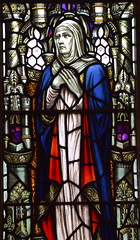
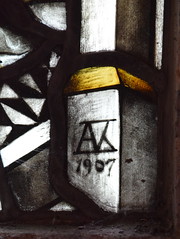
At the west end of the north aisle are two very early figures by AK Nicholson, depicting Dorcas and Anna. They are dated 1907, when Nicholson was still in his mid-thirties and very much in the Arts & Crafts tradition. The church's grandest
memorials are set at the west end of the nave and in the
chancel. The most striking of these is beside the tower
arch, a remarkably tall monument of 1675 to the lawyer
and landowner Sir Edwin Rich. It is fully of its date, as
lively as a Restoration comedy, surmounted by an
hourglass which, now broken, looks like an upturned
stool. The scrollwork is, as Pevsner puts it, coarse,
as if done with more enthusiasm than skill. The
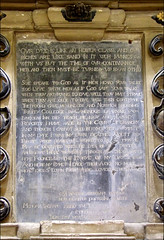
inscription reminds us that Our lyfe is like an hower
glasse and our riches are like sand wch runnes with us
but the time of our continuance her and then must be
turned up by another. It goes on to enjoin us to speake
to God as if men heard your talke, and to lyve with men
as if God sawe your walke. Famously, it continues
that Thetford gave me breath, and Norwich breeding,
but also records that he had to go to Cambridge for
learning. Simon Knott, September 2021 Follow these journeys as they happen at Last Of England Twitter.
|
|
|||||||||||||||||||||||||||||||||||||||||||||||||||||||
home I index I latest I introductions I e-mail I about
this site I glossary
Norwich I ruined churches I desktop backgrounds I round tower churches
links I small
print I www.simonknott.co.uk I www.suffolkchurches.co.uk