home I index I latest I glossary I introductions I e-mail I about this site
St Margaret, Morton-on-the-Hill




Follow these journeys as they happen at Last Of England Twitter.
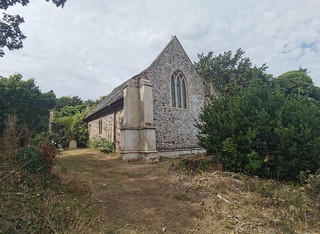
St Margaret, Morton-on-the-Hill St Margaret is surely the most elusive of all Norfolk churches. You would never think to look for it if you didn't know it was there, and even then you might not find it. It sits on a secretive bluff on the Morton estate above the Hall, its churchyard tree-shrouded, and on this day in the late summer of 2022 scattered with peacock feathers. Like many round here, the church was substantially rebuilt in the late 13th and early 14th Century, although unusually the earlier round tower was retained. When Munro Cautley came this way in the 1930s and examined the tower he found what looks like a blocked pre-conquest window, so it may be of this date. Unfortunately, the age of the tower is hard to tell today, for on Easter Sunday 1959 it collapsed, the rubble running through the tower arch and spilling over to the east to take out the roofs of both the nave and south porch. The fall was shortly after the verger had left the building, and as he reached the yard below, he heard a noise that he later described as sounding like a lorry load of shingle being tipped out. The furnishings that
could be salvaged were removed, and for a long time after
that the ruin was just left. It filled with brambles and
elder, and although it was too remote to suffer serious
vandalism, it was not beyond the reach of souvenir
hunters who looted the brasses, of which more in a
moment. It was not until the late 1970s that Lady
Prince-Smith of Morton Hall took St Margaret in hand with
the help of the redoubtable Norfolk Churches Trust. A
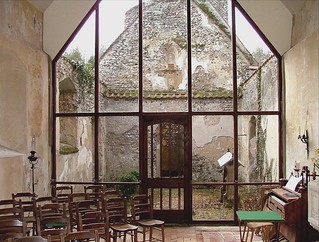
glass screen was built across the nave as a partition,
and the part of the church to the east of it was restored
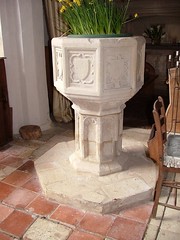
to use. The medieval font was put back together and moved
inside. Oddly, Bill Wilson in the revised Buildings
of England volumes for Norfolk describes the font as
being of about 1850 but it is clearly older. The
brick floors were repaired and the east windows of
chancel and the 19th Century north aisle were repaired
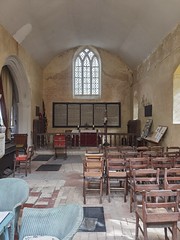
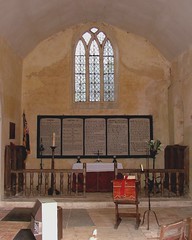
with clear glass. You step into an atmospheric space,
reborn sensitively and innovatively, and still in use for
occasional services. There is no electricity, but thanks
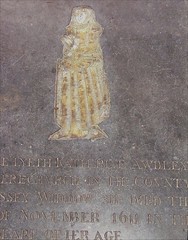
to the glass partition this building is full of light. Morton Hall was home in the 16th and 17th Centuries to a branch of one of the more significant families in recusant history, the Southwells. Their most famous member was Robert Southwell from up the road in Horsham St Faith. He was hung drawn and quartered on 21 February 1595 at Tyburn for the crime of being a Jesuit priest. He was canonised as a martyr saint by Pope Paul VI in 1970. Two of the Southwells are remembered in this church, one his aunt and the other his uncle. She is Katherine Audley, a Southwell who had married into the Audleys of Berechurch near Colchester in Essex. She died in 1611, and her highly polished brass effigy lies in the middle of the church. This is one of the brasses pilfered from Morton in the 1960s, but Lady Prince-Smith once told me that it was brought back and handed to her personally by the person who had taken it when she restored the church. "Of course, he had only taken it to protect it", she said, which I thought was very charitable. The other brass that is missing was set in the back of the tomb chest in the north aisle. It was an inscription to Katherine's brother, Thomas Southwell who died in 1609. Lady Prince-Smith told me a curious story about it. One day in the 1980s, when she was away from Morton, an elderly gentleman turned up at the Hall and said he had something for her. When prompted, he unwrapped a package to show the missing brass, but he refused to hand it over to anyone except Lady Prince-Smith in person. Because she was not there he took it away, but he never came back. Forty years have now passed, and so it seems likely that nobody now knows where this early 17th Century brass is. Simon Knott, September 2022 Follow these journeys as they happen at Last Of England Twitter.
|
|
|||||||||||||||||||||||||||||||||||||||||||||||||||||||
home I index I latest I introductions I e-mail I about
this site I glossary
Norwich I ruined churches I desktop backgrounds I round tower churches
links I small
print I www.simonknott.co.uk I www.suffolkchurches.co.uk