home I index I latest I glossary I introductions I e-mail I about this site
All Saints, Morston



Follow these journeys as they happen at Last Of England Twitter.
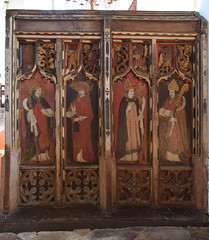
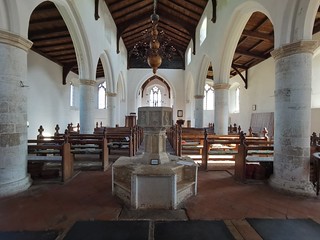
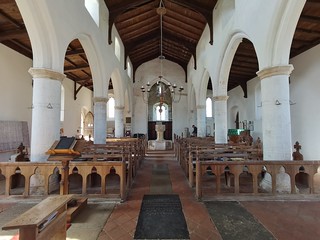
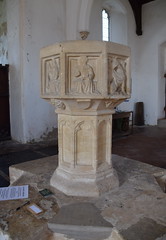
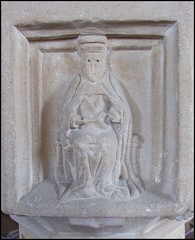
All Saints, Morston Morston sits on the north Norfolk coast to the west of Blakeney, the sad salt marshes sprawling beyond until they disappear beneath the unforgiving North Sea. The church sits memorably above the rolling coast road with no trees or other buildings to block a view of it, a sentinel for miles. The tower is stark compared with many hereabouts, partly because of its Norman origins in its lower third, but also the way it tops out flat without a parapet stage, and the considerable red brick expanse on the east side, both the result of repairs after an 18th Century lightning strike. The tower was completed in the late 13th Century, and this and the start of the following century seem a good date for much of the church, which is to say it is earlier than most rebuildings around here and it has surprisingly few later alterations. The roofs of the nave, chancel and north aisle at least were rebuilt in the 15th Century, and these survive. The clerestory is unusual, consisting of four small windows on each side, quatrefoils to the south, along with a castellated parapet at the east end only. It can never have let in much light but does serve to accentuate the height of the nave, for this is not a tall building. The impression on stepping inside is of openness and light, of width rather than height, a typical East Anglian country church, full of light falling on old wood and stone. There is no coloured glass. The furnishings are plain and simple, the floor consists of brick pamments, and the 15th Century font is set on a bulky Maltese cross base. The panels alternate the symbols of the Evangelists with four seated figures. Who are they? A clue may be up on the surviving dado of the rood screen, which is roughly contemporary with the font. At this time there was an attempt to exert the official doctrine of the Catholic Church, probably in the face of local superstitions, of which there must have been many in remote East Anglia. Donors wanted their souls to be prayed for after death, and so wall paintings, glass, fonts and screens of this time recalled the faithful to theological basics, either with a reinforcement of doctrine through the Seven Deadly Sins, the Seven Cardinal Virtues and the Seven Sacraments, or through a reminder of the key figures whose names were verified in both scripture and liturgy, for example the four Evangelists, St John, St Matthew, St Luke and St Mark who appear from left to right across the north side of the screen, or the four Latin Doctors, St Gregory, St Jerome, St Ambrose and St Augustine on the south side. It may well be that the seated figures on the font are the four Doctors too.
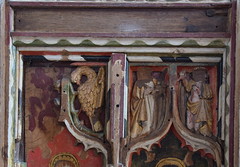
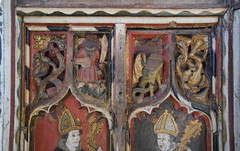
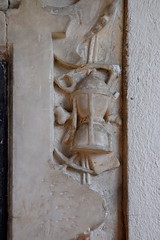
These eight figures represent the fundamental Biblical and Ecclesial basis of the Catholic Church. One interesting aspect of this screen is how deeply set it is, with very large spandrels above each Saint, with muscular carvings in them. These include St George with a Saracen's sword taking on a dragon, St Peter holding a key and facing the wounded Christ holding the end of a scroll, as well as angels and other birds and creatures. Unfortunately they are badly damaged along with the faces of the saints below. The papal tiara of St Gregory and the cardinal's hat of St Jerome were also scratched out by the 16th Century reformers. Above the chancel arch sits a large tympanum carrying the royal arms, a decalogue (the Ten Commandments) and the Lord's Prayer. It is dated 1829, which it means it must have been one of the very last sets of royal arms and decalogue sets in England that was erected in what was then its conventional place. Royal arms and decalogues date from after the Reformation, when an attempt was made to assert not only the secular power of the state but the basic catechism of the newly reformed Church of England. The Victorians, in their attempt to restore the medieval integrity of English parish churches, often relegated sets of royal arms and decalogues to the backs of churches when they restored them. A striking memorial at the east end of the south aisle is that to Susanna Kinges, the wife of John Kinges. She died at the age of 23 in 1615. Her inscription is framed by symbols of mortality, an hour glass with gravedigging tools, an upturned torch, a coffin, spade and pick, a skull and crossed bones.
After telling us in Latin that she left behind her only daughter, also called Susanna, it continues:
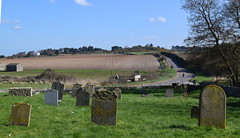
Other memorials in the church include an unusual brass memorial to Richard Makynges, a late 16th Century priest, the only brass figure of a priest of the Elizabethan period in Norfolk. Outside in the churchyard to the south-west of the tower is a small headstone blackened by over a century of smoke from the adjacent cottages. It remembers a boy, William Pells (of this parish) aged 12 years who was drowned on the Stiffkey Sands on the night of August 23rd 1845. For almost thirty years at the start of the 20th Century, the incumbent here at Morston was Harold Davidson, also the rector of nearby Stiffkey with which this was a joint benefice. Davidson achieved notoriety for his dealings with young girls in the theatres and teashops of London, which he did nothing to disguise, considering it missionary work. Inevitably this led to the neglect of his two churches, and although he became known as the Vicar of Stiffkey in the popular press of the day, it was actually the churchwarden of Morston, one Major Hamond, who finally lost patience with Davidson and made a complaint to the Bishop of Norwich about his scandalous behaviour. Davidson was charged before a consistory court with indecency. This long and depressing process was a time of traumatic conflict here at Morston, with Davidson prevented from taking services by force, and even on one occasion fighting during the morning service with the unfortunate Reverend Richard Cattell, vicar of nearby Wareham and a former English rugby international, who Hamond had brought in to take the services in Davidson's stead. It was even said that Davidson tried to prevent Hamond tending his own wife's grave in Morston churchyard on the grounds that Morston churchyard is the private freehold property of the rector. Unable to preach inside the church, Davidson took to preaching in the open air on the small green to the east of the church, unsurprisingly attracting a larger crowd than the congregation inside the church, many of whom had travelled to Morston from far afield to see what he would say and do. In the end, Davidson was found guilty and defrocked, spending his last days exhibiting himself in seaside shows in Blackpool and Skegness, where he met an untimely death in the jaws of a lion in the summer of 1937. He is buried in Stiffkey churchyard. Simon Knott, March 2022 Follow these journeys as they happen at Last Of England Twitter.
|
|
|||||||||||||||||||||||||||||||||||||||||||||||||||||||
home I index I latest I introductions I e-mail I about
this site I glossary
Norwich I ruined churches I desktop backgrounds I round tower churches
links I small
print I www.simonknott.co.uk I www.suffolkchurches.co.uk