home I index I latest I glossary I introductions I e-mail I about this site
St John the Baptist, Mileham

Follow these journeys as they happen at Last Of England Twitter.
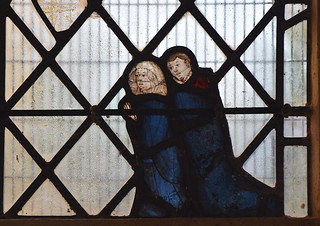
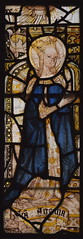
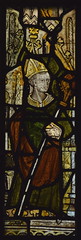
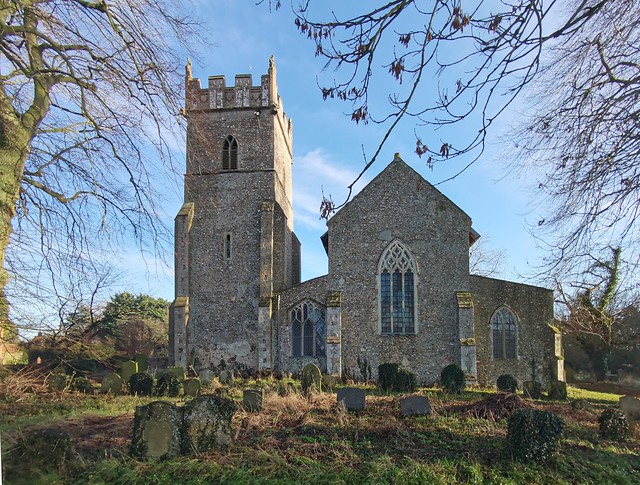
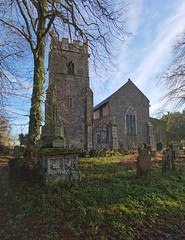
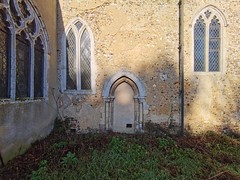
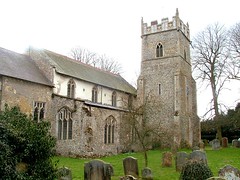
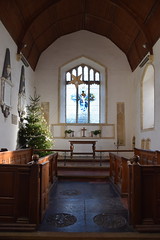
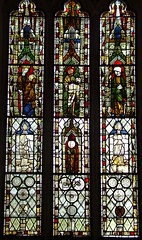
St John the Baptist, Mileham Mileham sits in the rolling fields between Swaffham and Dereham, a relatively large village in an intensely agricultural landscape. Its parish church of St John the Baptist is large, but because it is set back from the village street behind houses, with an obscured entrance to its churchyard, you could easily pass through the village without noticing it. There was a substantial Norman church here once of which little survives, although the doorway on the south side of the chancel must be from that time, albeit altered since. We will see more evidence of the Normans inside. Some medieval churches tell us that they were constructed in a single campaign, but Mileham church is an accretion of several centuries, each bringing their own style to the feast. The Norman church was rebuilt with aisles in the late 13th Century, and then in the 14th Century the west end of the nave was remodelled with the window tracery we see today. Then the tower was added, but it was not placed in the conventional position at the west end. Instead, it sits against the north aisle, forming a porch. It seems likely that this was because there was not sufficient room for it at the west end without including a processional way beneath it, and the soft ground may not have allowed for this, but it is also possible that the recently glazed west window had been placed there at the expense of an influential patron, and this forced the hand of the parish. A beneficial result of all this is that the most impressive view of the church is from the west, but seen from most other angles there is an awkwardness to the arrangement. Indeed, from the south-east the tower disappears completely from view, creating the impression of a much smaller, towerless and heavily-buttressed building. These imposing buttresses against the south aisle date from a 1970s rescue operation when the south arcade inside was found to be collapsing. It was tied into the base of the south wall which was then supported by concrete beams concealed in flint and freestone cases. The church is open daily, and you enter a beautiful space of light and shadow, serene old wood furnishings and brick floors. You can see at once that the north arcade was cut into the wall of what had been the Norman church. On the other side, the south arcade leans out alarmingly. Box pews engulf both arcades. All the glass in the nave is medieval, and that in the west window is the most interesting because the upper part, although reset, is 14th Century and was made for this window when it was new. Under canopies, there are large figures of St Catherine, St John the Baptist and St Margaret. The lower half is made up of fragments of 15th Century glass, among them two figures clearly by Norwich glaziers of St Dorothy and St Margaret, the workshops' trademark barleycorns spread across the floor beneath their feet. There is more 15th Century glass set in the east window of the south aisle. There are three more figures here, St Agatha with her name scroll beneath and St John the Evangelist, a bishop set between them. Two curiosities in the lower part of the window are what appears to be packhorses in single file, perhaps from a saint's legend, and two figures that may be travellers wrapped in cloaks, described in the guide as pedlars, but I think they are actually donor figures.
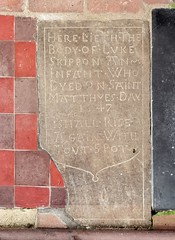
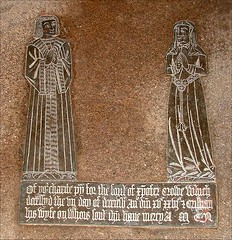
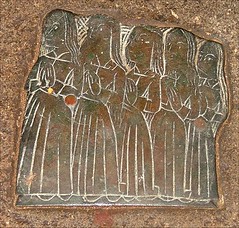
Mileham retains several late medieval brasses. In the north aisle, Christopher Cowle and his wife lie in full expectation of our prayers for their souls. Interestingly, their inscription is written in English and has suffered no vandalism, despite the fact that it includes the two prayer clauses so often excised from inscriptions elsewhere. We are asked Of Your Charite P(ra)y for the Soul of Xrofer Cowle which deceased the VII day of Decemb(er) Ann Dm MDXXIII + Cathrin hys wyfe on whose Soul Jhu Have Mercy A M D G. Five mourning daughters have been set adrift - did they originally belong to the Cowles? Mileham has an interesting series of inscriptions on ledger stones from the century after the Cowles. Several are to young members of the Skippon family, including one at the east end of the nave which tells us that Here lieth the body of Luke Skippon an infant who dyed on Saint Matthyes Day 1647 - I shall rise again with tout spot. This odd ending may have been a mishearing of the motto tout espoir, 'every hope'. The Skippon memorials are a reminder that, even after the Reformation, the liturgical calendar remained an important way of marking the passing seasons, for up in the sanctuary is another family inscription recording that Here lyeth the body of Elizabeth Skippon a virgin who peacefully deceased in the Lord on St Marke's Eve Anno Salutis 1655. 'Anno Salutis', meaning Year of Salvation, was a popular alternative at this time to Anno Domini. Another child's memorial in the nave reads Here in expectation of a joyfull resurrection resteth the body of Walter Dwssing son of Owen Dwssing Gent and Mary his wife, 1665. Most memorable of all perhaps are the four little ledgers side by side on the south side of the chancel. The inscription that runs across the top of all four tells a sad story. Under this stone doe ly fouwre children of Thomas Browne Gent and Elizabeth his wife it reads. The four children were born in consecutive years 1677, 1678, 1679 and 1680, and they are named in a list on the first stone as Thomas, William, Mary and John. The second stone lists their birth dates, the third their baptism dates, and the fourth their burial dates, all within a few weeks of their birth. Interestingly, the inscriber got into a bit of a muddle with Thomas, because he was born on the 17th of March, which is to say before the 25th, which was New Years Day at this time. His burial year was messily altered from 1676 to 1677, and 1676 added to the baptismal column. In reality he was born and died in the same year. The inscription across the four stones concludes These pretty babes may passe for wonders who ran through the world ere they could stand or goe. The shortest and the cleanest way is best, these took that to theire everlasting rest.
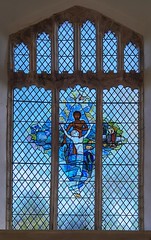
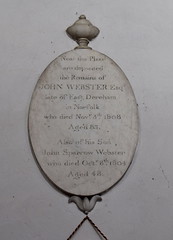
Several wall memorials in the nave suggest that Mileham was a busy and prosperous place in the 18th Century too. Anna Webster, who died in 1776, was the wife of John Webster, Surgeon in East Dearham, Norfolk. John Webster himself lived on until 1808, when he was remembered by an elegant little oval on the south arcade. Opposite, and matching it, are Martin Webster and Theodosia his wife. Martin died in 1774 at the age of 71 and it is thus likely that these are John Webster's parents. Theodosia lived on to the grand old age of 93, dying in 1795. With so many features of interest around, it seems odd that other than the usual restoration and reordering, the 19th Century pretty much left the church alone. It was not until 2004 that Pippa Blackall's striking depiction of the Baptism of Christ was placed in the east window. A dove hovers over the River Jordan running down from the top. John the Baptist is black, Christ is white, his outstretched arms prefiguring his crucifixion. The countryside around the two figures is presented in the artist's familiar naturalistic style. At the time of the 1851 Census of Religious Worship, there were 531 people living in the parish of Mileham, of whom 59 attended the morning service, barely ten per cent of the parish population. This was low even for this strongly non-conformist part of Norfolk, and it was hardly a scattered parish. The incumbent at Mileham was one Charles Barnwell. His annual income from tithe and glebe was almost £700, roughly £140,000 a year in today's money. Ninety-two people tipped up to hear his Sunday afternoon sermon, but even so the Reverend Barnwell felt moved to justify his income, noting that the commuted tithe is the gross amount not deducting rates, land tax and income tax. The glebe is similarly gross. He also pointed out that there is not a Sunday School, explaining the lack of scholars at his services. Perhaps they had all gone with their parents to the busy Methodist chapels of Mileham and Litcham, but of course the 19th Century Anglican revival was only just beginning in Norfolk. Simon Knott, January 2022 Follow these journeys as they happen at Last Of England Twitter. |







|
|||||||||||||||||||||||||||||||||||||||||||||||||||||||
home I index I latest I introductions I e-mail I about
this site I glossary
Norwich I ruined churches I desktop backgrounds I round tower churches
links I small
print I www.simonknott.co.uk I www.suffolkchurches.co.uk