home I index I latest I glossary I introductions I e-mail I about this site
St Peter, Mattishall Burgh


Follow these journeys as they happen at Last Of England Twitter.
| St Peter,
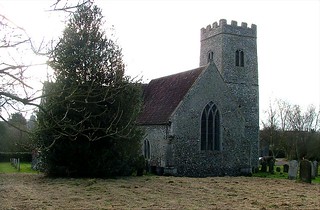
Mattishall Burgh Mattishall is a tiny, pretty town almost exactly in the middle of Norfolk. It has a magnificent church, All Saints, on the market square, but out here in what passes for a suburb is a second church, the parish church of Mattishall Burgh. Burgh, pronounced Burr'a, is just about the most common placename in Norfolk and usually refers, as you'd expect, to an outlying settlement of a larger community. St Peter is hidden from the road up a track, and is surrounded by houses and gardens, a rather incongruous setting considering that it is set on an ancient rise. From the outside it appears a small church, a largely 14th Century remodelling of something older, with a rare surviving sanctus bell turret on the nave east gable. Going around the other side, you get something of a surprise, because there is a huge north transept, which at first sight you think must be Victorian. But on closer inspection it appears to also be 14th Century, and, as Mortlock says, probably exactly contemporary with the tower. Mortlock, writing in the early
1980s, says that he found this church cherished and
welcoming, but I have to say that in several attempts to
visit this church in the last twenty years I have never
found it either open or accessible. Mortlock fondly
records the four pensioners who worked to save the church
from decay. But now there are no signs, no notices at
all, and you might almost think that St Peter is no
longer in use. Every time I've been here there's been a
big padlock on the porch doors. It is hard to think of a
building as being cherished if it is so unwelcoming. Simon Knott, December 2020 Follow these journeys as they happen at Last Of England Twitter. |


|
|||||||||||||||||||||||||||||||||||||||||||||||||||||||
|
|||||||||||||||||||||||||||||||||||||||||||||||||||||||
home I index I latest I introductions I e-mail I about
this site I glossary
Norwich I ruined churches I desktop backgrounds I round tower churches
links I small
print I www.simonknott.co.uk I www.suffolkchurches.co.uk