| |
|
All
Saints, Mattishall Mattishall
is one of the smallest towns in Norfolk, no more than a
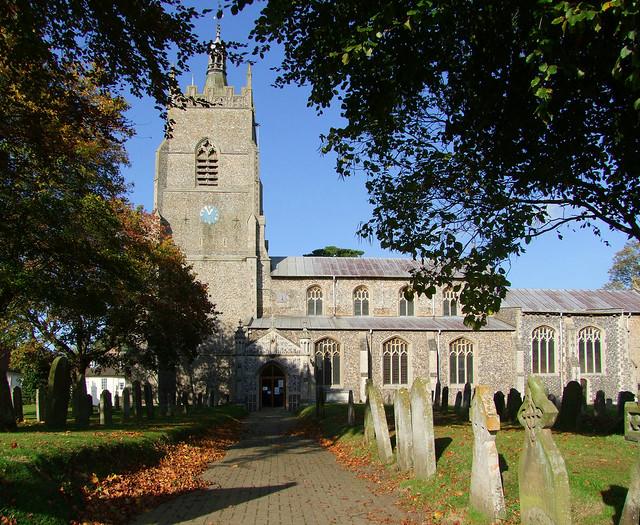
village really, but it has at its heart a magnificent
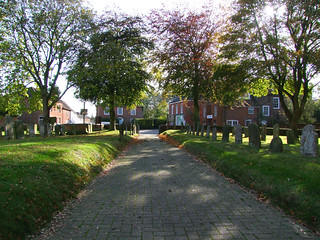
church. The church is set back from the pleasing little
market square. All Saints has echoes of the great urban
churches of Swaffham and Fakenham. Apart from the curious
Victorian confectionery of the south porch and a 17th
Century turret on the tower, what you see was all built
in one long campaign. As Simon Cotton points out, the
tower came first and is first mentioned in a bequest of
1383. Bequests to the nave and porch came in the 1440s
and 1450s, and a 1453 bequest to the roodloft suggests a
date for the finishing of the nave. Replete with aisles,
clerestory and that long chancel with its side chapels,
this is one of the great East Anglian late-medieval
churches.
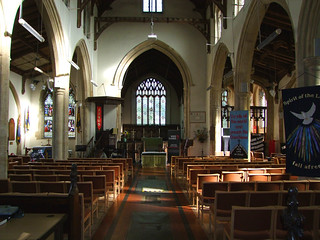
You step inside to a wide open space with an
overwhelmingly urban feel to it, as if we were in the
middle of Norwich or Ipswich. When I first visited here
some twenty years ago the creamy arcades rose
uncomfortably from a sea of imposing middle-brow
Victorian benches. On an earlier incarnation of this page
I made a case that they should be removed and replaced.
After all, there is nothing traditional about them, and a
photograph under the tower of the church in the 19th
Century shows the nave full of box pews. I take no credit
for the decision, but coming back in more recent years
I've been pleased to see that the 19th Century benches
have now been replaced by quieter modern chairs.
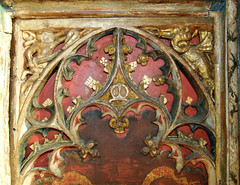
Mattishall's greatest treasure is the dado of the
roodscreen, a work contemporary with the building of the
church in the second half of the 15th Century. The panels
to each light are not subdivided, which is to say there
are two figures in each panel. Together they depict what
is known as a creed sequence, where the 12 apostles hold
a sequence of scrolls containing the clauses of the
Apostles Creed.
  
 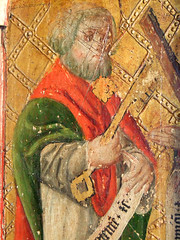 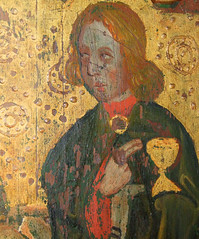
There is a traditional pattern to
which apostle holds which clause in a creed sequence, and
so identification is relatively easy. On the north side
they are Philip, Bartholomew, Matthias, Simon, Jude and
Matthew. On the south side are Peter, Andrew, James,
John, Thomas and James the Less.
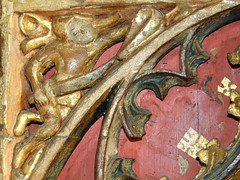
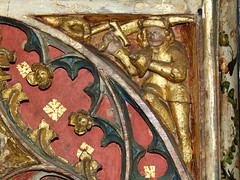
Of more interest perhaps is the
tracery of the panel canopies, and the tiny details in
the spandrels. A shepherd creeps up on a wolf or tiger,
St George with a sword approaches a dragon, an armoured
figure with a scimitar may be intended as a Turk, and in
the only vandalised scene Gabriel appears to the Virgin
Mary at the Annunciation.
 
There is another screen into the
south chancel aisle, beautifully patterned. All Saints
has three dressed altars, but perhaps the one in this
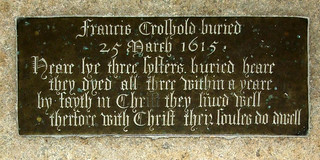
chapel is the loveliest. In the middle of the chancel are
a number of oddly placed brass inscriptions of the 17th
Century that are to the same family, but the surname is
spelt variously Cresheld, Croshold, Crolhold and
Crollold. These are all post-Reformation of course, but
another inscription back in the nave asks for prayers for
the soul of Katherine Dene.
There are a number of medieval figure brasses in the
nave, but they have been reused on late 17th Century
ledger stones. One, to Geoffrey Dane (presumably a
relative of Katherine) is now resplendent on the tomb of
Susan Edwards, a curious arrangement. Perhaps they were
unable to read the Latin, and assumed that the long hair
made him a woman. No less than two brass figures have
been reused on the 1688 tomb of William Brabant who was
rector here.
The font is a curiosity. It has no designs on the eight
panels of its bowl, but all of them are concave. The
traceried panels of the shaft appear to be medieval. Can
the bowl be old as well?
High above, the Royal Arms are to George II, and are only
remarkable for being dated 1745, a notable date in
English, Scottish and Irish history. Charles Stuart's
attempted coup de'etat was a romantic fancy, and
had no real chance of succeeding, any more than his
grandfather James II was ever likely to have held onto
his throne more than half a century earlier. And things
would not have turned out well if it had succeeded. The
power of the protestant London merchant classes, which
had formerly backed Cromwell, had also guaranteed the
success of William of Orange's takeover of the English
throne in 1688. That power was now deeply invested in the
Hanovers.
The Church of England and the regular Army, those two
constant, essential arms of government, reacted to the
uprising by forging a consensus which would be the key to
the imagination of the people, a notion of identity which
would at last reinvent and create the British as a
Nation. Nothing would bend it from its path now.
Meanwhile, in the rural backwaters, the Catholic
aristocracy was little shaken by the events of '45.
Perhaps they stirred, and perhaps they read their
newspapers with a frisson. But after all, they were only
just awakening from the long years of penal silence.
Although the Old Religion was still technically outlawed,
they were no longer persecuted, and many began to retake
their place in the national hierarchy. It was a
compromise, but an ordered and easy one.
But what of ordinary Catholics in England, Scotland and,
most of all, Ireland? What of their hopes? They had been
dashed along with the throne of James II at the Battle of
the Boyne, and were now trampled with the troops of
Charles Stuart into the blood-soaked fields of Culloden.
No one had expected the Jacobites to succeed, but the
fury with which the rebellion was put down had been
startling. Those hopes would turn to a hurt, and it would
echo uncomfortably for the emerging British State down
the next two and a half centuries.
Simon Knott, December 2020
Follow these journeys as they happen at Last Of England
Twitter.
|
|
|