| |
|
St Mary, Martham
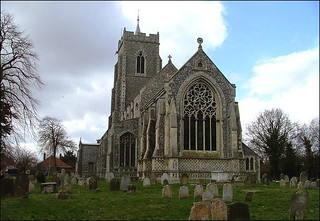
This magnificent
building sits on a gentle rise in its busy village not
far from the North Sea. Here we have left the tedious
urban coastal strip behind, and we are in a land of
villages, rivers and woods, the Fleggs, and St Mary is
the Cathedral of the Fleggs. Unequivocably so, because
this is the biggest, grandest church for miles around.
The views from the tower are spectacular. Even on the
hazy, misty day I went up it in August 2005 I could
identify twelve other churches from the top. On a clear
day there must be many more.
St Mary is a church of two distinct parts, and this is as
obvious from the outside as it is within. The tower is
early Perpendicular, and the nave with its aisles and
clerestories is classic mid-15th century work, a textbook
large East Anglian church. But the chancel is something
else again. It was built in the 1870s as a memorial to a
19th century rector, Jonathan Dawson, and was the gift of
Mrs Alice Langley. Tall, solid, in a flamboyante
style, it is an astonishing conceit, as if a chapel from
a French cathedral had been lifted up and put down here
instead.
The architect of the chancel was Philip Boyce. As Pevsner
notes, very little is known about him; he seems to have
worked out of Cheltenham, and was a member of the Royal
Institute of Architects for just four years. No other
work is known by him in East Anglia, and so si
monumentum requiris, circumspice.
As well as building the chancel, Boyce was responsible
for what is a crisp, reasonably successful restoration of
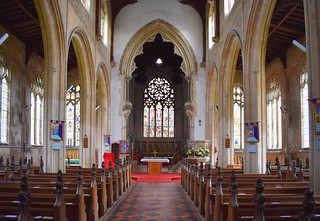
the nave. You step into a church full of light and space.
St Mary is home to a memorable collection of medieval
survivals, the first of which is the 15th Century seven
sacrament font. This is in relatively good condition,
with crowded scenes set beneath cusped arches which
retain traces of their original colour. The carving is
not crude, but it is certainly not delicate, and perhaps
this font offers less to the casual explorer than some
other seven sacrament fonts, but it has a number of
interesting details.
 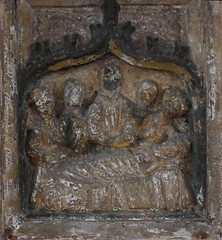 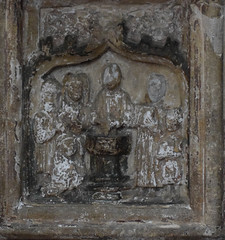
 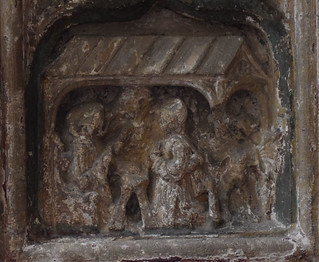 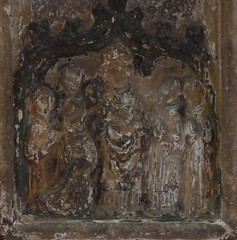
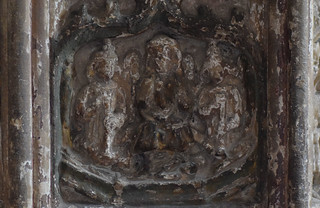  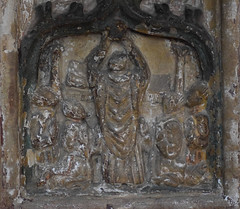
The most easterly
panel is Last Rites, the dying figure wrapped up like a
mummy. You can see the chrismatory box in the hands of
the acolyte standing at the foot of the bed. Then, in
anticlockwise order, comes Baptism (NE), the infant being
fully immersed in the water in the medieval manner, and
then Confirmation (N) including a babe in arms. Next
comes Confession (NW), perhaps the most interesting panel
because the action takes place under the canopy of a
chapel as on the font at Marsham, with the devil sneaking
out through the door. The last three panels are
Ordination (W), with the ordinand kneeling, Last
Judgement (SW), which is the odd panel out, Matrimony
(S), a very clear panel with the woman wearing a kennel
headdress of the 1480s, and finally Mass (SE), the Priest
with his back to us, the altar beyond with riddle posts.
Eight Saints stand in niches around the pillar, including
St Andrew with his saltire cross. I suspect that at some
point the font has been turned one place anti-clockwise
and reset, perhaps not intentionally and probably during
the 19th Century restoration, because I think that
Baptism may have originally faced east and the Last
Judgement west.
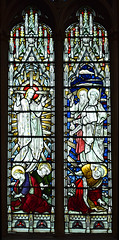
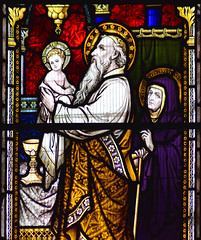
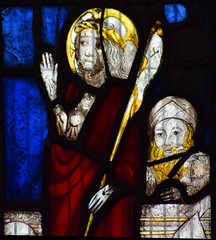
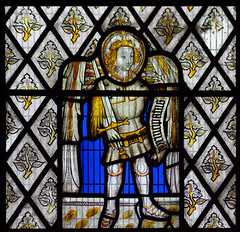
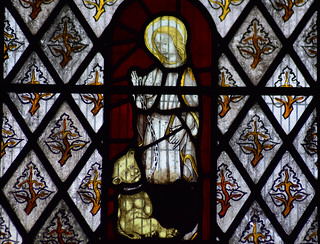
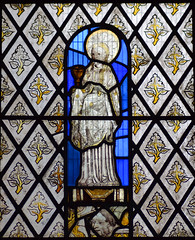
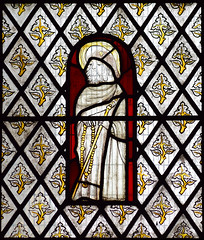
But Martham's most spectacular treasure is the collection
of medieval glass in the east windows of the south and
north aisles. These consist of a series of more than
twenty panels of individual saints and scenes, presumably
part of much larger sequences originally. Much of it is
good glass of the 15th Century Norwich school, and it is
likely that it formed a collection and did not all come
from this church originally. It was probably set in its
current windows by Hardman & Co as part of the 1860s
restoration of the nave. All of it is restored to a
greater or lesser extent, but the added panes are not
intrusive. Some scenes have been reconstructed using the
smallest of details as a starting point, while others
have been merely filled in where a piece was missing. The
many figures were likely originally in the upper lights
of large windows.
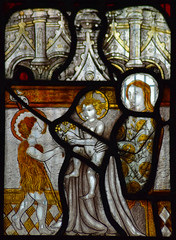
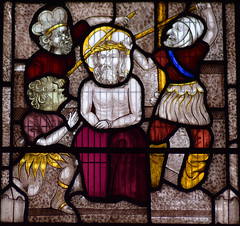
The north aisle east
window features a large crucifixion in the middle at the
top, with two other large scenes below, the Scourging of
Christ and a tender scene of the infant Christ meeting St
John the Baptist. Flanking these are scenes including St
Edmund, St Margaret, The Ascension, the Resurrection, St
Agnes and a King and Queen who might be part of a
Coronation of the Queen of Heaven scene.
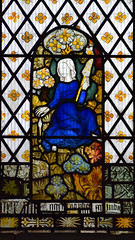
The east window of the south aisle contains a similar
collection, but with one or two more unusual subjects.
The main central light is a dramatic figure of St
Michael, with innocent souls on one pan of his balance
and wicked looking devils on the other. Below him is Eve
spinning. The flanking subjects include St Mary of
Magdala, St James, St Margaret, a tonsured figure with a
crook and a variety of angels illustrating the orders.
  
This is all
spectacular stuff, and it is offset quietly by a good
range of bench ends, some old and some new, which are
good quality work and include a number of figures and
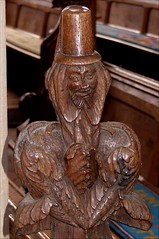
faces. Curiously, some of the medieval poppyheads appear
to have been altered, probably in Victorian times. One
face has been given a 17th Century puritan's top hat, and
another turned into a bell with a Marian monogram.
And so, we come to the chancel. It really is very
impressive. You enter beneath a cusped chancel arch
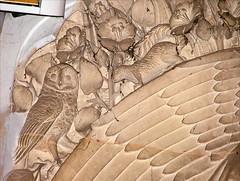
through a fine wrought-iron screen. The capitals on the
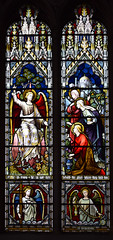
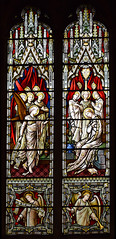
arch are a cornucopia of intricate detail. The glass is
all by Hardman & Co, in a style diversified enough to
allow each window its own presence whilst still being
part of a coherent scheme. It has a rich cathedral
quality that is in keeping with the architecture, and the
east window must be one of the grandest in any village
church in East Anglia. The faux-Easter sepulchre on the
north side of the sanctuary is the Reverend Dawson's
memorial. Put together with the capitals and stone
reredos I do not think there is a richer, louder and more
confident Victorian moment in Norfolk, not excluding
Booton.
Simon Knott, November 2020
Follow these journeys as they happen at Last Of England
Twitter.
|
|
|