home I index I latest I glossary I introductions I e-mail I about this site
All Saints, Marsham


Follow these journeys as they happen on X/twitter.
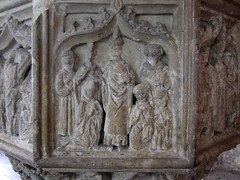
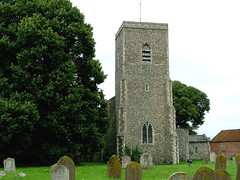
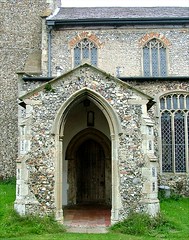
All Saints, Marsham Norfolk's most famous churches are often those which appear architecturally spectacular to even disinterested eyes, but there are plenty of other churches that most people would pass without a second glance, a few of which are of outstanding interest. All Saints, Marsham, is one of these. It sits in a large, busy village on the Norwich to Cromer road, but the church is set back to the south of the village, and you approach it up a narrow lane past 19th Century cottages. A niche above the east window faces the road, and in medieval times the statue it held would have been the last thing seen by parishioners before setting out on the long journey to Norwich and London, and beyond. An early 14th Century tower and apparently the porch too, but the church against it was rebuilt over the subsequent couple of centuries. Paul Cattermole and Simon Cotton transcribed William Camplyn's bequest of 1533 of 6s 8d and an oke saving the toppe to reparation of the north aisle. Judging by the window tracery, this seems a good date for the completion of the church. Presumably the wood of the 'oke' would be of use in the construction, while 'the toppe' would have been more useful for firewood. All in all, this appears a typical late medieval East Anglian church as you approach it up the lane, its aisles and clerestory familiar from elsewhere, although the building folds itself back modestly behind its tower when seen from the west. The tall, single storey porch has an entrance which is nearly as high as itself, and the wooden ceiling is gaily painted. You step into it and pass through the south door into a quiet, squarish space of wood and stone. The coloured glass does not intrude, the first impression is that this is not a spectacular building, and perhaps this is why Marsham church is not better known. But the interior is harmonious, and it has more than its fair share of survivals of its liturgical life down the long centuries. It is not so much secretive as deceptive, but to wander around inside is to encounter wonders. The first of these greets you as you enter the door. Under the west gallery is one of Norfolk's twenty-odd 15th Century Seven Sacrament fonts. Marsham's is tall and elegant, reminiscent of the one nearby at Burgh-next-Aylsham. The scenes are set in deep reliefs under cusped ogee arched canopies, which perhaps explains ther good condition, for it would not have been necessary to knock them flush before plastering. Though of course, there is some mid-16th Century iconoclastic damage.
Starting from the
east, the first panel depicts Baptism, with the infant
being fully immersed in the customary medieval manner, a
godparent on the left holding the chrysom cloth. Then,
moving anti-clockwise, the Mass panel at north-east has
the priest at the altar, elevating the host with his back
to the viewer facing the altar, while an acolyte on the
left rings the sanctus bell in a stirrup above his head.
The north panel is Ordination, with three kneeling
ordinands. The Matrimony panel to the north-west has the
couple holding hands on the left of the scene while the
priest points to a page in an open book held by an
acolyte. Confession to the west is set beneath a canopy
which may be intended to represent the Holy House in
Nazareth. An angel stands at the back, while the devil
sneaks out on the right. The odd panel out on this font
is the Last Judgement at south-west. Christ sits on a
rainbow flanked by Mary and John, while at his feet, the
dead rise from their coffins. The last two panels are
Last Rites to the south, the dying man's wife mourning in
front of the bed, and an acolyte holding the chrismatory.
Finally, Confirmation at south-east with, as usual, an
infant in arms. The nave windows have
fragments of medieval and continental glass, but they are
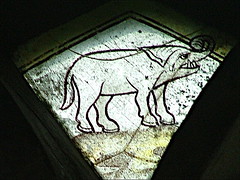
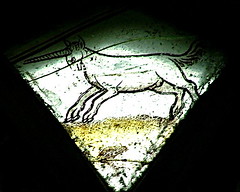
unusual. Set in two small lights in the north aisle are
an elephant and a unicorn, the only two in medieval glass
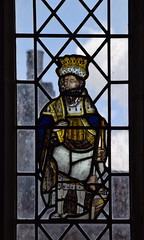
anywhere in East Anglia I believe. There are also two
fragmentary figures in the south aisle, one a king with a
harp, who must be David, and the other a knight with
three heraldic choughs on his tabard and banner. They
came from Bolwick Hall, and were placed here by the
Mercers' Company whose arms are now between them. Up
above, the alternating hammerbeam roof is a fine late
medieval example, but the walls of the nave began to
spread in the eighteenth century, and so solid oak tie
beams were put in to stop it collapsing. They are a
curious and powerful contrast with the delicacy of the
woodwork above. You can still see how the south arcade is
leaning, especially at the east end.
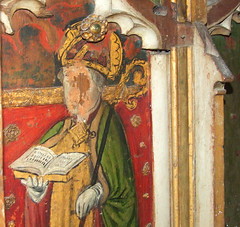
On the north side, the first figure is St Faith with her saw. The great Priory at nearby Horsham was dedicated to her, and most of the English churches dedicated to her are in this part of Norfolk. Next is St James the Less with a fuller's club, then St Thomas with a lance, St James with a staff, St John with a poisoned chalice, St Andrew with a cross and finally St Peter with his keys. It's on the south side that things are less conventional. The first figure is clearly St Paul. He appears paired with St Peter either side of the opening on a number of Norfolk screens. He holds a book, and leans on his sword, except that his sword isn't there. It appears that it was never painted, and the screen is unfinished. After St Philip with a basket, there are four more figures in an attitude of holding their symbol, but the symbol has never been painted. They must be St Simon, St Bartholomew, St Matthew and St Jude, though it isn't clear in which order. The final panel depicts a bishop who is likely to be St Thomas of Canterbury. The upper tracery of the screen hangs like foliage, an echo of the forest of branches in the roof above. The early 20th Century
glass casts a dim light. The east window, by Powell &
Sons in 1907, is a familiar design of I am the vine,
ye are the branches, giving the workshop full
licence for its typical early 20th Century lush vinework,
angels and saints. Another window has 1930s glass by them
depicting St George and, more unusually, Sir Galahad from
the legend of King Arthur. Herbert Bryan's glass of
Abraham, Sarah and Isaac of about 1905 is also unusual,
the infant Isaac at Sarah's feet carrying his bound
branches in an echo of the saltire cross on the screen. Simon Knott, December 2023 Follow these journeys as they happen on X/twitter.
|
|
||||||||||||||||||||||||||||||||||||||||||||||||||||||
home I index I latest I introductions I e-mail I about
this site I glossary
Norwich I ruined churches I desktop backgrounds I round tower churches
links I small
print I www.simonknott.co.uk I www.suffolkchurches.co.uk