home I index I latest I glossary I introductions I e-mail I about this site
St Mary, Little Walsingham

Follow these journeys as they happen at Last Of England Twitter.
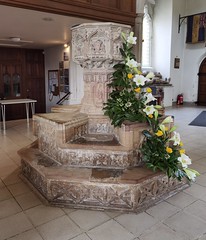
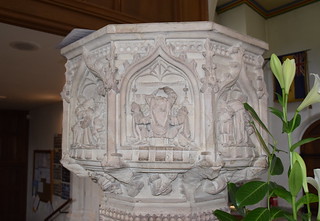
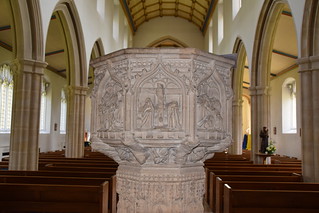
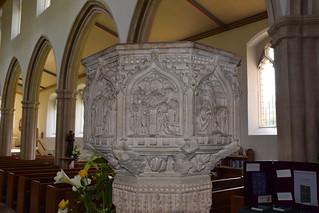
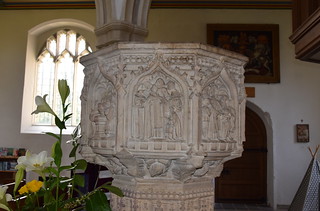
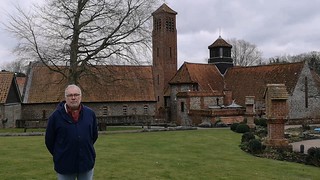
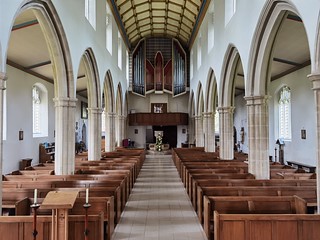
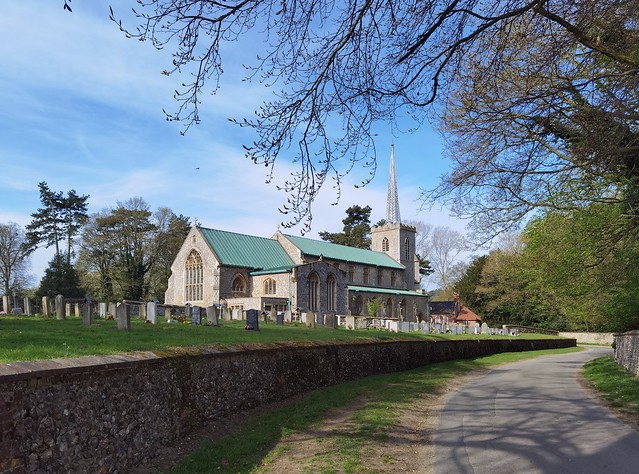
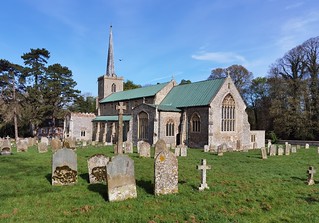
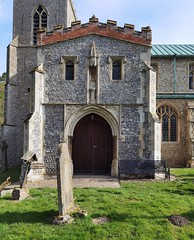
St Mary, Little Walsingham This grand church sprawls in a wide, ancient churchyard to the south of its village, with woods and fields beyond. It is a moving sight for anyone approaching it along the lane that comes from the road from Little Walsingham to Great Snoring. The Abbey grounds rise on either side, the lane sunk down within them. As the lane begins to curve, the church slowly comes into being before you. If there is a more atmospheric place than this on a crisp winter day, with the smell of woodsmoke from the red-brick cottages and the sound of jackdaws in the bare trees, then I have yet to find it, although at any time of the year this is a memorable church. Even if you did not know that Walsingham was a special place, you would be impressed by this well-fed beast sprawling under its green copper roofs. Only the tower with its lead spire seems undernourished. As you'd expect of a large church in this part of Norfolk, St Mary was mostly rebuilt in the 14th Century, and then elaborated further a hundred years later. However, it is difficult to tell too much from the church as it is today, for on the night of the 14th of July 1961 this great structure was completely destroyed by fire. It was fierce and furious, and all that was left was the tower, the porches and some of the outer walls. It was rebuilt by Laurence King who had recently completed the same job at St Mary le Bow in London which had been gutted in the Blitz. The window tracery had to be replaced, although it seems that King replicated what was there before as far as possible. Somehow, knowing that the church we see today has risen from the dead makes it all the more moving. Little Walsingham was the home of England's most important medieval Marian shrine, and you may have caught sight of the ruin of the Abbey of Walsingham, where the shrine was established, off to the right as you wandered up the lane. But many people will come to visit this church because of its important place in Anglo-Catholic history. Today, even the word Walsingham has become a touchstone, symptomatic of an energy and a presence. Here we are in a village in which a confusion of diverse traditions comes together for a moment, to stop and be still. What happened here at Walsingham in the centuries before the Reformation has never been forgotten, even if it remained the preserve of antiquarians and historians for several hundred years. The revival of sacramentalism in the Church of England in the 19th Century, largely at the impetus of the Oxford Movement, has been explored elsewhere on this site. Suffice to say that in the middle years of the 19th Century, Anglican churches began to be restored to their medieval integrity. Chancels were reopened, altars reinstalled. What had become preaching houses were transformed into liturgical spaces. As the century wore on, this process ramified, and some churches went even further, embracing the Catholic tradition which some Anglicans believed to be their birthright. By the end of the century there was a strand of Anglicanism which taught that, in fact, the Church of England was the one true Catholic Church in this land, and that the Roman Church (the first word said disparagingly) was little more than 'the Italian Mission to the Irish'. In these Anglican churches you might find daily mass with crucifixes on the altar, statues of saints and (but this was in extremis) incense being used. Most would not do this. But if the full-blown Anglo-Catholic tradition was only embraced in a minority of parish churches, it would not be untrue to say that it dragged along the great majority of other parishes in its sacramental wake, and by the start of the 20th Century, the great majority of Anglican churches had come to look as they do today. Unusually, St Mary has a 14th Century west porch. These are fairly rare in East Anglia. There's one at Cley, and another at Debenham in Suffolk. The imposing two-storey south porch is from the following century, but these days you usually enter the church through the more humble north doorway. You step into a space which is thrilling and vivid, long and full of light. King's replacement arcades arise like a forest of trees from his simple furnishings set on a marble floor, the view east to the remarkably effective raised chancel thanks to the glass by John Hayward, with whom King had also worked at St Mary le Bow. If the distance of sixty years since the recreation of this church does anything, it is that it gives us the sense of a space full of confidence, a hangover perhaps in conservative East Anglia from the Festival of Britain ten years earlier which had kick-started so much quality in design for the new Elizabethan era. It was a happy time for the repair and refurbishing of damaged churches, but this time was coming to an end, and ten years later it might all have been quite different. Not a great deal survived the fire, but remarkably one thing that did was Little Walsingham's seven sacrament font. Pevsner called it almost the perfect Norfolk font, noting that a replica of it was displayed at the 1851 Great Exhibition. The panel depicting the sacrament of Confirmation faces east, and then anti-clockwise from it are Baptism (north-east), Ordination (north), Matrimony (north-west), The Crucifixion, depicted as the odd panel out here (west), Last Rites (south-west), Confession (south) and Mass (south-east).
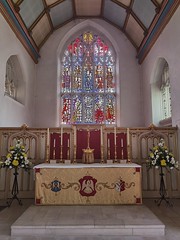
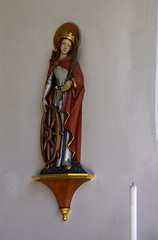
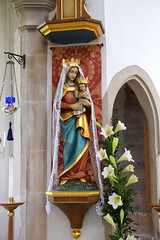
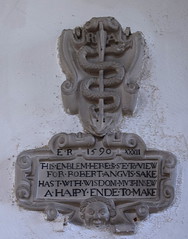
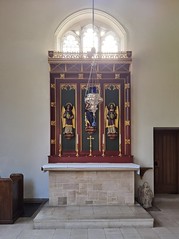
Cautley, writing in the 1940s, describes the church before the fire, and notes a good font cover, inscribed and dated 1625. This was destroyed in the fire of course, and today's elegant replacement was designed by John Hayward. However, we know from the inscription that it was the gift of Sir Henry and Lady Jane Sidney, and they survived the fire - or, at least, their effigies did, now reset against the west window of the north aisle, she raised slightly above him on the window ledge. Before the fire their monument was in the north transept, and their relegation to the back of the church leaves that space open to form a beautiful chapel with an altarpiece by George Bodley, brought here from elsewhere after the fire I assume. Another chapel in the south aisle is furnished with statues of St Catherine and St George, a simple altar beneath, the space full of light. The aisle chapels and transept are left open to the chancel through the arcades without screens or furnishings, creating a space that gives the impression of the church widening as you head eastwards. A collection of brass figures and inscriptions have been reset below the arcades here. Brasses generally survive fires if they are set in the floor as the heat rises away from them. It is when they are reset in the walls that they run away like butter. They are mostly of about 1500 in date, and the most memorable here include those to a civilian, headless now but still clinging on to his large purse, a lady with her hands in an attitude of prayer who turns her head to look at her husband, and a chalice brass for a priest, William Westow, with his hands lifting the chalice and host above his inscription. To the east then, and John Hayward's exciting glass of 1964 in the east window, full of vivid confidence and reminiscent of his work in several of the restored London churches including St Mary le Bow and St Michael Paternoster Royal. The Blessed Virgin and Christchild in the style of Our Lady of Walsingham sit at the centre surrounded by saints, while below them the panels tell the story of Richeldis and her vision, and the establishment of the shrine. The view back to the west is entirely harmonious, the organ pipes swelling up into the west end of the nave roof the finishing touch. I said earlier that this church had a special place in Anglo-Catholic history. It seems to be generally true that the later the full-blown Anglo-Catholic tradition was embraced, the more extreme the Anglo-Catholicism in a parish would be. The tradition came fairly late to Norfolk, especially here in the north of the county. As William Davage records in his book Vicars of Walsingham 1921-2021, the parish had fallen under the influence of the Oxford Movement fairly early on thanks to the patrons, the Lee Warner family, one of who had even been taught by John Henry Newman at Oriel College, Oxford. In 1882 George Ratcliffe Howard had arrived fresh from his curacy at the stratospheric St Barnabas, Pimlico and introduced a daily mass and a statue of the Blessed Virgin. But the man who transformed this parish, and the fortunes of Walsingham, was Alfred Hope Patten, who became rector here in 1921. The parish was, as William Davage observes, fertile ground. Patten countered the Catholic Church's establishment of a Shrine of Our Lady of Walsingham nearby at the Church of the Annunciation in Kings Lynn with his own shrine, here in the parish church of Little Walsingham. The church authorities were outraged, and he was ordered to remove it. He did this in considerable style, translating the statue to a new home, a replica of the Holy House of Nazareth said to have been seen by the 12th Century Richeldis in a vision. He built a shrine church around it, which has been extended in later years, its grounds a large garden edged by pilgrim hostels, a refectory and other buildings. The tradition that Alfred Hope Patten entrenched during the thirty-seven years of his incumbency at Walsingham continues, and casts its spell on other churches in the quiet lanes round about, creating a sacramental garland which attracts thousands of visitors every year. There is no doubt that the Anglo-Catholicism Patten knew is in retreat, and that the Church of England continues to transform itself. And yet people come, and will continue to come to Walsingham, to visit the shrine and then wander out to this great church, one of the most memorable and beautiful of East Anglia's larger churches. Simon Knott, May 2022 Follow these journeys as they happen at Last Of England Twitter.
|
|
|||||||||||||||||||||||||||||||||||||||||||||||||||||||
home I index I latest I introductions I e-mail I about
this site I glossary
Norwich I ruined churches I desktop backgrounds I round tower churches
links I small
print I www.simonknott.co.uk I www.suffolkchurches.co.uk