| |
Shrine of Our Lady of Walsingham, Little
Walsingham
(Anglican
Shrine of Our Lady of Walsingham)
In the Middle Ages, the shrine of
Our Lady at Walsingham was second only to the Shrine of
St Thomas of Canterbury in its significance to English
pilgrims. The statue of the Blessed Virgin and child was
contained within a holy house, supposed to be a replica
of the building in Nazareth where Mary had received the
news of her pregnancy from the Angel Gabriel. It was said
that the angel had appeared to Richeldis, a noblewoman,
in a dream, and asked her to construct the building. By
the 12th Century, a large Augustinian Priory had grown up
here at Little Walsingham, and pilgrims, unable to visit
the real Nazareth in the Holy Land because of the
Crusades, came to England's Nazareth instead.
It was not to last. Pilgrimage, and the means of Grace
which it sought to effect, were heavily frowned upon by
the Anglican reformers of the 16th Century. The Crown had
its beady eye on the wealth of pilgrimage sites, and so
in the 1530s they were abolished by royal decree, their
communities dispersed, their furnishings burnt or sold,
their money accruing to the Crown. The statue of Our Lady
of Walsingham was burnt at Chelsea, although it has been
suggested that the statue in the Victoria and Albert
Museum known as the Langham Madonna may actually be the
Walsingham statue, either rescued or sold. A heavy
silence then descended on Walsingham. It was not
difficult for such a remote place to become a backwater,
and 16th Century recusants, along with antiquarians of
the 17th and 18th Centuries, bemoaned its desolation.
The story of Walsingham begins again with the
decriminalisation of Catholicism in the 1820s. This had a
two-pronged effect. Firstly, a group of Anglican
intellectuals at Oxford were appalled by the possibility
that the Church of England might become nothing more than
a protestant sect, and sought to proclaim what they saw
as the true Catholicity of a National Church. Secondly,
the rapid emergence of Catholic communities in England
led to the re-establishment, in 1851, of the Catholic
hierarchy. For the first time since the Reformation,
England had Catholic parishes again.
It has to be said that neither of these two events made
much of an impression on Walsingham. There were few
ripples to be noticed in this backwater of 19th Century
England. It was not until the 1890s that a Priest at the
Kings Lynn church of the Annunciation, the Catholic
parish into which Walsingham fell, built a Marian shrine
within the Kings Lynn church, dedicating it as the Shrine
of Our Lady of Walsingham. That same decade, Charlotte
Pearson Boyd, a convert to Catholicism, bought the
Slipper Chapel at Houghton St Giles and gave it to the
Diocese of Northampton for Catholic use. This is now the
heart of the Catholic National Shrine of Our Lady, but in
the 1890s the Bishop of Northampton seems to have been a
little embarrassed by it, and the statue remained at
Kings Lynn.
All this was happening in the background, then, when the
main Anglican player entered on to the stage, a man whose
name will be forever associated with the story of
Walsingham. Alfred Hope Patten was a convinced
Anglo-Catholic, and in 1921 he arrived in this Church of
England parish which already had firm Anglo-Catholic
sympathies. A young man, he brought the energy of the
movement to this rural outback, and one of his first
actions was to install a replica image of the medieval
statue of Our Lady of Walsingham in the Little Walsingham
parish church.
This was a fairly provocative act for the time. The
Church of England was at the apex of its cultural
influence, thanks largely to the way in which it had
ministered the experience and the grief of the First
World War. It had a central place in the English
imagination. The Anglo-Catholic Movement was in its
ascendancy, at the peak of its enthusiasm.
Anglo-Catholics seemed to challenge the Anglican
consensus at every turn. They would shortly attempt to
have the Church of England replace its totemic Book of
Common Prayer, in use for some 350 years, with a new
prayer book. This would fail, and in retrospect the
Anglo-Catholic tide began to recede at that moment. But
that was all in the future.
The Anglican Bishop of Norwich was outraged by Hope
Patten's statue, and demanded that it be removed. Hope
Patten carried out this request in considerable style,
translating the image to a new location on the other side
of the Priory ruins, and building another replica of the
holy house of Nazareth around it, just as had happened
some 750 years previously. Hope Patten believed that the
pendulum of the Church of England was swinging his way,
and that the views of the Bishop would one day come to be
seen as of a past age. There were enough militant
Anglo-Catholics in positions of influence to ensure that
Walsingham had powerful friends. The new shrine soon
began to generate interest, and it was not long before it
became necessary to build a larger church around the
shrine, which was completed shortly before the outbreak
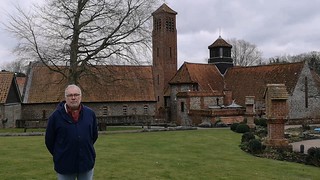
of World War II. This was substantially extended in the
1960s, giving the building the shape and appearance it
has today. It has to be said that the 1930s was not a
good time to be building a new church or extending it.
The exterior is very much in the spirit of that decade.
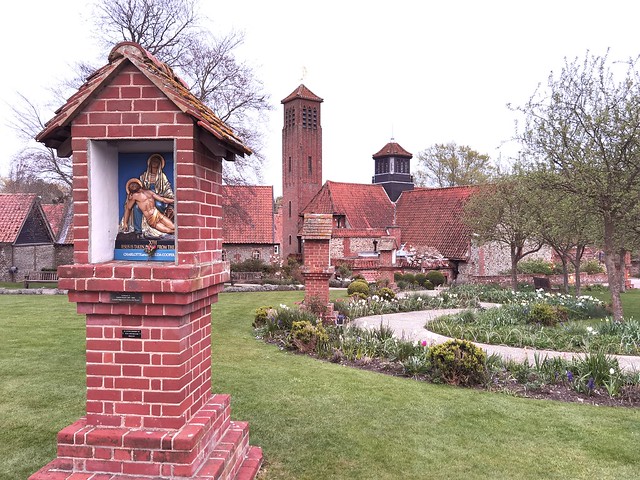
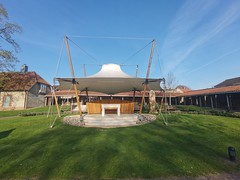
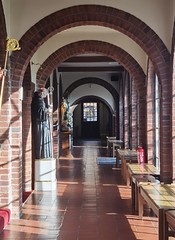
The main entrance is ostensibly from the west, but in
practice the extended church has arcading which opens
onto the shrine gardens, which have been developed
extensively as a place to sit or wander, and are enclosed
by early 21st Century buildings which include offices,
hostels and a refectory.
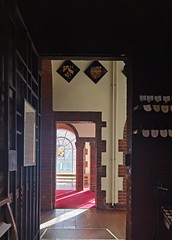
Inside at the west end of the
church there are steps down into the holy well,
supposedly discovered after Hope Patten paused in prayer
above it. There is a large ceramic relief of the
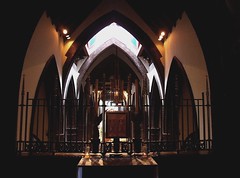
Annunciation here. Behind this is the Holy House itself,
lit up inside by hundreds of candles which burn here
daily for Anglo-catholic parishes and intentions from
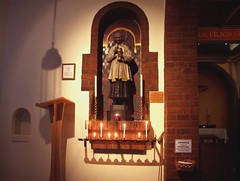
around the world. The grand altar is surmounted by the
splendidly dressed replica of the original Walsingham
statue, glittering in its finery. Altar, reredos and
baldachino are the work of Ninian Comper, who also
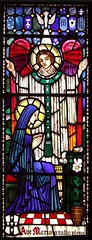
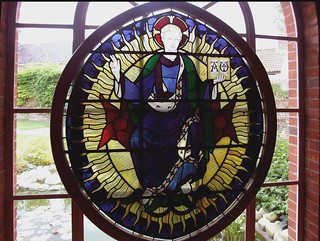
designed much of the glass, although there is also a
delightful Annunciation window by Trena Cox, one of only
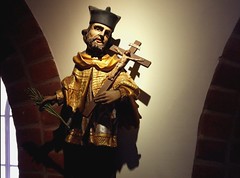
two of her works in East Anglia. In the arcades around
the Holy House are memorials of militant Anglo-Catholic
priests of the late 19th Century, from the time before
their extraordinary movement reached out and touched this
place. It is all a world away from the simplicity of the
Catholic shrine a mile off at Houghton St Giles.
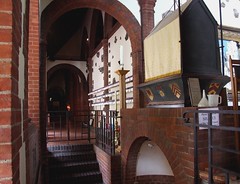
Beyond the Holy House, the shrine church opens up and
extends into a labyrinth of chapels on two levels. There
are fifteen of these, allowing the rosary to be said, one
mystery in each chapel. One of the chapels is dedicated
and consecrated for Orthodox worship. Others are altars
for particular Saints or causes. Whichever way you go,
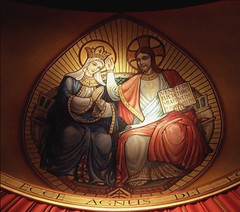
you eventually end up in the Blessed Sacrament chapel
with its ceiling mosaic of the Coronation of the Blessed
Virgin, above the high altar. It is a moving experience.
Perhaps it is fair to say that the shrine never made it
to the heart of Anglicanism in the way that Hope Patten
had envisaged. But in another way, it has reinvented
itself, along with the mainstream of the Church of
England, to stand as a witness to the Faith for the
hordes of tourists and visitors who make their way to
Walsingham. They come here with their hunger for the
spiritual, their God-shaped holes, and enter a sense of
the numinous which has a like nowhere else in England.
God moves in mysterious ways.
Simon Knott, February 2023
Follow these journeys as they happen at Last Of England
Twitter.
a video
exploration of Walsingham's history and places

 
  
  
|
|