home I index I latest I glossary I introductions I e-mail I about this site
St Andrew, Little Snoring



Follow these journeys as they happen at Last Of England Twitter.
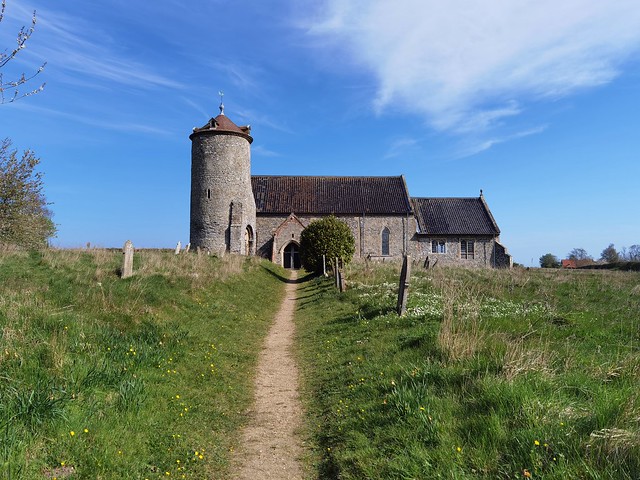
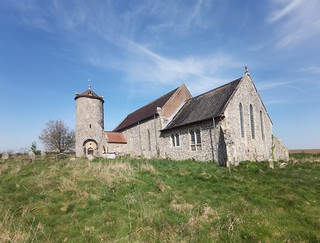
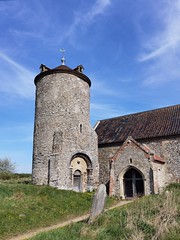
St Andrew, Little Snoring As often in this part of the world, Little Snoring is larger than Great Snoring, the parish names originally derived from the lesser and greater manors. The parish is suburban Fakenham really, but the little church is one of north Norfolk's most memorable sights, on a rise above the fields out on the road to Walsingham. The flat expanse to the north of the church was the former WWII air base, which unusually in East Anglia was an airfield used by Hurricanes and Spitfires rather than American bombers. The church was contained within the perimeter fence in the last years of the War, and was used as the base chapel. All wartime survivals have long since disappeared, ploughed under decades ago, but there are still plenty of romantic associations. Little Snoring is widely known for its amusing name (it simply means the place of a people who followed a man called Snear) but also for this church, for it is one of just two with a detached round tower. It asks more questions than it answers, for while the other detached round tower, at Bramfield in Suffolk, has always been free-standing, this tower clearly once stood at the west end of a now-vanished church. In the eastern face of the tower there is a tower arch, which was later filled in. It isn't clear exactly what happened here. The tower seems largely of the 11th Century, which is to say Saxon-becoming-Norman, but at some point the church that it belonged to was demolished. But was it replaced by the one that now stands a few metres to the north, or was that church there already? At Reepham, for example, the two churches in the churchyard are so close together that they are actually touching. The matter is clouded by the fact that the tower archway is early Norman, and much of the masonry of the doors and windows of the new church also appear to be 12th Century at the latest. Could they even be contemporary? Most probably, the new church was a replacement for the old, and materials from the old church were reused to build the new church. The first church might not even have been finished before it was decided the soft ground could not support it, although the old and new churches would have been surprisingly close if that was the case. That materials from the old church ight have been reused in the new is supported by the entrance on the south side, where an Early English doorway is set within a Norman doorway. You step into a church
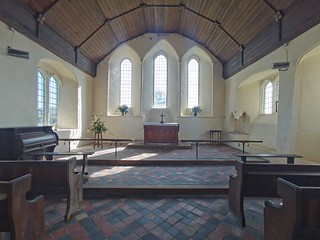
which is is earthy and rustic. The nave and chancel are
separated by a fairly narrow chancel arch, creating a
feeling of uncluttered rooms, and you step through into a
13th Century chancel which seems surprisingly wide,
perhaps because of the imposing three lancets of the east
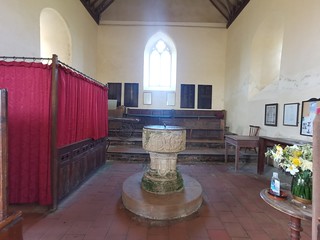
window. At the other end of the church, the sturdy round
font with its vine relief sits in an expanse of tiles.
Cautley thought it was one of the best of its kind in
East Anglia, and it was probably contemporary with the
building of the new church. In this harmonious space
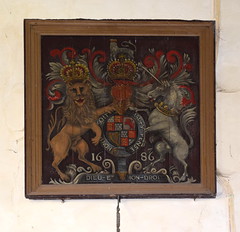
there is nothing particularly remarkable, except perhaps
for the Royal Arms, which unusually are to James II.
Curiously, there is another set to James II across the
fields at Great Snoring, perhaps revealing Jacobite
sympathies in these valleys. Simon Knott, May 2022 Follow these journeys as they happen at Last Of England Twitter.
|
|
|||||||||||||||||||||||||||||||||||||||||||||||||||||||
home I index I latest I introductions I e-mail I about
this site I glossary
Norwich I ruined churches I desktop backgrounds I round tower churches
links I small
print I www.simonknott.co.uk I www.suffolkchurches.co.uk