home I index I latest I glossary I introductions I e-mail I about this site
St Mary, Little Fransham


Follow these journeys as they happen at Last Of England Twitter.
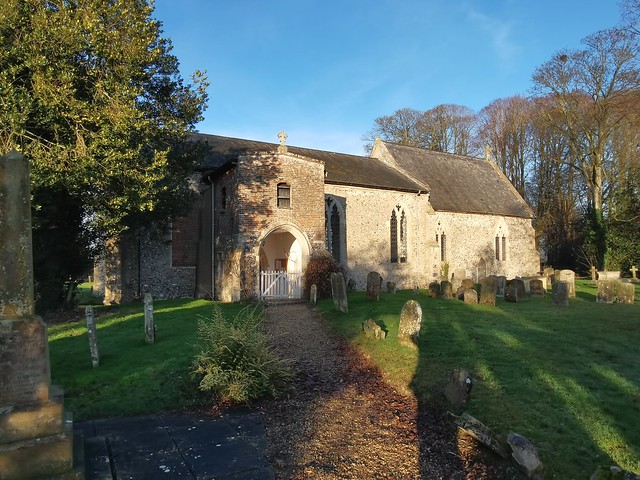
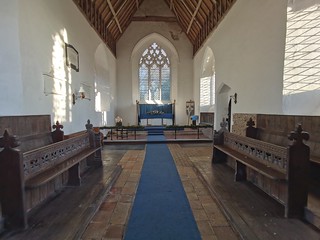
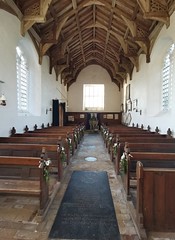
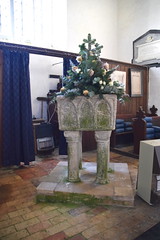
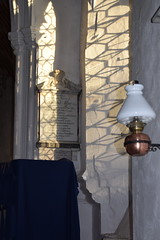
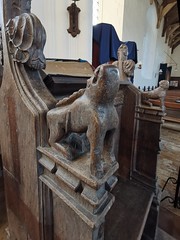
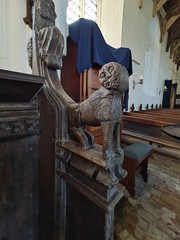
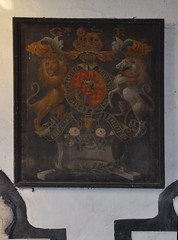
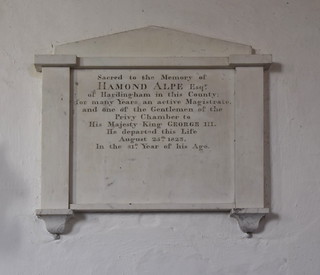
St Mary, Little Fransham St Mary is a reclusive delight. Its parish sits along the busy A47 to the west of Dereham, but the church is half a mile or so to the north of the road in a secluded churchyard set back from the lane to Mileham. No tower pokes tellingly above the treetops, but down a short track you reach a delicious oddball of a building, the chancel roof cresting high above that of the long nave. The west end presents a puzzle. Pevsner points to the domestic, transomed four-light window in the west wall which he says replaced the tower which fell in 1700. You come around to the south side and see the lower part of a flint 15th Century porch, but the upper stage has been entirely rebuilt in red brick with the date 1743 worked into the end of the braces. The theory is that this structure was erected to house the bells which lost their home when the west tower fell. However, looking at the buttresses at the west end of the nave it is hard not to think that they are also 15th Century, and looking at the surface of the wall it is difficult to see that there was ever a tower here at all. Elsewhere in the church the window tracery is mostly Decorated, but within the porch a 13th Century doorway suggests a likely date for the walls. You step into a long, open interior that is full of light thanks to the lack of coloured glass. The font is a fine example of the ideas buzzing about as Norman developed into Early English in the early 13th Century. It is still square, but with the arcading that would shortly become fashionable on octagonal fonts. Presumably it dates from when the current church was built. In the north-west corner is a cluster of memorials to the Dickens family, no doubt collected together here during the 19th Century restoration. Above them are the royal arms for George III, the most common type in the county, but this is a particularly good set, finely painted, especially the lion's head. Turning east, you can look up into an arched hammerbeam roof in the nave, the roof of the taller chancel consisting of tie-beam braces. The long benches in the chancel have bench ends and traceried backs very much like those a couple of miles off at Beeston-next-Mileham. The 1851 Census of Religious Worship gives a fascinating insight into the rejection of the established church in Little Fransham. The parish had a population of 267, but in addition to the parish church there were no fewer than three non-conformist communities meeting in houses or cottages in the parish, the Baptist & Methodist Congregationalists, the Wesleyan Methodists and the Wesleyan Methodist Reform. In addition, all the parishes around Little Fransham also had their varieties of Methodist congregations, some of the parishes having much smaller populations. Under the circumstances, the thirty people who attended morning worship at St Mary that morning seems quite high. They were augmented by the 29 scholars of the parish school, who of course had no choice but to be there. Simon Knott, January 2022 Follow these journeys as they happen at Last Of England Twitter. |


|
|||||||||||||||||||||||||||||||||||||||||||||||||||||||
home I index I latest I introductions I e-mail I about
this site I glossary
Norwich I ruined churches I desktop backgrounds I round tower churches
links I small
print I www.simonknott.co.uk I www.suffolkchurches.co.uk