home I index I latest I glossary I introductions I e-mail I about this site
St Andrew, Little Cressingham



Follow these journeys as they happen at Last Of England Twitter.
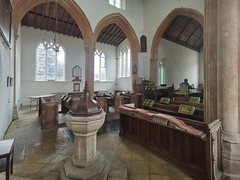
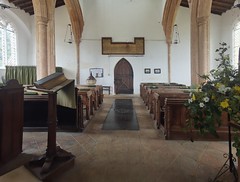
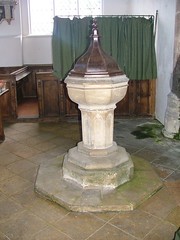
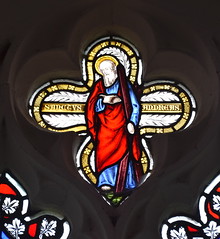
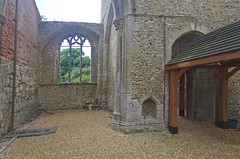
St Andrew, Little Cressingham The rolling fields between Swaffham and Watton are where a more familiar Norfolk begins to emerge from the Breckland. Little Cressingham is one of a number of small villages not far off the main road, and its church is a ramshackle yet beautiful building which feels as if it has grown organically from the landscape, and is now beginning to make the return journey. The 14th Century chancel and 15th Century nave with aisles and clerestories are common enough in East Anglia, the tower set at the west end of the south side is more unusual, but not unknown. But the most striking feature here is that the south side of the tower collapsed towards the end of the 18th Century. Although the tower must have collapsed outwards, the western half of the nave had also become ruinous, probably as a result of the general neglect of medieval church buildings in the 17th and 18th Centuries. In the 1780s came a big patching up. A new west wall was built out of brick across the nave, reducing the size of the church to two bays of the nave and aisles, and the chancel. The new wall is somewhat more homely than the original one to the west, for the massive outline of the west window there shows that this must have been a very grand church indeed. You enter through the old tower arch on the northern face of the tower into what was once the west end of the nave, the old arcades rising like trees to form colonnades. Then you enter the church properly through the little doorway in the new west wall. As you would expect, the interior is wider than it is long, full of light and with a pleasing rustic folkiness. Above the west doorway is the decalogue board that formerly sat beneath the east window. The tracery of this window has at some point been reorganised, curiously but attractively. There are some fragments of what looks like old glass in the east window of the south aisle, forming a setting for a small cruciform late 19th Century image of St Andrew. The font is a good example of the simple Classical style that predominated in the decades before the Ecclesiological Movement of the 19th Century. A roughly contemporary ledger stone bears the symbol of a turtle. Much of the refurnishing here happened in the middle years of the 19th Century, although interestingly, at the time of the 1851 Census of Religious Worship no return was made for Little Cressingham, and indeed none was asked for, suggesting that it had fallen off the radar of the census-takers, as did half a dozen other Norfolk parishes. In the south aisle, the 1706 monument to William Henry Fortescue, Viscount Clermont and Earl of Clermont in Ireland, seems much grander than it would in a larger church. Nearby, a small plaque remembers Henry James Hoggart of the Norfolk Regiment, Member of this Choir who fell in the Great War. He was just twenty years old. At the end of the inscription is the sad little coda This Tablet is Erected by his Mother. The war memorial nearby records that this parish lost no fewer than eight of its sons to the slaughter, which must have been heartbreaking in such a tiny backwater. Simon Knott, August 2022 Follow these journeys as they happen at Last Of England Twitter.
|
|
|||||||||||||||||||||||||||||||||||||||||||||||||||||||
home I index I latest I introductions I e-mail I about
this site I glossary
Norwich I ruined churches I desktop backgrounds I round tower churches
links I small
print I www.simonknott.co.uk I www.suffolkchurches.co.uk