home I index I latest I glossary I introductions I e-mail I about this site
St Andrew, Little Barningham

Follow these journeys as they happen at Last Of England Twitter.
| St
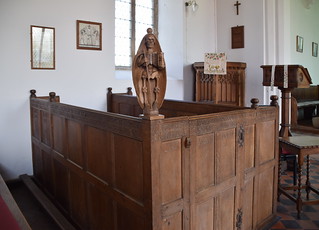
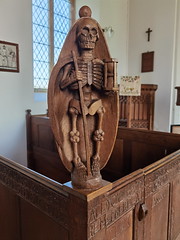
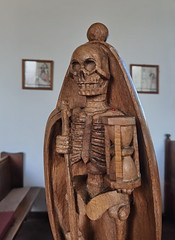
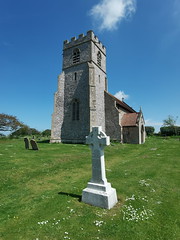
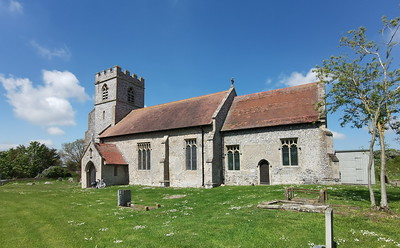
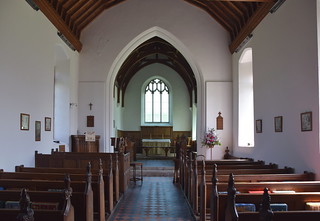
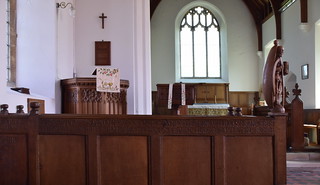
Andrew, Little Barningham This pretty village sits in a fold of the hills to the east of Holt, its parish church like a fortress above it. Despite its name, the village of Little Barningham is larger than its sisters North Barningham and Barningham Winter. There is a fairly steep climb up to the churchyard from the west of the church, which then opens out into a a large circular area, suggesting that this was perhaps a pre-Christian site. The crispness of the exterior of the church hints at the overwhelming 19th Century refurbishment here. The medieval walls were refaced in knapped flint and the tracery of the windows was replaced, over a period of twenty years at the end of the century, firstly in the chancel and then the nave, porch and tower. You may expect Victorian grandeur inside, but in fact you step into a relatively plain and simple interior of wood and tiles. The major survival is an early 17th Century box pew which stands at the front of the north side of the nave. On its south-west corner is the large figure of a skeleton in a shroud, holding a scythe and an hour glass. This is Death himself, and the inscription, after recording that Steven Crosbee had it constructed to seat married couples, reminds us that As you are now so once was I. Remember Death, for ye must die. The pew is dated 1640, that heady time of puritan revolution, when the world turned upside down as Christopher Hill puts it, and many parish churches became the meeting houses of some often quite off-the-wall gathered protestant communities. A further inscription records that the pew was extended in the 19th Century, perhaps for use by a local family.
The puritan obsession with death
was a complex one. Firstly, and most obviously, they
wanted to suppress the old idea that the welfare of the
souls of the dead could be prayed for. This had been at
the heart of Catholic theology, but the puritans wanted
to affirm the Protestant Reformation, which tried to
break the link between the dead and the living. Once
dead, they argued, there is no hope for us, no prayers to
be said, and no kindness to be expected, only judgement.
Further than this, images of skulls and skeletons
emphasised the physical reality of death, and reflected
puritan disgust at the human body, at sexual desire and
sensuality, root causes of sin. But there was also the
puritan emphasis on equality, that, whether rich or poor,
we would all be judged the same. All these attitudes
became bundled in these images, at once horrific and yet
strangely satisfactory at this distance in time. Early 20th Century stations of the cross along the walls suggest that St Andrew was once, like many north Norfolk churches, resolutely in the Anglo-Catholic tradition. On this bright spring day the altar frontal felt appropriate, depicting as it does birds, flowers, lambs and the like, an optimistic affirmation of the world coming back to life. I doubt that the puritans would have approved of it. Simon Knott, June 2021 Follow these journeys as they happen at Last Of England Twitter. |


|
|||||||||||||||||||||||||||||||||||||||||||||||||||||||
|
|||||||||||||||||||||||||||||||||||||||||||||||||||||||
home I index I latest I introductions I e-mail I about
this site I glossary
Norwich I ruined churches I desktop backgrounds I round tower churches
links I small
print I www.simonknott.co.uk I www.suffolkchurches.co.uk