home I index I latest I glossary I introductions I e-mail I about this site
All Saints, Litcham



Follow these journeys as they happen at Last Of England Twitter.
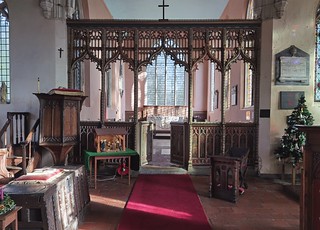
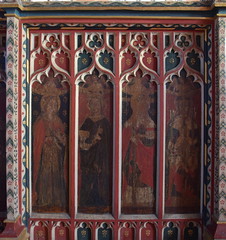
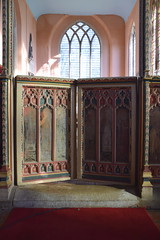
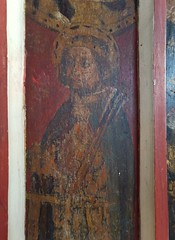
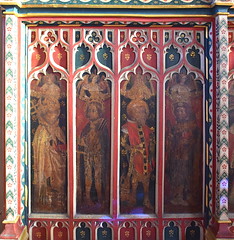
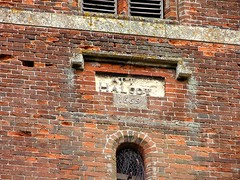
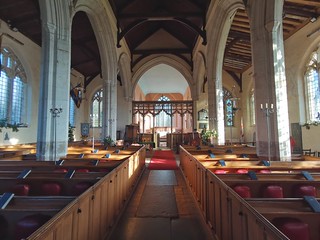
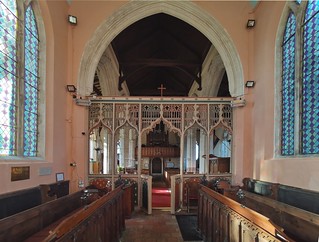
All Saints, Litcham It was a cold, crisp day at the start of January 2022, and I was out exploring churches with Cameron Self in the area between Dereham and Fakenham. I was particularly looking forward to visiting Litcham, because although I remembered it as one of my Norfolk favourites I hadn't been back there since 2006. That had been on a late afternoon in Holy Week that year, although you wouldn't have known this from many of the churches I'd visited earlier in the day. A sombre Eucharist had been in progress at Dereham, and there'd been covered statues at Brisley, with news of evening liturgies at a couple of other churches in that benefice. But generally it was business as usual, which often meant nothing was happening at all. At one church near Fakenham I saw a sign asking all flower arrangers to 'meet up on Easter Saturday to get the church ready for Easter Sunday', which seemed a breathtaking ignorance of the liturgical calendar. In many places that day it appeared that Holy Week had become nothing more than a time to decorate the church for Easter, and at some churches the flowers were already in place, even though Good Friday hadn't happened yet. But then we'd come to Litcham. The priest-in-charge at the time had been a lovely man called Jonathan Boston. He'd been described to me by a correspondent a few weeks previously as the most High Church incumbent in Norfolk, and so I didn't know quite what to expect. I wondered if this meant he was a spiky Anglo-Catholic, which seemed a little unlikely, given that Norfolk's spiky hotspots are well-known. But on stepping into the church I began to get an impression of what my correspondent had meant, and it was something quite different. Everything was neat and seemly, plain and ordered, a place to be still and know. Looking at the noticeboard gave a hint of what the liturgical life of Litcham church was like, for there was a hearty mix of BCP and CW, Matins and Evensong as well as the Parish Eucharist, and most of the services seemed to be choral, and there were introits and canticles. There were photographs of All Saints' robed choir, with a suggestion that children from the village might like to join - not because the choir was foundering, I hasten to add, but simply because it was a worthwhile thing to do. I began to see that this was one of the last refuges of what most of the Church of England used to be like - properly High Church, seemly and with ceremony, gravitas and style. This was the Church of England that had been important in most people's lives once, not for being inclusive or accessible, but for seeming permanent and essential, of being mystical, of something other than that which we would find in our ordinary lives. It reminded me of churches when I was young. And returning in 2022 I remembered Litcham - the place, for it still has an air of the past about it. And yet it seems a self-sufficient, purposeful place. It has a shop, a school, a pub and a post office. It does not by any means feel as if it were a mere dormitory for any nearby town. The centre of Litcham is convoluted enough to slow traffic down, and even to confuse, which I liked a lot. We had to get a map out to find out where the church was, for it is set back from the road, its long churchyard coy behind deceptive ivy-clad birches. The view from the west is unusual, because the red brick tower was largely rebuilt in the late 17th Century at the expense of one Matthew Halcott, whose name is picked out above the date 1669. Pevsner tells us that Halcott was a rich tanner, and we can easily imagine early modern Litcham as a busy little industrial town, processing the goods of, and providing tools for, the work of the countryside around. The tower it replaced had been destroyed in a fire, and the original tower was probably all of a piece with the rest of the church which seems to have gone up in one long campaign of the late 14th and early 15th Centuries. The intersecting tracery in the windows of the chancel seems older, but Pevsner thought it had all been replaced in the early 19th Century. The east window is most odd, set within a large blind arch as if a smaller window had been reset into the place of a larger one, which is presumably exactly what happened. There are aisles, but no clerestory. Does the simple nave roof suggest that one was eventually intended, but was not built before the Reformation intervened? As I've already suggested, you step into a harmonious and atmospheric interior, a traditional space. It is not a particularly rural interior in character, but neither does it have that urban patina so often imparted by 19th Century restorations. It has a presence, as if of that certain kind of self-confidence which suggests authority. Light slants sideways through the nave. The brick floors stretch into the shadows, and the box pews face Litcham's beautiful painted screen. Most of it is rebuilt and repainted, but surviving are no fewer than twenty two early 15th Century panels with figures of saints, sixteen on the dado and six more on the doors, where they are arranged in threes. The eight on the north side of the screen are female saints arranged in two groups of four, as are the male saints on the south side of the screen. Each figure has a demi-angel above its head. Starting from the north end, the first four panels are fairly indistinct, and curiously the panels become clearer the more you head south. The first seems to be a nun without a crown, and so might well be St Clare. Next is St Margaret lancing a dragon and St Dorothy holding a basket of flowers, while the fourth figure appears to be a royal saint though without any distinguishing objects or features. The next group of four are St Agnes with her lamb, St Petronilla with her large key and book as at North Elmham, St Helen with her cross and lastly St Ursula holding her arrows and hiding some of the eleven thousand virgins in her skirts. The figures on the doors are too indistinct to identify, and it is not really even possible to tell if they are male or female, although the sixth figure looks as if it is holding three money bags suspended on strings, and may well be St Nicholas. The south side of the screen, however, is the clearest, and has several intriguing features. The first four figures are St Gregory in a papal tiara, St Edmund holding three arrows, a figure leading a dragon on a halter that Mortlock identifies as St Armel, and St Geron with his falcon as at North Tuddenham. The final group of four are perhaps the most interesting of all. Firstly, St Walstan, Norfolk's farmworker saint, wearing a crown and holding a scythe in one hand and a sceptre in the other. Beside him is St Hubert, an unusual depiction, for the stag with the crucifix in its horns approaches from behind, and St Hubert stands with his back to us, his face in profile, to meet it. The third figure in this set is St Louis of France holding a crown of thorns, and then the final figure is another Norfolk saint, St William of Norwich, a boy martyr whose cult is usually considered evidence of medieval antisemitism. He holds three nails in his hand.
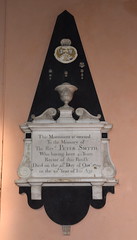
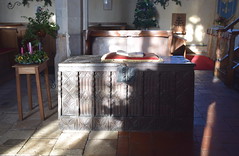
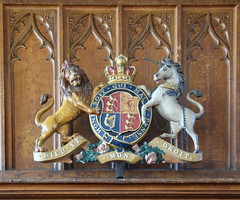
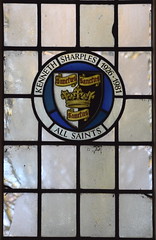
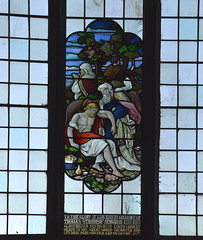
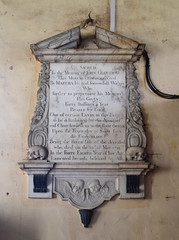
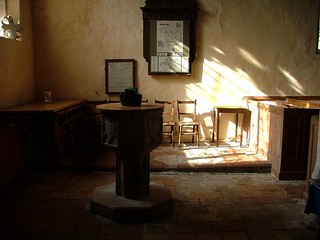
You might think that Litcham has another remarkable series of survivals in the group of tall figure brasses set on the wall of the south aisle, but in fact they are replicas, obtained by Jonathan Boston from the Lincoln Brass Rubbing Centre when it closed. One of them is a copy of the early 15th Century brass of Sir George Felbrigg at Playford, Suffolk, while another is of Sir Robert de Septvans, whose figure brass of a century earlier is at Chartham in Kent. There is very little coloured glass. The 1890s memorial glass to Robert Standish, surgeon with its depiction of the Good Samaritan at the west end of the north aisle was actually installed here in 2019, brought from a church in Cradley Heath in the West Midlands by Standish's great-granddaughter, a Litcham parishioner. A 1980s memorial roundel depicts a black and white halved shield with the words Sanctus, Sanctus, Sanctus. An older memorial on the wall of the south aisle remembers John Glover, who died in 1741. His inscription tells us that this monument was erected by Martha, his real sorrowful wife who further to perpetuate his memory has given forty shillings a year, payable forever out of certain lands in this parish to be distributed by the minister and church-wardens to the poor thereof on the feast of St John the Evangelist being the birth day of the deceased. Beyond the screen, the chancel is softened by pastel-coloured walls. Memorials here include one to Peter Smyth, who having been 43 years Rector of this Parish died in 1789. Across from it, Frederick Kepple Fitzroy is remembered. He was a lieutenant in the 81st Regiment who died at Mussoorie, Upper India in 1863 at the age of 25. He was, the inscription tells us, beloved by all ranks in the regiment. His sorrowing brother officers have caused this tablet to be erected. Above, crossed swords and lowered banners are surmounted by the Fitzroy shield. Turning back to face the west, the view is of old wood, of the 15th Century pulpit and the remarkable 14th Century parish chest with its traceried panels, and beyond to the early 19th Century gallery with its cast iron royal arms of Victoria. The old font sits below it in an uncluttered space, and all in all this is a church made beautiful by being so simple, speaking of both familiarity and a mystical sense of otherness, as if this was something beyond our comprehension, outside of our everyday existence, a place where there was room for us to be more than we ever could in our daily lives. The Church of England has been transformed since I was a child. It so often no longer holds a central place in the lives of the communities to which it ministers. Perhaps this is a result of an increasingly diverse and fragmented society, resulting in a loss of confidence, or a change of priorities. But perhaps it is something that has changed in the nature of the Church itself. I wandered around,
sensing ghosts of my own past. I had been a choirboy in a
church just like this, not in a quiet Norfolk village but
in the busy working class suburbs of north Cambridge. The
church had been at the centre of our lives - we played
football for the choir team, we played hide and seek in
the graveyard, we helped out at jumble sales, we went to
fetes in the walled gardens of the huge Georgian
Vicarage. Most of our parents were blue collar workers,
apart from the occasional teacher or office worker. Many
mums worked on the production lines of the Pye Telecom
factory. Blocks of flats shadowed the Vicarage walls.
Some of the boys in the choir were not even Anglicans,
but from Catholic or non-conformist families, or even
from families of no faith at all. Jonathan Boston, whose church this was and who maintained its tradition in the face of a changing world, died in 2021. He had stayed on at Litcham after his retirement, continuing his ministry in Litcham church. He was much loved by the people of the village, all of whom he seemed to know by name. The churchwarden at Litcham told me that when the hearse carrying him to his funeral drove through the village, the streets were lined with people paying their last respects. I thought how lovely that was, and what a lovely place Litcham was, and that I wouldn't leave it so long before coming back again. Simon Knott, January 2022 Follow these journeys as they happen at Last Of England Twitter. |







|
|||||||||||||||||||||||||||||||||||||||||||||||||||||||
home I index I latest I introductions I e-mail I about
this site I glossary
Norwich I ruined churches I desktop backgrounds I round tower churches
links I small
print I www.simonknott.co.uk I www.suffolkchurches.co.uk