| |
All
Saints, Lessingham
.JPG) |
|
Having
already sampled the delights of the amazing
screen at neighbouring Hempstead, we had passed
through this village, and seen the apparently
14th century tower sticking above the house tops.
Coming back, we found you had to drive almost a
mile out of the village and then return towards
the church on a minor track; there is a footpath
from the village, but no vehicular approach,
which I rather thought was just as it should be. As with
other churches in the benefice, All Saints is
welcoming to pilgrims and strangers; indeed, this
church is militantly open, with a large 'welcome'
board up on the top road.
|
I said in
the previous paragraph that the tower was apparently
14th century. This is because, despite the tracery of the
bell windows, it has certainly been at least completely
refaced; and the bell windows themselves match the 19th
century ones installed during the rebuilding of the nave
by Diocesan architect Herbert Green in the 1890s.
Photographs
of the church before the restoration show it as pretty
much a complete ruin, with only the chancel in use. Green
restored the whole building, allowing the congregation to
move back into the nave, and so it was with some irony
that the chancel was severely damaged by a storm in
October 1961. I am indebted to Bob Henderson for this
information. It was decided to block off the chancel and
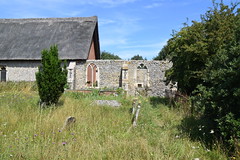
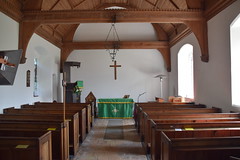
make the ruin safe, creating the fine thatched space we
see to day, with what is effectively a walled garden on
the site of the chancel.
Before the
chancel was demolished, All Saints had the surviving
panels of a splendid rood screen with twelve painted
figures. I had read much about it. Although much later
than the screen at Hempstead, it was of particular
interest because, as well as the twelve figures of
apostles, there were further figures which had been
superimposed on paper some time in the 16th century;
perhaps, unusually, during the 1550s reign of Mary I.
| The
screen is no longer in Lessingham church, and for
reasons that will become apparent there is some
dispute about the identities of the figures on
the panels. I had read the Norfolk Museums
Service record, but this did not completely agree
with an account that Chris Harrison had found by
WW Williamson in Norfolk Archaeology in
1950. Williamson had seen the screen in situ. The Norfolk
Museums Service record shows that the panels
depict, from north to south, I: St Thomas (St
Gregory superimposed), II: St Matthew
(superimposed figure removed), III: St Simon, IV:
St James, V: St Andrew, VI: St Peter (St Jerome
superimposed) VII: unidentified figure, VIII:
unidentified figure (St Augustine superimposed),
unidentified figure (St Ambrose superimposed), St
Philip, St Jude, St James the Less.
|
|
 |
Williamson's
account differs slightly. He saw, from north to south, I:
possibly St Roche - but panel hidden behind pulpit and
damaged, II: possibly St Matthew with halberd (damaged),
III: probably St Simon with fish (damaged), IV: St James
as pilgrim, V: St Andrew with cross saltire, VI: St
Jerome as Cardinal seated, VII:St Gregory defaced and
seated, VIII: St Augustine as Bishop and seated, IX: St
Ambrose as Bishop and seated, X: probably St Philip with
basket of loaves, XI: St Jude with boat and XII: St James
the Less with fuller's club.
There were
once doors, with two panels each. These depicted St
Apollonia, St Catherine, St Margaret, and St Mary of
Magdala. Williamson identified two of these, and one
other, as being loose panels in the vestry in 1950. Their
location since is unclear.
Green
moved the screen into its original position at the
entrance to the chancel, but after the destruction of the
chancel and the blocking off of the arch, it was moved to
an unsatisfactory position at the west end of the nave.
After a couple of years, it was decided to loan it to the
church furnishings museum at St Peter Hungate in Norwich,
where it would be a star attraction, and in 1968 the
screen headed off to the big city.
However,
when public spending cuts forced the closure of that
museum in the 1990s (it now lies empty, awaiting a new
use) the screen went into storage, in the depths of
Norwich castle. In 1995, it was moved to the
Architectural Service archive at Gressenhall. The two
sides were packed into enormous pine cases, and screwed
up tightly to prevent them rattling around.
One hot
summer day in 2006, I went with Chris Harrison to visit
the archive. It was like stepping into Aladdin's cave.
The kind archivist unscrewed the front of the two cases,
and revealed the wonders inside. It was the first time
that the cases had been opened, the first time the screen
had been seen for eleven years. I hope I don't sound
immodest if I say I felt a little like Howard Carter.
The screen
is intricate and flowery, full of the flavour of the
English Renaissance -or, at least, what it might have
been if puritanism hadn't intervened. This suggests that
the construction of the screen itself is quite late,
perhaps early in the 16th century. It has been heavily
restored, presumably by Green; the base is new, as are
some of the uprights. Holes where buttressing might have
been attached have been cut out and filled.
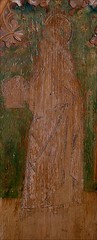
The
figures are painted in two, possibly three, distinct
styles. The original twelve are all by the same artist,
and depict the eleven disciples and one other, possibly
St Paul. Where a paper figure has been superimposed,
there is a white banner with a legend about two-thirds of
the way up the panel. This appears on panels I, II, VI,
VII, VIII and IX. Curiously, there is a break in the
background painting at the same point in panels XI and
XII - could they also have been superimposed? Or,
intriguingly, were they prepared, but the imposition
never carried out? Gessowork flowers are discernible on
at least one of the panels, St Thomas, and probably date
from the original decoration of the screen. They may have
been generally removed before superimposition.
My
photographs of the screen panels are below, my
identification of the figures in the captions and in full
below that.

On the north side of
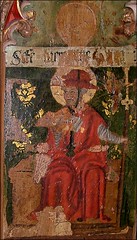
the screen, figure I is, I believe, St Roche superimposed
over St Thomas. The superimposed figure is seated, and
lifts his cape above his leg. A figure in white, possibly
an angel, points to the leg, while a little dog looks on.
Unfortunately, the leg itself is obliterated, but almost
certainly it shows plague sores. Now, there was a great
outbreak of plague in this part of Norfolk in 1555 - St
Roche also appears on the screen at nearby Stalham - so
this may well be evidence of a Marian restoration. St
Thomas behind holds a spear.
Figure II is St
Matthew. A superimposed figure has been removed. Figures
III, IV and V are St Simon, St James and St Andrew.
Superimposed figure VI
is clearly St Jerome, wearing his cardinal's robes.
Providentially, the superimposition is damaged in exactly
the right place to see that the figure behind is holding
a key, and is thus St Peter.
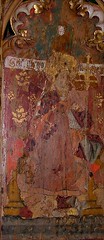
On the south side, the
first figure imposed is clearly St Gregory. He wears a
papal crown and carries a papal cross. The figure beneath
is unidentifiable, although I believe that what appears
to be a white shell on his head is actually a fragment of
the later superimposition. Most likely, it is St Paul to
match St Peter across the doorway.
Superimposed figure
VIII is St Augustine, and IX is St Ambrose (Ann Elenholm
Nichols' identification of this last as St Anselm is a
proofing error, I think). As with panel VII, it is not
possible to discern who the figures underneath are.
Figures X, XI and XII are St Philip and St James the
Less. The last two panels appear to have been at least
prepared for superimposition.
| So, Williamson was
correct, despite the pulpit. A
stunningly lovely screen, and not without a
frisson of excitement. It would be nice to think
that one day it could be put back on public
display, possibly even at Lessingham church. And
you can't help wondering what happened to the
door panels. Did they also go to St Peter
Hungate? Are they somewhere in storage, even now? Even
without its remarkable screen, All Saints remains
a pleasant, well-kept, much-loved and welcoming
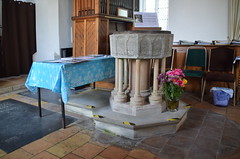
village church. There is now nothing remarkable;
the Purbeck marble font typical of this area, a
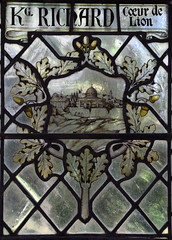
decent Jacobean pulpit and tester, an unusual war
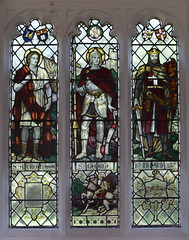
memorial window that includes, as one of the
Saints, Richard the Lionheart. For me, a more
moving war memorial is the original handwritten
roll of honour, still surviving here after almost
a century.
|
|
.JPG) |
Simon Knott, April 2005, revised and
updated July 2006
|
|