home I index I latest I glossary I introductions I e-mail I about this site
St Peter, Kimberley


Follow these journeys as they happen at Last Of England Twitter.
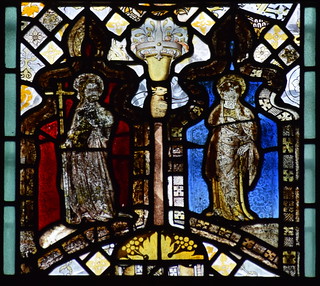
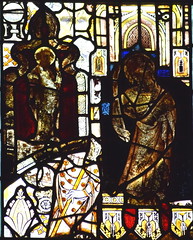
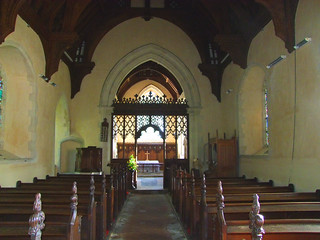
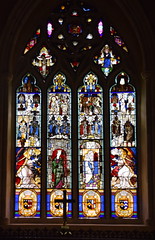
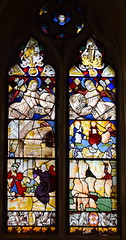
St Peter, Kimberley This church has a prominent and attractive setting, shadowed under big trees on the edge of the village green. Fields roll away beyond the graveyard, rooks arcing and wheeling above the greening furrows on the day I first came here, in one of the first winters of the century. Coming back several times since, most recently on on a balmy summer day in July 2021, I remembered it fondly, for this is a most welcoming church, open every day and well-known in this part of Norfolk for its plant stall. It was my first visit to Kimberley for six years, and I was looking forward to seeing something that hadn't been here on the previous occasion. St Peter is a landmark on one of the main roads betwen Norwich and the west of the county, and over the years I have become used to seeing it in early morning and late afternoon lights, heading out of the city or back home at the end of the day. The tower is late, rebuilt right on the eve of the Reformation, giving it that big Tudor west window. Simon Cotton points to a bequest of 1536 referring to the new tower, and several large bequests followed even after, for the top part is from a century later. Along with the park lodge to the south of the church it tells us something else about St Peter. This is an estate church, and the family at the Big House took its patronage of the building and parish seriously. They were the Wodehouses, and in 1631 they repaired the tower and topped it out with the fashionable geometric pinnacles of the day, and a central spire reminiscent of a contemporary font cover. An inscription giving the date of the rebuilding is picked out in red-brick letters on all four sides of the tower. The eastern end of the churchyard drops away steeply, a hazard to those like me who tend to walk backwards away from a church when viewing it. Externally, the chancel is largely late 19th Century in appearance, but this is very much a church of interest, and this is in no small way due to the Wodehouses. Despite their spirited 17th Century adornments, to enter the building is to be reminded that the Wodehouses' church is a small and unassuming one. The nave can be a bit gloomy, for the windows are not large and they are generously filled with glass of the 19th and 20th Centuries by Clayton & Bell and Paul Quail. The Clayton & Bell glass consists of the Risen Christ flanked by three unusual saints, at least for Norfolk. That to the left is labelled St Frances, although it is likely to be a design used to depict the allegorical figure of Charity. St Frances was a fairly obscure late medieval saint whose charitable activities during an early 15th Century famine in Rome were supported by a miraculous storehouse that never emptied. She was canonised in 1608. On the other side are the Irish pairing of St Bridget and St Patrick. The window remembers Frances 'Fanny' Wodehouse, who was the daughter of Alexander Holmes of the Curragh, Kildare, Ireland. Paul Quail isn't an artist I always warm to, his jaunty cartoonish scenes often seeming out of place in the gravitas of a church. But the glass here is some of his better and more interesting work, depicting scenes in the life of St Francis. But the best glass, and what makes Kimberley well-known, is in the chancel. The east window and south side window are patchworks of English and continental glass from the 14th to the 17th Centuries, full of excitement and quite a contrast with the otherwise austere sanctuary. On the occasion of a visit in 2014 I found that it had all been removed for restoration at a cost that eventually grew to a six figure sum. A churchwarden I spoke to at the time told me that 'it would be better to let the Germans have it back!' although both of us agreed that this didn't seem very likely to happen. In fact, the majority of the glass is English in origin, though probably not much of it came from this church originally, if any at all. As was fashionable, a number of seriously rich 18th Century antiquarian-minded squires travelled on the Grand Tour to Europe, buying up old glass from monasteries closed by wars and the French Revolution. Once at home they could install it in their Houses, and then perhaps later bequeath it to their parish churches. However, it is unlikely that the Wodehouses did this, because for the many who did not go on the Grand Tour there was the possibility of buying old glass from a number of English importers. We know that the Wodehouses also gave the large range of continental glass in the east window at nearby Hingham, and, as is often the case in Norfolk, they did not have to leave the country to do this. Almost certainly, the glass in both churches came from a Norwich dealer called JC Hampp, who dealt widely in that kind of thing, as well as English medieval glass purchased from churches that had fallen on hard times, or were being restored without thought to their past. The Kimberley glass was installed in the 1820s by Samuel Yarrington, a stained glass painter who made a living installing antiquarian glass for display. It may be that the English glass here also came from Hampp - or, just perhaps, it was Kimberley's own.
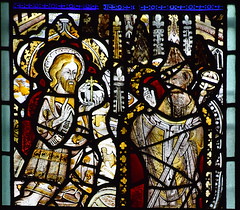
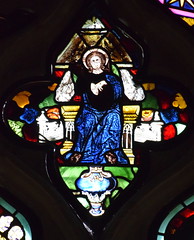
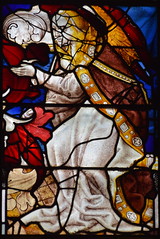
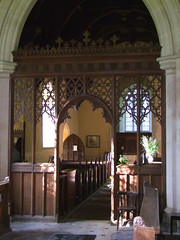
It is an interesting collection because it contains figures that were more commonly placed in upper lights. The English figures, all of the 14th and 15th Centuries I think, are saints, including St Bartholomew, St John the Baptist, St Margaret, St Catherine, and two figures of St James the Less. The continental glass is slightly later, and includes a vivid scene of the dead rising from their graves on the Last Day, to face the judgement of Christ seated in majesty and flanked by the Blessed Virgin and St Peter above them. Another fragmentary panel appears to show Christ driving the money-changers out of the Temple, one of whom is escaping with a sheep on his back. The latest glass is probably 17th Century border glass and depicts two putti leaning on skulls, one blowing bubbles and the other about to blow out a lighted candle, both symbols of the transitory nature of life. The 1870s restoration
at Kimberley was extensive, and included the complete
rebuilding of the chancel arch. Medieval features were
removed, or at least neutered by being crisply recut, and
the font was replaced. However, the former entrance to
the rood loft stairs is set in the east wall of the nave
to the north of the chancel arch, and although it has
been truncated at the bottom and turned into a large
niche, it still retains the fleurons around its flattened
Tudor arch. It may be contemporary with the rebuilding of
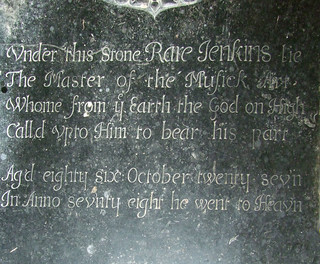
the tower. Under this stone
Rare Jenkins lie At the west end of the church is the only one of Norfolk's sets of James I royal arms to carry his motto Beati Pacifici - 'Blessed are the Peacemakers'. The Scottish monarch chose this legend in 1603, at the time when he was attempt to unite his old and new kingdoms. How intriguing to think that it must have been placed here by optimistic churchwardens on the death of Elizabeth, perhaps hoping for better times to come. How little they knew what the coming century would bring. Perhaps the more commonly found Stuart motto of Exurgat Deus, et dissipentur inimici ('Rise up God and scatter my enemies') would have been more appropriate. Simon Knott, July 2021 Follow these journeys as they happen at Last Of England Twitter. |




|
|||||||||||||||||||||||||||||||||||||||||||||||||||||||
home I index I latest I introductions I e-mail I about
this site I glossary
Norwich I ruined churches I desktop backgrounds I round tower churches
links I small
print I www.simonknott.co.uk I www.suffolkchurches.co.uk