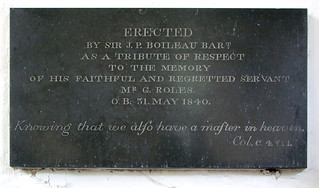
| |
|
St Peter,
Ketteringham Ketteringham is
just south of the main A11 road, but clever planning
policies make it seem remote. More remote than it felt
before the road was built, probably. The village
straggles along a mile or so of street, and the church is
about half a mile to the south. My OS map showed a road
leading up to it, but when we looked for this road it
turned out to be the private drive of Ketteringham Hall,
and was locked off. Instead, we had to go out into the
country on the road to East Carleton and then come back
northwards towards the church, which sits immediately
beside another entrance to the Hall grounds. You can see
at once that this was a park church, with the main
churchyard entrance pointing towards gates from the
grounds, the public lychgate in the corner added almost
as an afterthought.
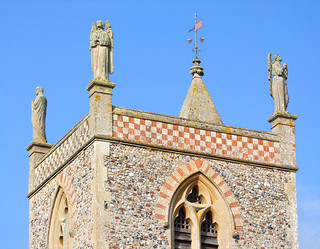
Another sign that this was a park church is that it was
patently given a good going over in the late 18th
century. The antiquarian-minded squirearchy of the times
didn't know much about medieval architecture, but they
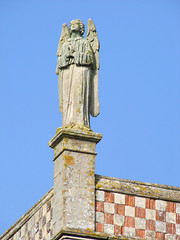
knew what they liked. Hence, the fortress-like pinnacle
to the tower stairway, and the guardian angels at the
other three corners. The residents of the Hall at the
time were the Atkyns, and their successors were the
Boileaus, whose famous mausoleum is to the east of the
church. This was built under traumatic circumstances, one
of the central incidents in Owen Chadwick's masterly book
Victorian Miniature.
The mausoleum, a blockish thing in a kind of Egyptian
Doric style, was covered in tarpaulin when I first
visited in 2005, and I later discovered that it was on
Norfolk's 'Buildings at risk' register. The Boileaus no
longer live at Ketteringham (they left in 1947, as a
consequence of two hefty lots of death duty) and the
family apparently no longer feel a commitment to maintain
it. There was a request by them in 1991 for it to be
demolished, but the mausoleum is now a listed building,
and this did not happen. In the end, it was taken on by
the Mausoleum and Monuments Trust and restored to a good
state.
For many years after the Boileaus left, the Hall was a
school. Today it is the headquarters of Lotus Cars, but
previous residents have left their mark upon St Peter, as
we shall see. Just as the exterior tells you about the
idiosyncrasies of the residents of the Hall, so the
interior reveals their tastes. There have been four main
families that have left their impression here - the
Grays, the Heveninghams, the Atkyns and the Boileaus.
The atmosphere of the interior, at once rustic and grand,
tells you that the Boileaus had more say here in the 19th
century than the ecclesiologists of Oxford and Cambridge
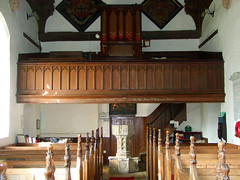
ever did. Sir John Boileau, the hot-tempered,
paternalistic Squire, was responsible for the elegant
west gallery. He spent thirty years in dispute with the
vain, egotistical, Calvinist rector William Andrew and
his appalling wife Ellen, a long series of events
recounted in detail by Chadwick's book.
The key lets you in through the vestry, and you step into
a chancel which is quite overwhelming in the quantity of
its memorials. There are over 500 years worth of them
from all four families, and the best thing is that they
are almost all both interesting and quirky. Few of them
are merely pompous or run of the mill.
  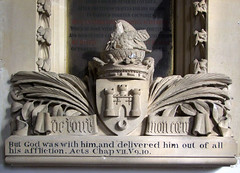
  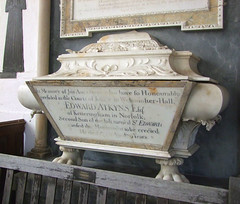
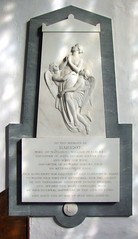 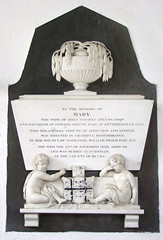 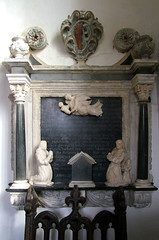 
There are, broadly speaking, four
groups. On the south side of the chancel is a large table
tomb which might once have formed an Easter sepulchre.
Set in its recess are two late 15th century brasses to
Sir Henry and Lady Gray. An older brass to Jane Gray is
set on the wall to the west of it. Moving west, the
massive tomb by Robert Page is for Edward Atkyns, who
died in 1750. It looks like nothing so much as a bath tub
with lion's feet.
Directly opposite is the family pew of the Atkyns, later
that of the Boileaus - memorials of both families tower
above it, most prominently the weeping woman and urn on
the Richard Westmacott memorial to father and son Edward
and Wright Atkyns. The array of weapons stacked beside
the urn recall that the son died in battle.
This is echoed in one of the later brass inscriptions set
below to Charles Augustus Penryn Boileau, youngest son of
Sir John Boileau. Something of a rake, he went to the
Crimean War as a way of escaping his debts, and died in
Malta on his way home as a result of injuries suffered at
the 1855 siege of Sebastapol. A tangle of musket, sword,
bugle is starkly carved from stone beneath.
A memorial of similar size to John, Charles' eldest
brother, matches it. He was more successful in public
life than his brother, for he was a parliamentary private
secretary to Lord John Russell. Russell's retirement
coincided with the end of the Crimean War, and John
rushed out to see it end, but caught a fever in
Austro-Hungary. He came home, but was sent to the south
of France to recuperate. He got as far as Dieppe, and
died there in 1861.
Between the two brasses is a central, larger one to their
parents. Sir John Boileau, his movements, talents and
emotions known to us today from Chadwick's book, was a
bull-headed yet sympathetic character who might have
stepped out of the pages of Trollope. He lies here now
with his wife Catherine. Catherine should have been
remembered by a memorial window depicting the saint that
shares her name, but rector William Andrew fanned such an
uproar in the parish about having an image of a Saint in
the church that Sir John eventually relented. The rector,
who was not unkind, reported to Sir John that his
greatest fear was that the simple people of the parish
might think it was the Virgin Mary.
Perhaps the most curious memorial is the most westerly
one of this group. It is a 1910 memorial to Charlotte
Atkyns who died in Paris in 1836, and is buried in an
unmarked grave. Born a Walpole, she found herself caught
up in the French Revolution. her inscription
recalls that she was the friend of Marie Antoinette, and
made several brave attempts to rescue her from prison.
After that Queen's death she strove to rescue the Dauphin
of France. She bankrupted the family fortunes in her
quest, mortgaging the Ketteringham estate and claiming to
have spent an extraordinary eighty thousand pounds, about
fifteen million in today's money.
Owen Chadwick recalls that, on her death, she requested
that her body be returned to Ketteringham and a marble
slab be placed on the chancel walls. Her relatives of the
time, left destitute by her enthusiasms, not unreasonably
failed to carry out either request. You might think that
Charlotte's Francophile adventures and the French name of
the Boileaus might indicate a family connection, but in
fact the Boileaus were an old Huguenot family who came to
Norfolk by way of Dublin, and already owned Tacolneston
Hall. They bought the bankrupt Ketteringham estate after
Charlotte's death.
Perhaps the best of all the memorials is in the
north-east corner of the chancel. It is to Sir William
Heveningham and his wife Mary. It is curious, for the
figures and prayer desk at the bottom and the ascending
angel above appear to obscure the inscription, but there
may be a reason for this. Sir William was one of those
who sat in judgement on Charles I, and although he did
not actually sign the death warrant, he was deprived of
his inheritance, and for many years his name was under a
cloud.
So this church is obviously worth the visit for the
memorials alone, but there is rather more to it than
that, for here is has one of the best collections of
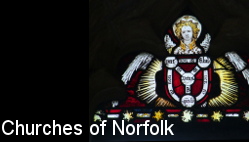
medieval and Flemish glass in central Norfolk. One of the
most interesting aspects of the collection, given that
the Hall was in the hands of four powerful families over
the centuries, is that it includes a 15th century Grey
arms, and so we may perhaps assume that the families that
collected the later continental glass were adding it to
English medieval glass that was already in situ. The most
important glass is an English medieval Coronation of the
Queen of Heaven, a relatively rare pair of panels. Also
English are numerous angels, a Saint Cecilia playing her
psaltery, and a Bishop. St Christopher carries the Christ
child while a hermit looks on. Continental roundels
include St Barbara, St John the Baptist, St James, the
Blessed Virgin prsenting the infant Christ to the young
St John the Baptist. A couple of the roundels appear to
be rebuses.
  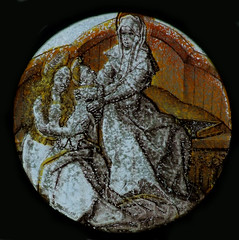
 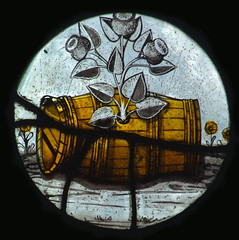 
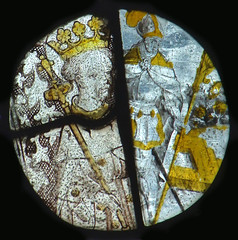  
   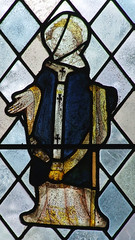 
One of the striking things about
the glass is that this is obviously a collection set for
display. I assume that this was the work of the late 18th
century Atkyns family. Mary Parker tells me that the
entire window was reset in 1908 by the King workshop of
Norwich, and that some of it is now in reverse order to
that given in an account of 1851. Some of the panels are
in poor condition, and I fear that this may be because
they were originally set back-to-front, that is to say
with the painting outside, exposed to the elements. The
King restoration corrected this, but not before the
damage had been done.
At the other end of the church below the gallery, the
late 15th Century font is curious. Four of the panels
feature evangelistic symbols, and two others roses, but
the final two panels are the only two that appear to have
suffered deliberate damage. One is clearly a crucifixion
scene, something like that which you find often on fonts
in the seven sacraments series. The eighth panel is
harder to decode. It shows a figure holding a staff,
perhaps the Resurrection.
The renewed roof, with its restored angels, is set on
interesting corbels, and there is a good view of them
from up in the gallery. This is a small, narrow church,
and the intimacy of the views from aloft is striking. In
such a small building it even gives a good vantage point
for photographing the east window if you have a decent
zoom. Sir John Boileau built the gallery as a way of
providing seating for the Sunday School, an interference
that the Rector deeply resented. There was no way that
Sir John's liberal paternalism and the Rector's
fundamentalist intransigence were ever likely to
accommodate each other. The firm security of tenure
enjoyed by both, and the further sources of friction that
arose between them, not least the interference of the
Rector's wife, made the situation explosive.
All around are hatchments of Atkyns and Boileaus. There
is no doubt that they had their say, but strangely enough
there is no sense of triumphalism. Rather, they mark a
church which was a real backwater, both geographically
and in terms of English church furnishing and decoration.
But if this was a backwater, it was a moneyed one. There
is a quality to the way everything was carried out here,
and this remains today. As a good example, take the late
16th century painting on boards of the Wedding at Canaa
in use as a reredos. My goodness, what a thing to find in
an English country church! At the time it was painted, we
were all enthusiastic protestants, stripping our churches
and our lives of things of beauty. But here it is, an
extraordinary Flemish survival, probably collected in the
early 19th century.
What must it have been like to attend divine service here
in the 19th century? I assume that the entire parish,
pretty much, worked for the Hall. Whose side were they on
in the long-running dispute between Squire and Rector?
The Rector had the advantage of a three-decker pulpit.
The reading light now faces north-west, but at one time
he would have faced north-east, to address the Hall pew.
This must have given him something of an advantage on a
Sunday. But today it is the Hall families we remember,
the Grays, the Heveninghams, the Atkyns and especially
the Boileaus. So, spare a glance and a thought before
leaving for the cold stone memorial on the south nave
wall for William Wayte Andrew, Rector through the middle
years of the 19th century. In his evangelical Calvinist
zeal he faced up to the Boileaus, but it must be with
pursed lips that he is a silent witness to them now.
Simon Knott, April 2020
Owen Chadwick's Victorian Miniature is available from amazon.co.uk
Follow these journeys as they happen at Last Of England
Twitter.
|
|
|