| |
|
St Mary,
Kenninghall Kenninghall, the village, is surrounded by
other villages which are far better known, although not
necessarily for their churches. Banham has its zoo,
Bressingham its gardens and Quidenham has its convent and
the Norfolk children's hospice. So it comes as a surprise
to discover that Kenninghall is a large, comfortable,
self-sufficient kind of place, and its great church is
grander, and perhaps more interesting, than those of its
neighbours.
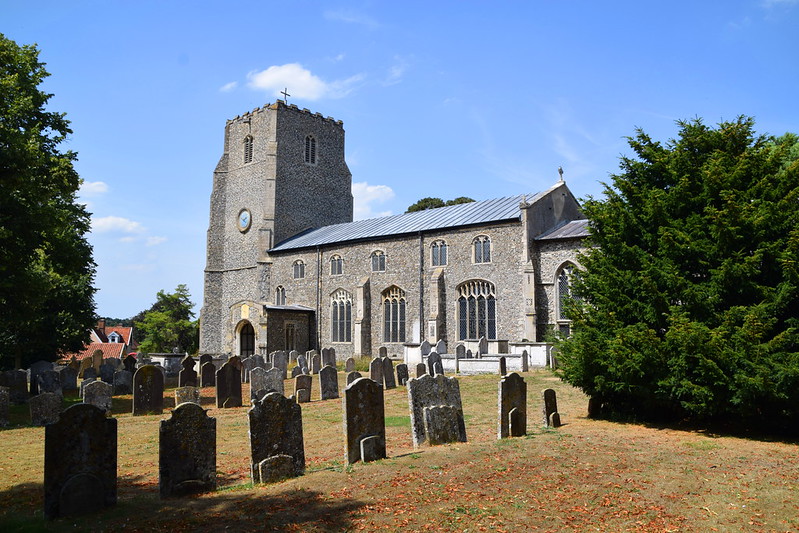
St Mary stands in an imposing position above the road,
the south side particularly striking with its big
Perpendicular windows and a clerestory of five small
double light windows. There never was an aisle on this
side. The tower is big and bulky. Mortlock says that a
spire was intended, and the money for it committed, by
the Duke of Norfolk, whose shield can still be seen on
the south-east buttress of the nave. But Norfolk was
imprisoned for treason before it could be built, his
assets frozen, and then, of course, the English
Reformation intervened.
St Mary is exactly the kind of church which would be
better known if it was in another county and not so much
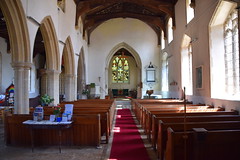
off the beaten track. You step into a large, urban
church, full of confidence, and with more than a few
survivals of the building's late-medieval and
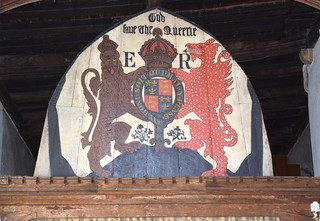
early-modern life. Best of all is the tympanum bearing
the royal arms of Queen Elizabeth, one of only four sets
in all East Anglia. It has been fixed at the east end of
the north aisle, but you can still see that it was shaped
to fit the chancel arch. God save the Queene,
reads the legend, a crowned lion and a gorgeous speckled
red dragon flanking the Tudor arms. This is a much
simpler affair than the more famous, and more elaborate,
Elizabethan arms a few miles off at Tivetshall. Here, the
arms are cleanly drawn and charged with the quiet triumph
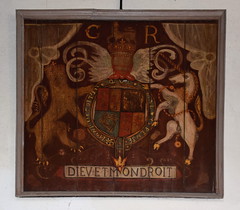
of Protestantism. As if that wasn't enough, the church
also has the arms of Charles I hanging above the north
door.
On the
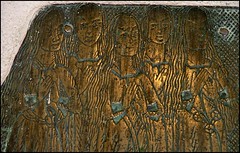
other side of the church there are fragments of a large
brass. The main figures are gone, but surviving are the
two groups of children. These have been reset on a wall,
so if there is a fire they will melt - floor-mounted
brasses don't melt in fires - but at least it makes them
easy to look at. With them are a pair of image brackets
remounted from elsewhere, one of them ornate with
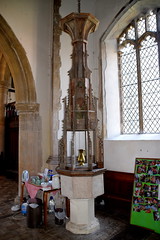
fleurons. Roughly contemporary with the brasses is what
must have been a magnificent towering font cover. It
rises like a steeple, familiar in style from elsewhere in
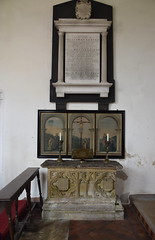
Norfolk at Elsing and Walpole St Peter. Similarly
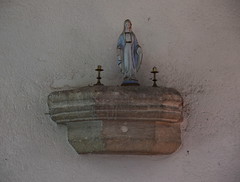
battered are the remains of a medieval table tomb with
empty brass inlays, pressed into service as a side altar
in the chancel.
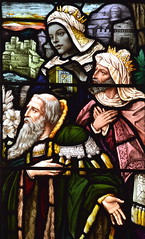
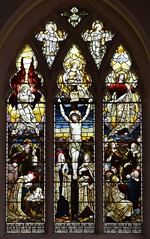
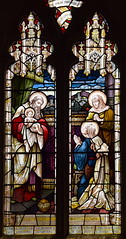
The glass is pretty much all of the 20th Century,
although you might be forgiven for thinking otherwise
because the east windows and chancel south windows by
Heaton, Butler & Bayne are all still very much 19th
Century in style, based on workshop cartoons used up to
half a century earlier. In fact, the earliest window here
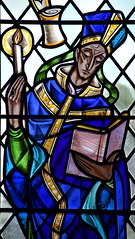
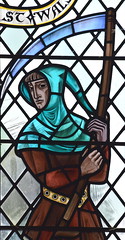
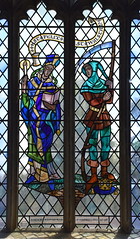
is from 1900. The best of them is the 1960s one on the
south side of the nave depicting the figures of the East
Anglian Saints Felix and Walstan. Lively and animated, St
Walstan swings his scythe and the evangelical St Felix
holds a lighted candle and an open book. They are by Paul
Jefferies for King & Son of Norwich.
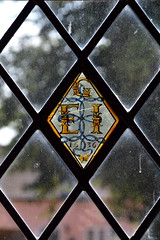
The only earlier glass survival is a delightful single
quarry depicting a marriage knot of 1636. Its jauntiness
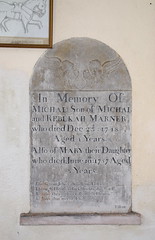
is countered by the sobriety of the small, simple
memorial reset against the tower arch to two young
children, Michael and Mary Marner, who died seven years
apart in the middle of the 18th century. A verse explains
that The Great Jehovah full of Love through Death's
dark shades did send to take these pretty spotless Doves
to Joys that never End, which must have been small
comfort, even in those days.
|
|
|