home I index I latest I glossary I introductions I e-mail I about this site
St Lawrence, Hunworth

Follow these journeys as they happen at Last Of England Twitter.
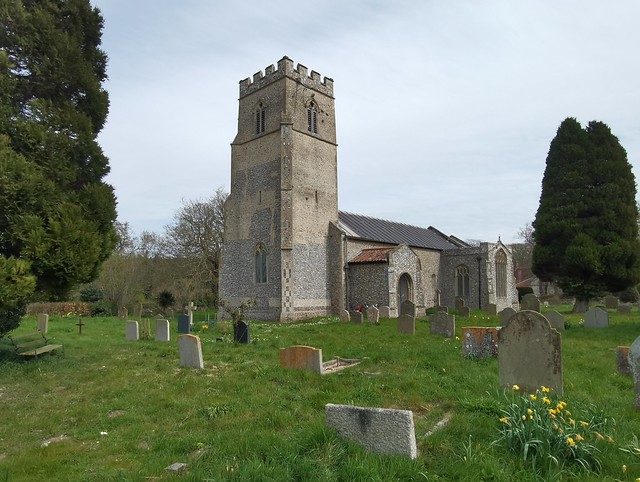
St Lawrence, Hunworth Hunworth is one of the larger villages in the lovely rolling landscape between Holt and Fakenham, but its parish church sits outside of the village centre on the road to Stody, and feels more remote than it actually is. I'd not been here for years, but coming back on a beautifully sunny April day in 2022, insects careering dozily and a flurry of finches tumbling from one treetop to the next in the small churchyard, I remembered it, for it had been like that before. As often in rural north Norfolk, a church of the 12th Century was upgraded in the early 14th Century and then given its big windows in the 15th Century. The chancel was completely rebuilt in the 1850s, the triple lancet east window in the style of about 1300. A curiosity is the late medieval transept that sticks out on the south side. Simon Cotton tells me that a bequest of 1506 survives in which one John Colyns declares that I woll that myn executors pvey a table of Alabastr of the story of our lady and sent Anne her moder, and goes on to say that some of the money must be used to shete new the lede on that Chapell of our lady and sent Anne, in the seyd church of Honeworth. This seems to refer to the new transept, and that it was a chapel dedicated to Our Lady and St Anne. You step into a building which, though restored, feels entirely rural. There is no coloured glass and the overwhelming impression is of the woodwork in the furnishings and roof. We might almost be in a small barn. Everything lies under a plain light, a cool simplicity that matches the silence and the birdsong. This is essentially still the church as restored by the Victorians, its tiled floors and polished benches beneath the ancient walls coming togther to form a pleasing, quiet harmony. The only notes of colour are the fresh green riddel curtains behind the altar, and a little statue of the church's patron saint set in what must be a small medieval image niche beside a window splay on the north side. In this stillness, the eagle of the lectern looks as if he might be landing dramatically. Beside him, the transept seems curiously narrow with its benches crammed in, but of course if it was built as the chapel of Our Lady and St Anne it would not have originally been ordered for congregational worship. A large ledger stone of 1770 set at the east end of the nave remembers Edmund Britiffe, who was late Pay-master of his Majesty's Exchequer Bills. Charmingly, it also remembers his little sister Henrietta, who died a few years after him. A peaceful place to see out eternity, I thought. Simon Knott, May 2022 Follow these journeys as they happen at Last Of England Twitter.
|
|
|||||||||||||||||||||||||||||||||||||||||||||||||||||||
home I index I latest I introductions I e-mail I about
this site I glossary
Norwich I ruined churches I desktop backgrounds I round tower churches
links I small
print I www.simonknott.co.uk I www.suffolkchurches.co.uk