home I index I latest I glossary I introductions I e-mail I about this site
St Mary, Howe


Follow these journeys as they happen at Last Of England Twitter.
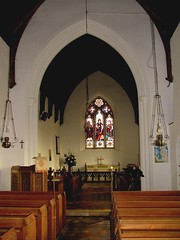
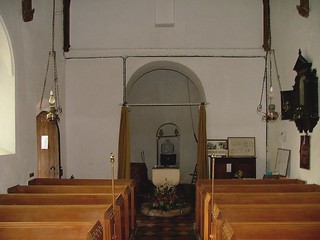
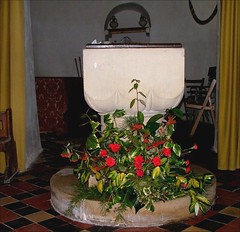
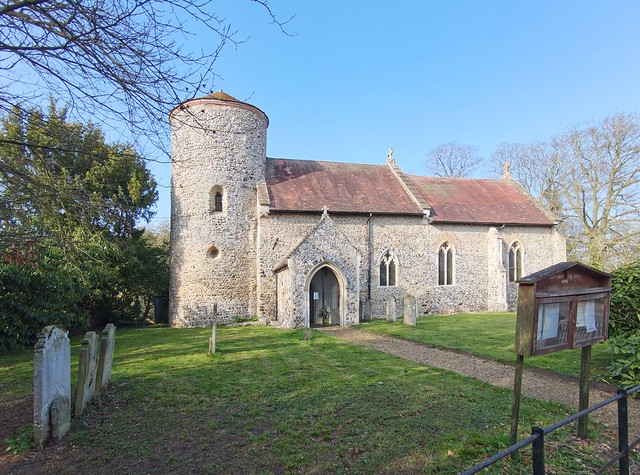
St Mary, Howe This is a charming little round-towered church in a delightful setting, and it grieves me that it is part of the unwelcoming Poringland group of parishes who keep their three churches locked without keyholder notices. The heavy lock on the porch doors at Howe sends a strong, uncompromising message to passing pilgrims and strangers, as it did to me when I revisited in the spring of 2022. The church sits among a group of old houses at a meeting of narrow lanes through an intensely agricultural landscape. The fields start to roll and fold as Norfolk spreads westwards away from the marshes and the rivers. An old postbox set in the wall of the graveyard completes the scene. The round tower is unmistakeably 11th Century, with its round windows and coursing with darker stone. There is a little conical cap, a bit like the one across the county at Little Snoring. The windows of the nave and chancel are mostly in the Decorated style, suggesting a 14th Century rebuilding, but at least one seems to be set in the ghost of a once larger window, perhaps Perpendicular, so presumably 19th Century replacement. Even then, there is little to disguise that this was once a typical, homely Norman church, on the site of one which was even older. The only time I've seen inside Howe church was back in 2006 when I came this way with the late Peter Stephens, and we found someone cleaning the church. The photographs at the bottom of this page are all from that occasion I'm afraid. Perhaps the most memorable sight as you enter is the early Norman tower arch and, within the tower, the outline of a similarly arched west doorway. They are a counterpoint to what is a typical late 19th Century restoration in common with many of the little churches in this area. Sometimes this is charming, but my memory of Howe on the one occasion I've seen inside was of a slightly weary anonymity, as though a lack of communal life had sucked the vitality out of it. St Mary has one of the most
elaborate First World War memorials in Norfolk. It
dominates the west end of the nave. I wondered if it had
been bought from a French workshop, because this kind of
overtly lush sentimentalism was relatively rare in
England. It is in dark wood with enamelled panels in the
Gothic style like a Flemish altarpiece. The memorial
opens as a triptych, a grieving woman resting her head
against a shield at the centre which reads To the
Memory of the Brave Sons of the Empire who Fell on the
Battlefields of Europe. "They Have Fought the Good
Fight", Dying in the Cause of Humanity that Honour
might Live. Interestingly, the circumstances of the
death of all six named on the monument is included as
well as the dates and their ages. An enamelled medallion
below updates the list with those local lads killed in
the following war. Simon Knott, December 2022 Follow these journeys as they happen at Last Of England Twitter.
|
|
|||||||||||||||||||||||||||||||||||||||||||||||||||||||
home I index I latest I introductions I e-mail I about
this site I glossary
Norwich I ruined churches I desktop backgrounds I round tower churches
links I small
print I www.simonknott.co.uk I www.suffolkchurches.co.uk