home I index I latest I glossary I introductions I e-mail I about this site
Church of the Reconciliation, Houghton St Giles
(Catholic National Shrine of Our Lady, Walsingham)

Follow these journeys as they happen at Last Of England Twitter.
| Church of
the Reconciliation, Houghton St Giles (Catholic National Shrine of Our Lady, Walsingham) In 1982, Pope John Paul II visited Britain.
It was the first Papal visit since before the
Reformation, and it was hoped that the Holy Father might
visit Walsingham, but such a visit would have been a
logistical nightmare for the Shrine authorities and the
Norfolk Police. Instead, the statue of Our Lady of
Walsingham was taken to London, to Wembley Stadium. The
Holy Father insisted that it remain on the altar during
Mass. If Pope John Paul had come to Walsingham,
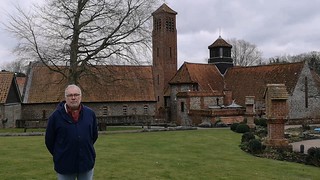
he would have found something extraordinary. Here, in
these remote Norfolk fields, work had just been completed
on one of the largest 20th Century churches in East
Anglia, the Chapel of the Reconciliation. It was built in
a Norfolk vernacular style to accommodate the thousands
of pilgrims who make their way here each weekend in
Summer. Even then, it is not always big enough, and on
really crowded occasions the wall behind the sanctuary
can be removed to create a church in the round, half of
it out of doors. Simon Knott, February 2023 Follow these journeys as they happen at Last Of England Twitter.
|
|
|||||||||||||||||||||||||||||||||||||||||||||||||||||||
home I index I latest I introductions I e-mail I about this site I glossary
links I small
print I www.simonknott.co.uk I www.suffolkchurches.co.uk
ruined churches I desktop backgrounds I round tower churches