| |
|
St Mary,
Houghton-on-the-Hill
 |
|
I
first visited this church about ten years ago, in
the company of a group of church enthusiasts. I
hadn't even thought then of embarking on the task
of visiting every Norfolk church, let alone of
creating this site to document that journey. Perhaps this was where the first
germ of the idea came to me. At the time, St Mary
was just about the the most famous church in
Norfolk, appearing in the national press and on
television. Since then, it has settled into a
somewhat quieter retirement, but it is still
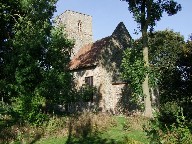
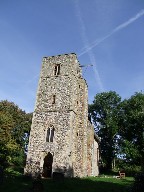
difficult to be alone here. When Arthur Mee came this way in the
late 1930s, St Mary was a small, almost derelict
church on a bald hill above the road between
South and North Pickenham. It had suffered damage
in the First World War when a returning Zeppelin
dumped its bombs into the churchyard. Mee found
the chancel ruinous, and the top of the tower
open to the sky. There was a cottage beside it,
and a farmhouse across a field. The last baptism
had been in 1933, the last wedding eight years
earlier.
|
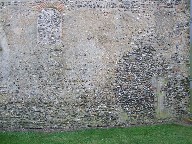
Within ten years, the cottage and
farmhouse had both gone, as the whole of England came
under intense cultivation, and St Mary found itself a
parish with no inhabitants at all. With no proper road
leading to the hamlet, and in an area severely curtailed
by the presence of American Air Forces, it was abandoned.
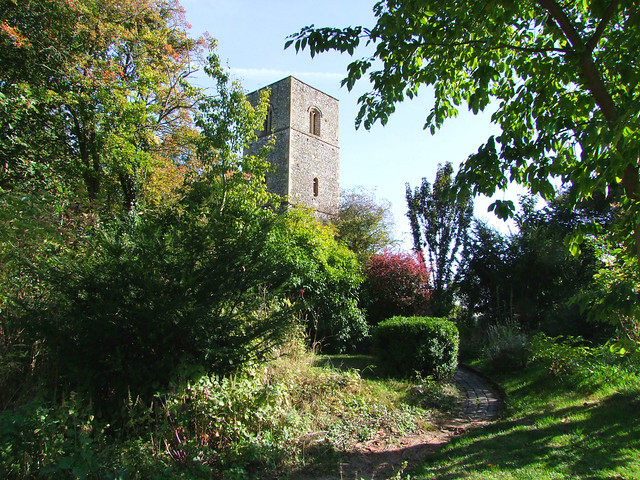
After the war, thickets of trees and brambles reclaimed
the hillside, and this was just another lost Norfolk
church, one of several.
The story goes that in the hot summer of 1992, members of
North Pickenham WI were on a ramble in these hills when
they stopped for a rest on the edge of the former
churchyard of St Mary's. One of the number, a woman
called Gloria Davey, was intrigued by headstones among
the thickets, and cleared a path through the churchyard
towards the church. There, she found St Mary a ruin, all
the roofs now gone, and the entire shell encased in ivy.
She climbed in, and was horrified to discover what she
called 'signs of Satanic worship'. When she got home, she
told her husband, North Pickenham churchwarden Bob Davey.
The next day, he went and took a look, and decided to
organise a series of watches to deter night time
visitors. More significantly, he contacted Norfolk County
Council and ensured that St Mary was added to the
'Buildings at Risk' register, an important step to
setting in motion a process of repair, and attracting
funding. The county, we may assume, were relieved to find
a local with so much interest and energy, and were happy
to agree.
Over the next ten years, Bob Davey spent every waking
moment bringing St Mary back from the dead. He cleared
the churchyard, made the floors safe and cleared all the
rubble from the site. Norfolk Archeological Service
became interested, and when an architect came to look he
felt it would be possible to rebuild a roof on the old
timbers rather than building an entirely new one. By now,
Bob had already organised open-air services in the empty
shell, but the addition of a roof meant it was worth
doing something about the walls.
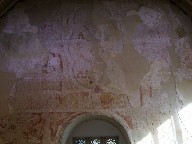
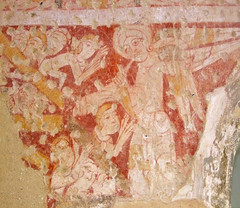
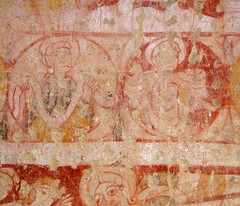
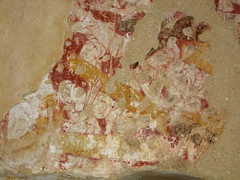
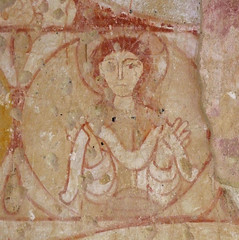
This was when something extraordinary happened. Under the
crumbly Victorian plaster were found painted texts from
Elizabethan times - and under those, a vast array of wall
paintings from the 12th, 13th and 14th Centuries. And
under them, amazing things, for here, on this
quiet little hilltop, is one of the best sequences of
late Saxon wall-paintings in western Europe. Immediately,
the big guns came in - the Courtauld Institute, English
Heritage, other national heritage and archaeological
organisations, and, most important of all, funding
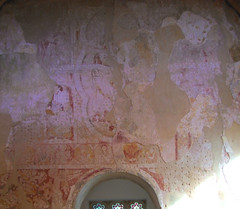
bodies. The most significant painting is that over the
chancel arch, which depicts the Trinity as part of a last
judgement. It is believed to be the earliest
representation of the Trinity in this form. Incredibly,
pigments used include cinnabar, perhaps the most
expensive of all at the time. How on earth did it end up
being used here? All around are arrays of apostles and
angels, a glorious Holy Mother of God, and the saints of
heaven in all their glory. For a moment, modern nations
fall away, and we are anywhere in Europe or north Africa
at the dawn of the second millennium.
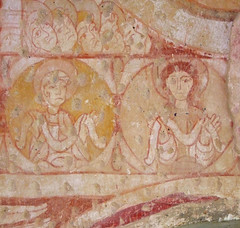 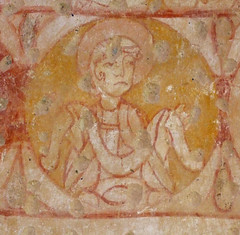
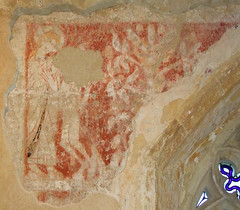 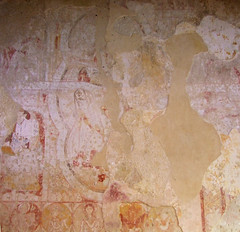 
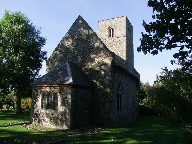
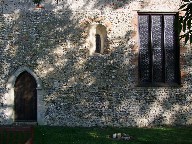
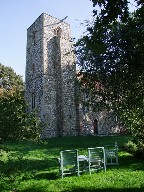
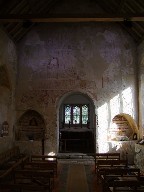
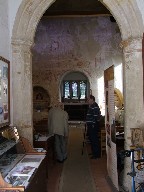
The church is, inevitably, now very
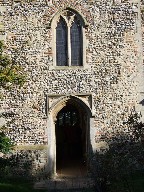
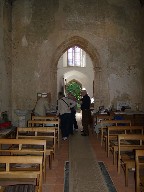
crisp and restored in appearance. You enter from the
west, beneath the tower. You step through the tower arch
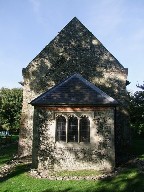
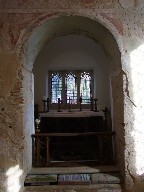
into the enchanting interior. Through the chancel arch, a
tiny truncated apse just has room for its altar. Work
still continues apace, both on interpreting and
preserving the wall paintings, and on gradually replacing
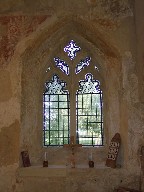
the windows, which were repaired urgently and temporarily
early on. Bob Davey traced the former font to a garden in
a nearby village, and brought it back. It isn't
particulary fine, but it is, at last, home. One of the
two bells (the other is now at Swaffham) was also
returned.
| During the early part of
the restoration there was another attack of
vandalism when the ledger stone in the centre of
the nave was broken open. This was repaired with
cement, but perhaps needs to be left cracked and
broken as a reminder to us all of how vulnerable
these places can become if we neglect them. St Mary is now probably the most
looked-after church in Norfolk. Visitors come
from all over the world, and it is used regularly
for services by all denominations from
traditionalist Catholic to Pentecostal, but for
years it remained Bob Davey's baby. When I first
met him soon after the start of the Millennium,
he was regularly appearing on television
programmes and being interviewed by newspapers
and magazines. The Prince of Wales, who takes a
great interest in medieval churches, came and
took a look. Not long after, Bob Davey was
awarded the MBE.
"I have a feeling this
was meant to be", he told me in 2003,
"St Mary's is now my life". He
collected a huge fund of stories about the church
and the former village, past and present, some
more likelier than others. For the rest of
his life he still spent part of most days up
here, showing visitors around with as much
enthusiasm and interest as he had done the Prince
of Wales. Bob died in 2021 at the age of 91, but
the energy of his devotion lives on, and the
church is still open from 2pm to 4pm each day,
weekends only in winter.
|
|
 |
|
|
|