home I index I latest I glossary I introductions I e-mail I about this site
St Mary and St Andrew, Horsham St Faith
Follow these journeys as they happen at Last Of England Twitter.
| St Mary
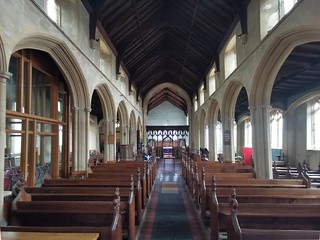
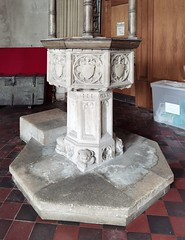
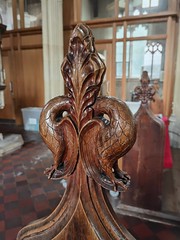
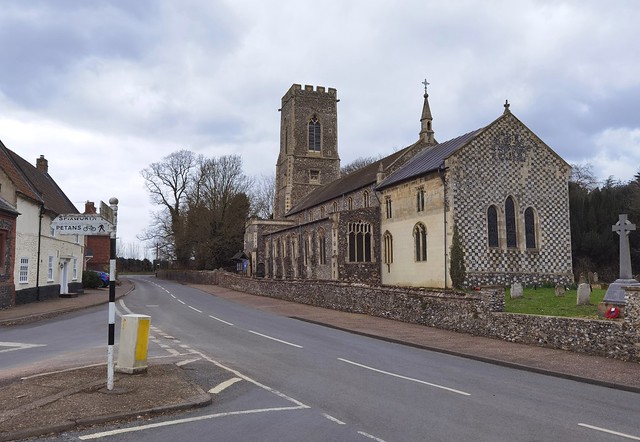
and St Andrew, Horsham St Faith Horsham St Faith sits to the north of Norwich, separated from the city only by those twin temples to the modern gods of fast noisy transport, the airport and the northern relief road. And yet there's no doubt that it is a village rather than a piece of suburbia that has floated off in a fit of absence of mind. That said, the parish church's size and its setting beside the main road through the village gives it an urban feel, and you can't help thinking that this was a busy place when the church was largely rebuilt towards the end of the medieval period. And you'd be right to think this, for the parish was home to the Priory of St Faith, established here by Robert Fitzwalter after a pilgrimage to Santiago de Compostella in the years after the Conquest (legend says that he tried to build it first at nearby Horsford, but it fell down). Part of the Priory survives as a private house with wall paintings of national importance. In the 15th Century, the nave of the church was rebuilt with aisles and clerestories in the new Perpendicular style against a Decorated tower which had been erected in the previous century. However, as Pevsner indicates, the tower arch inside is in the newer style, so it may well have been that this was one continuous campaign that rebuilt them both over the course of half a century or so. The chancel seems oddly rustic against the splendours of the nave, for it appears that an earlier structure had its roof raised and a clerestory inserted rather than the whole thing being rebuilt. The east wall, with its memorable chequered flintwork, was retained, and the three lancets in it seem oddly low now that the roof has been raised. A perky sanctus bell turret rises from the eastern gable of the nave, although I think the upper stage at least is modern. The south porch, which came with the new nave, has a boss of the crucifixion of St Andrew in the centre of its vaulting, suggesting that this was indeed the medieval dedication. You step through it into what at first appears an oddly proportioned space, for the west end of the north aisle has been converted into a meeting room and kitchen. But as you turn to the east a large, wide church unfolds before you. There's hardly any coloured glass, which comes as a surprise in what is otherwise a vigorous 19th Century restoration which brought tiled floors and a complete scheme of benches. However, older furnishings survived, and as we shall see they are of some significance. The first of these, at the west end of the nave is the enormous early 17th Century font cover, which Pevsner thought fine. It is about ten feet tall, and it rises in two separate stages, the lower one containing an obelisk between four columns, the upper curving gracefully into a thistle-like crown with a long finial. In such a large space the rood screen set within the chancel arch does not dominate the nave, and its upper stages are all of the 19th Century restoration, but the dado below with its painted panels is fascinating, for they are in a style unique in East Anglia.
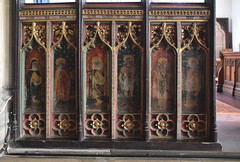
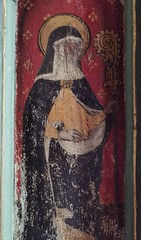
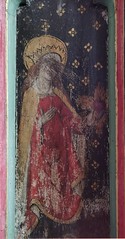
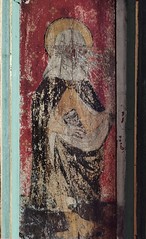
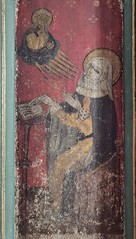
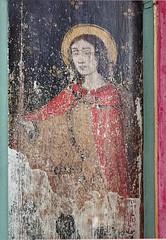
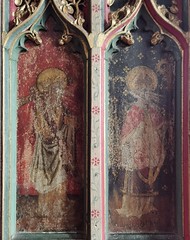
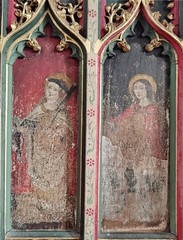
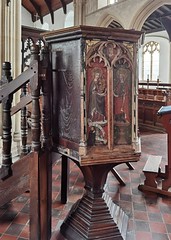
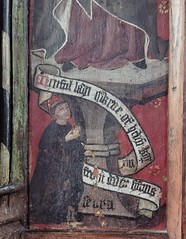
A dedicatory inscription across the top of the dado tells us that it was erected in 1528 by the bequest of William Wulcy, and asks for our prayers for his soul and that of his two wives. There are twelve panels, six on each side, depicting a curious mixture of saints as so often in the few decades left before the Reformation intervened and did away with such things. And yet, the depictions are so idiosyncratic that they are not all clearly identifiable. The north side begins with an abbess who is generally identified as St Etheldreda, although unusually she is not wearing a crown. The next panel shows a crowned female holding a flaming pierced heart, and it was identified by WW Williamson in his Saints on Norfolk Rood Screens as being St Catherine of Siena. This seems to have been accepted by much of the literature since, but it would be an unlikely depiction of the saint despite her growing cult in England at that time. I think it is more likely to be the Blessed Virgin. The next panel depicts a nun who is holding up what appears to be a stem of lilies, which might make her St Anne, the Blessed Virgin's mother. However, Ann Eljenholm Nichols suggests that it is a monstrance, meaning that this is St Clare. Then comes St George holding a sword and standing above a dragon, then St Helen with her cross. The last figure is a bishop. Williamson thought that the object he is holding was an auger, and this meant he was St Leger, but might it possibly be a sword? The panels on the south side are clearer, and generally more easily identifiable, although there are a couple of uncertainties. St Bridget of Sweden receives inspiration from God floating in the air above her, and then comes what is generally assumed to be a depiction of St Oswald, since this is what appears to be written beneath him. However, as he has no nimbus I wondered if he might actually be Henry VI, who was treated as a saint but never formally canonised. He appears on several Norfolk screens. His pierced eyes have been filled in with plaster at some point, which gives him a somewhat eerie countenance. Next, St Apollonia holds her tooth in pincers, St Roche lifts his cloak to show us his plague sores, and then comes what is generally recorded as St Margaret, a surprisingly conventional depiction given the rest of the screen. What appears to be a creature has been scratched out at her feet. But if you look closely you can see that what at first sight appears to be her lance does not continue down to the ground, and might in fact be a martyr's palm. In addition, she holds what appears to be a ribbon or a chain. I think it is likely that this is St Juliana, with the devil on a lead as at Hempstead St Andrew out on the coast. However, Ann Eljenholm Nichols cites an early record of the now indecipherable inscription as being St Martha, who has the same imagery.The final panel shows St Lucy, unusually holding fire rather than her eyes. Until the calendar changes of the 1750s, The feast of St Lucy coincided with the winter solstice and the turning of the astronomical year, so fire was appropriate for the saint whose day marked the longest night, and lighter days to come. As if this were not enough, Horsham St Faith also has a pre-Reformation pulpit with painted panels. It is fully half a century older than the screen. Anti-clockwise from the north side they depict the Blessed Virgin and child, St Faith, St Thomas of Canterbury, St Christopher, St Andrew, St John the Evangelist, St John the Baptist and St Stephen. On the doors are two abbots holding croziers, and Williamson thought they were likely to be St Benedict and St Wandregesilius. On the first panel, at the feet of the Blessed Virgin, kneels a clerk with a scroll reading mercyful lady qwene of hevyn, kepe me fro the dedly synnys sevyn.
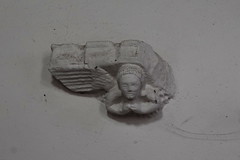
In contrast with these treasures the nave is plain, even severely so, partly because of the lack of coloured glass but also because there are surprisingly few memorials, and those which are here were mostly relegated to the back of the church by the 1870s restoration. The chancel you step into is also a simple space, lit by unobtrusive 1850s glass in the east window by the Norwich firm of J&J King. A curiosity on the north wall of the chancel is an angel corbel. It is hard to see what its purpose was, unless it is all that remains of an Easter Sepulchre that had an upper wooden stage, as at Bures in Suffolk. Also in the chancel is the 15th Century brass of a cleric. It depicts Geoffrey Langeley who was Prior of Horsham St Faith, and who died in 1437. Interestingly it was not originally in this church at all, but at St Lawrence in the centre of Norwich. It was brought here when that church was declared redundant in the 1970s. The 1851 Census of Religious Worship reveals something of the non-conformist enthusiasm of this part of Norfolk. The population of the parish was just under a thousand, but William Athill, incumbent and perpetual curate here and the vicar of neighbouring Horsford, recorded that the average attendance on a Sunday was just sixty for morning worship and a hundred for the afternoon sermon, which was always more popular in Norfolk. However, as to the attendance on the Sunday of the census Athill responded I cannot at all answer this querie having only been appointed to the benefice in May 1851 (the census was at the end of March), so it seems no record had been kept in the registers. It was common for incumbents to talk up their attendances or to blame the poor weather on census Sunday if the attendance had been low, but as a new incumbent Athill would have known that it would not hurt him to present a low attendance in the return in the hope of being able to raise it in the months and years to come. In which case, this might be an unusual incidence of an incumbent actually talking down his congregation rather than up. Given that the attendance that afternoon at Horsham St Faith Methodist chapel was three hundred, he had a job on his hands. Simon Knott, March 2023 Follow these journeys as they happen at Last Of England Twitter.
|
|
|||||||||||||||||||||||||||||||||||||||||||||||||||||||
home I index I latest I introductions I e-mail I about this site I glossary
links I small
print I www.simonknott.co.uk I www.suffolkchurches.co.uk
ruined churches I desktop backgrounds I round tower churches