home I index I latest I glossary I introductions I e-mail I about this site
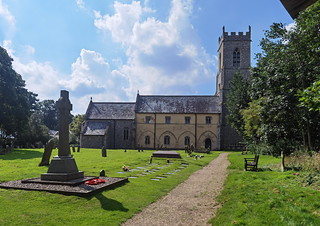
St Benedict, Horning


Follow these journeys as they happen at Last Of England Twitter.
St Benedict, Horning Freewheeling down the high-hedged lane that leads from the busy village to the lonely churchyard, I was put in mind of my only previous visit to Horning church which, as I discovered when I checked my notes later, had been exactly sixteen years to the day previously. That was also a beautiful day in late summer, which is perhaps why it recalled itself to my mind, the bowering trees and the ripening blackberries in the hedgerow instantly familiar. On that previous occasion I hadn't actually set out that day with a visit to Horning church in mind. I was out with my wife Jacqueline and my daughter Martha, then eight years old. Her big brother James was at some scout camp or other in the wilds of Norfolk, and after dropping him off there we decided to spend the rest of the day on the Broads. I love the Norfolk Broads. There's something reassuringly old-fashioned about them. They still have tea shops called 'tea shoppes', and in those days you could still buy souvenirs like thermometers set in china dogs and miniature brass gongs embossed with a map of the Bure. Perhaps you still can. There were technicolor postcards of Potter Heigham Bridge printed in the 1970s, the prices in single figures. Everyone tells you that the Broads are insufferably overcrowded, but they aren't really. Wroxham and its adjacent Hoveton shopping centre are pretty full, mainly with fortnighters from the Midlands and the North of England, and some of the main waterways have snarl-ups like the Ipswich rush hour, but most of the lanes and backwaters are almost completely empty. We headed to the south bank of the Bure, and bearing in mind that it was the middle week of August we passed hardly another car once we got north of South Walsham. We climbed Ranworth
tower, and Martha had the frisson of hearing her
father get told off by another visitor for using a flash
to photograph the Ranworth screen, against the official
rules as printed on a Very Large Sign in those days.
Well, for goodness sake, why didn't they just say
please don't take photographs, buy our postcards instead?
I must say that I was a bit disappointed to return to
Ranworth in later years to find that the sign was no
longer in existence. We had lunch at the Woodbastwick
brewery, and while we sat there it occured to me that we
were only a couple of miles from one of the few Broadland
churches I hadn't visited yet. I suggested that, you
know, why didn't we just stroll down to the river and
take the foot ferry across to Horning? And he was. A little
launch with an outboard motor headed down the Bure from
the direction of Potter Heigham and reversed into the
cutting. Another family had joined us on the bank, and we
all piled in. Once seated, we headed back out downriver,
and then up to the boat yard at the top of Horning creek.
It was a lovely trip, bobbing around in the wide, lazy
river. It took no more than ten minutes, and the nice man
charged us just a pound a head - and he charged Martha
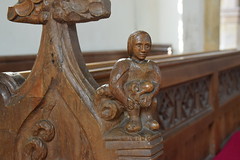
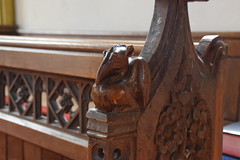
nothing at all, saying she hadn't taken up enough space. The north arcade survives more fully on the inside. The tower arch soars, and as so often the font below it is exactly contemporary with it. A curiosity is the set of stalls in the chancel, which are carved in ogee-arched niches on the ends with all manner of wonderful things. The devil pushes a man down into hell, another man fights with two serpents. On the bench ends, a Chinese dragon, a man apparently feeding a serpent although presumably he is actually fighting with it, and a fat little pelican, all carved in a cheerfully amateurish style. Presumably they date from the 1870s restoration or soon afterwards. I was pleased to find the church open, because 2021 was the second summer of the Church of England's Great Covid Panic, when it had hastily locked the doors of its churches against the people of God, and I had found that some churches had been slow to reopen even eighteen months on. But not only was Horning church open every day, pretty much all of the Broadland churches seemed to be, on this side of the Broads at least. I got back on my bike to head on to Ludham, overtaking myself in 2005, when we had wandered back down the lanes, gorging ourselves on Norfolk blackberries, in time to cross the Bure and head to the hell of the pleasure boat trips and souvenir shops of Hoveton and Wroxham, to squeeze the last ounce of pleasure out of the day. Simon Knott, September 2021 Follow these journeys as they happen at Last Of England Twitter. |



|
|||||||||||||||||||||||||||||||||||||||||||||||||||||||
home I index I latest I introductions I e-mail I about
this site I glossary
Norwich I ruined churches I desktop backgrounds I round tower churches
links I small
print I www.simonknott.co.uk I www.suffolkchurches.co.uk