home I index I latest I glossary I introductions I e-mail I about this site
St Andrew, Honingham
Read
the captions by hovering over the images, and click on them to
see them enlarged.
| St
Andrew, Honingham I had almost given up hope of seeing inside Honingham church, until my friend John told me he'd arranged for it to be open, and would I like to come along? In truth, I was wary about meeting a character I had encountered at the church some ten years previously; not so much for what had happened, but that I had written about it in some detail afterwards. I was a little apprehensive, therefore, to turn up and discover that the man opening the church was the same one I had met all those years before. But it didn't matter, because he didn't remember me, and probably had never read what I had written.
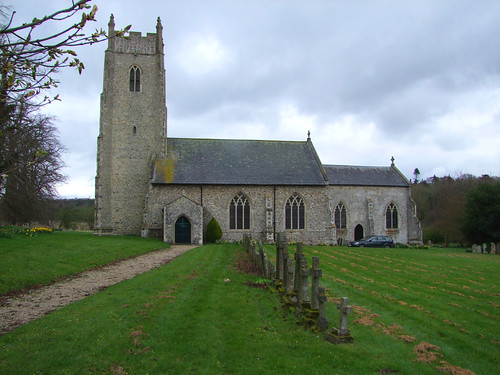
If a Martian came down and landed in the graveyard of St Andrew, Honingham, what on earth he would make of it? Would he think it was an art object? A barn, or storage facility? Or would he search for an industrial purpose? Perhaps the tall pinnacles on the tower might suggest to him that he was at the site of a scientific experiment. If the Martian had any brains, and I assume that he would have if he'd made it this far, he might perceive that the road is a lot newer than the church, and perhaps he would decide that the church was a relic of the past, its function now sidelined, perhaps forgotten altogether. Indeed, he might wonder if the road had been built deliberately to speed humans past this building and the tall stones set around it. Perhaps this was a dangerous place. Or, maybe, it was simply an embarassing reminder of past superstitions, a haunted site. An unlucky place, perhaps. The Martian might watch the traffic hurtling past, the drivers deliberately not looking, and think yes, that must be right. Whatever he decided, it would have to be based on a survey of the exterior, because St Andrew is always locked, unless the Sunday club is in session. He wouldn't even be able to look through the windows, because they are filled with frosted quarries. Eventually, he might find the porch, and think it is some sort of antechamber (not an entrance, of course, for the doors beyond are locked) and for a moment ponder the holy water stoup, now filled with an old birds nest. What on earth would he make, I wonder, of the signboard on the wall that reads in part: Friend, you have come to this church.
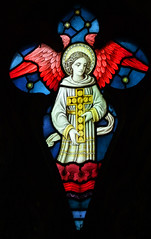
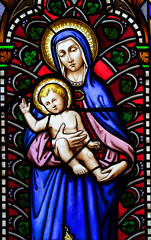
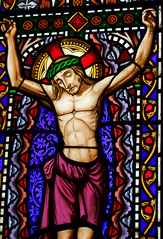
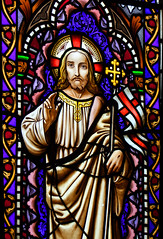
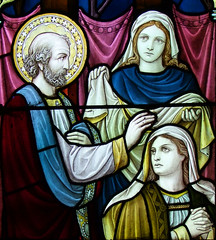
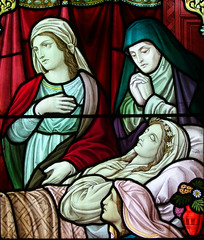
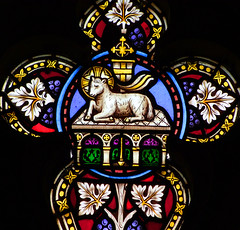
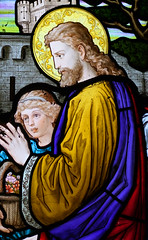
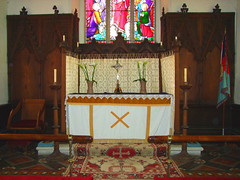
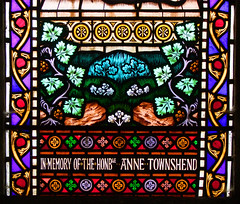
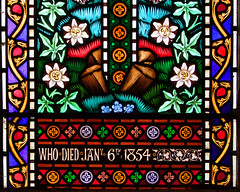
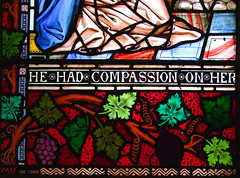
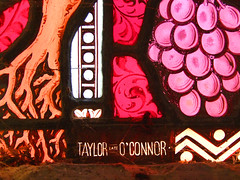
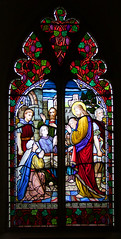
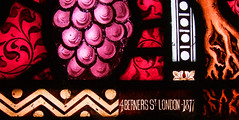
Leave it not without a prayer. A lovely sentiment, no doubt; but the Martian would still be left locked out of the house of God - if it is the house of God, of course, for if the locks and chains keep out the stranger and the pilgrim, how on earth can it be that God is in there to bid us welcome? My friend Peter has been trying to see inside this church for years. We came this way most recently in early March, 2006. The day had started in bright sun, but as we headed here from Marlingford the east wind blew sheets of glacial cloud above us, which turned grey and, as we parked the car, turned to snow. Parking is difficult; there is a layby, but you need to approach from the west to park here. Otherwise, there is a drive which goes up to the east end of the church, but this was already occupied by a large BMW estate. We parked in the layby, and sat in the car for a moment, watching the fat flakes thicken. What to do? We decided that we might just as well get out and go and take a look. Either, by some miracle, the church would be open and offer us shelter, or we could confirm our prejudices about the perpetual locking of St Andrew and be on our way. The south side of the church has been cleared of headstones, and they have been placed in two perfectly straight lines, about 15 m apart. What would the Martian make of this? Some sort of sports arena, perhaps? Or a place to worship the sun at the solstice? Our Martian couldn't possibly be expected to know about the great lawnmower enthusiasm of the 1960s and 1970s, when so many graveyards were cleared like this one. But the dead have their revenge, and this wide open space is now scattered with an acne of molehills. We got into the porch and tried the inner door, which was locked of course; although it did feel as though one great shove with a shoulder would probably open it. And that was when the heavens opened. The snow was so thick in the air we could only just make out the suicidal cars thrashing up the main road to and from the Midlands. Peter is a careful driver, and he didn't much fancy heading on in a blizzard, and there didn't seem much point getting caked in snow just to go back and sit in the car, so we sheltered from the weather in the porch, and read the notices miserably. I noticed that the presentation to the living had been suspended, which sounds drastic but simply means that the parish can't afford a Rector. The annual accounts were posted, and I noticed that the total income for the year was roughly the same as the weekly income of the church I attend in the middle of Ipswich, so this is a small parish. Eventually, I exhausted the possibilities of the noticeboard, and, feeling that I had probably squeezed the last ounce of pleasure out of the porch, I gazed out at the graveyard. This was when I noticed something rather curious. The back of the BMW estate was open, and beyond the second line of gravestones a smartly dressed man was standing in the snow bashing molehills with a spade. At first I thought this must be an act of devotion on the part of a parishioner, or simply a Saturday morning habit. And then I wondered if it might be some kind of country lore: if in the snow you clear his stack, mister mole will not be back - perhaps this man had been waiting for it to snow for months. We watched him for a while, the snow blanketing the sound of his spade into silence, rendering it surreal. But the wind was vicious, and so we stepped back into the porch, and worked out where we wanted to go next. It was while we were pondering over the map that we heard footsteps, and looking up saw that the smartly dressed man had approached us. He looked at us quizzically. "Just here out of interest?" he asked. "Well, we'd like to be", I replied, indicating the door. "But the church is locked." This was such a heavy hint that, once dropped, it hit the floor with a loud clang. Surely, if this man had a key, he'd give it to us, or let us in. But he just smiled sadly and nodded in agreement, as if to say yes, the church was locked, and there was nothing he could do about it. Perhaps he'd been trying to see inside for years as well. Instead, the three of us exchanged a few polite comments about the weather, and he wandered off back to his moles. And then ten years passed, and here I was again at Honingham church. No moles now, and so the churchwarden was at leisure to let us in through the chancel door. The first impression was of the jewel-like intensity of the chancel windows, several the work of George William Taylor soon after he had taken over the O'Connor workshop in Berner Street, London in 1877. Indeed, the windows are actually signed Taylor late O'Connor. I always find Taylor's manga-eyed women a bit mawkish, but in these early days he was probably working with the O'Connor pattern book, and the combination of their cartoons and his romanticism is very pleasing, even if there is a bit of manga creeping in. But in the end, Taylor was unable to revive the O'Connor's fortunes. The mass-produced glass of the workshop was becoming unfashionable with the rise of the Arts & Crafts movement, and they weren't able to compete with the economies of scale of the really big workshops like Hardman & Co and Ward & Hughes. They produced their last glass in about 1900 and the company closed soon afterwards. The main subjects here are all concerned with bringing the dead back to life: Peter raising Dorcas, Christ raising Jairus's daughter, and so on. Best of all is a triple window of Nativity, Crucifixion and Resurrection, probably produced by the O'Connors before George Taylor came along.
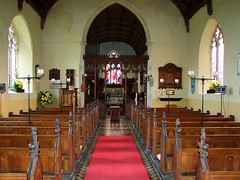
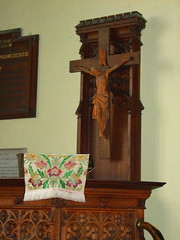
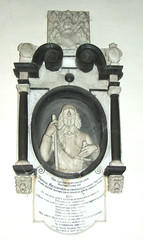
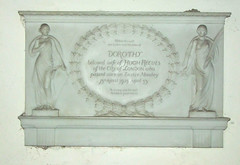
By contrast with the chancel, the nave is startlingly plain, perhaps a result of a considerable restoration in the early 20th Century. The memorials are all gathered at the east end and include one to Sir Eric Teichman. After a distinguished career in the diplomatic service, mainly in China, Teichman devoted his life to raising funds for Dr Barnardos Homes. He lived at Honingham Hall, and in the winter of 1944 he was shot dead in the grounds by two American servicemen who were poaching there. The soldier who fired the fatal shot with an M1 Carbine, a Private George E Smith of Pittsburg, USA, was sentenced to death and hung at Shepton Mallet prison on VE Day, despite a call for clemency from Teichman's widow. Of course, the memorial gives you none of these details, but the incident was quite a cause celebré at the time, I believe. So it was all very interesting, and despite the gloom of the nave I decided that I liked Honingham church. We went out to the car and set off for East Tuddenham. But back in 2006 we were still sitting in the porch, of course. The snow gradually thinned, and at last it stopped. We stepped out, examining the sky for signs. An uneasy truce had set in. Just a thin dusting remained on the grass to show that it had ever snowed; the sun was edging to come out, the white rime on the green fading, but there were more sheets of greying clouds huddled off in the distance. It was time to go. We wanted to make a statement of some kind, and so we left the porch gates open, as if to suggest that the the doors were not barred, and that God was in His dwelling house waiting to bid a welcome. But by the time we got back to the car and headed eastwards past the church, someone had already closed them. Simon Knott, March 2006, revised and updated May 2016
Amazon commission helps cover the running costs of this site |
home I index I latest I introductions I e-mail I about this site I glossary
links I small
print I www.simonknott.co.uk I www.suffolkchurches.co.uk
ruined churches I desktop backgrounds I round tower churches