| |
|
St Peter
and St Paul, Honing Honing
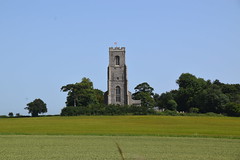
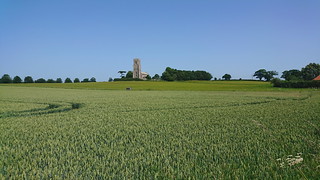
has one of the most pleasingly visible of all East
Anglian churches, a sentinel on the hilltop seen for
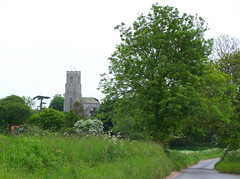
miles from the narrow lanes round about. Footpaths wind
between fields to reach its narrow churchyard, and the
main track to the church arrives from the east beyond the
village. That there is something a little unusual about
this building is obvious the moment you step into the
beautiful graveyard, fort the chancel has been almost
entirely truncated, leaving barely eight feet like a
lean-to against the nave wall. This makes the nave seem
bigger than it is, and also creates a happy proportion
with the fine tower. Something has happened here.
Stepping into the wide, light nave, the curiosity
continues. The aisles beyond the arcades seem so narrow
as to be unlikely, and the walls beyond are obviously
rebuilt. And then, look up - the roof extends from outer
wall to outer wall, the arcades finishing uselessly up
there in the gloom. Obviously, this church underwent a
fairly complete rebuilding during the 18th Century, a
time when churches were considered as preaching houses,
and sacramental spaces were not a high priority.
Pevsner and Mortlock both thought it likely that the
aisles have always been this narrow, and the new walls
were built in the same places as the old. Pevsner points
out that the medieval porch would have needed to be moved
if the rebuilt walls had been drawn in. But I think that
this is exactly what did happen, and I think this was
once a much wider church with arcades and aisles, and
separate roofs to nave and aisles. Churches like this
were often repaired by demolishing the aisles and
infilling the arcades to make new walls. The fact that
this is a Hall church makes me think that the local
landowner was some sort of antiquarian, and enjoyed
recreating what was still essentially a medieval space.
He moved the walls in to make it possible to span the
whole building in one roof, but left the arcades because,
well, they are pretty.
And the external structure still echoes what was there
before, albeit not in an articulate 19th century way. He
probably wanted a View from Honing Hall as much as
anything else. It isn't all successful. The filling in of
the lower part of the west door to create a window is
clumsy and ugly. But otherwise it is a fascinating
result, unlike any other church I know.
There are a number of memorials to members of the Cubitt
family. Edward George Cubitt, who died in 1870, served
with His Majesty's Dragoons during a great part of the
Peninsular War, was in retreat from Burgos, was also
present at the Battles of Vittoria, Pampeluna, and
Toulouse, and entered Paris with the Allied Army of
Occupation in 1815. More poignantly, a memorial to a
20th Century Edward George Cubitt and his wife remembers
their grandchildren, threee of them killed in the Great
War, two on the same day, 15th August 1915, when the 5th
Battalion of the Norfolk Regiment were wiped out at Suvla
Bay, disappearing into the heat and dust of Gallipolli.
There are hatchments, and a few
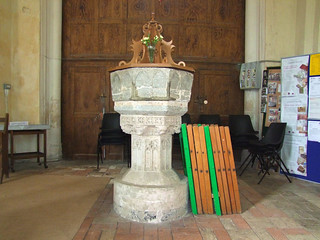
medieval survivals. The font is one of the familiar
series of 13th Century Purbeck marble fonts, reset on a
stem from a century or so later. A pretty figure brass of
1496 to Nicholas Parker, knight, lies in the choir. But
best of all is the setting, the graveyard dropping away
to the west, and across the fields a lonely, ancient
pathway leading back down to the village in the valley
below.
Simon Knott, August 2019
Follow these journeys as they happen at Last Of England
Twitter.
  
|
|
|