home I index I latest I glossary I introductions I e-mail I about this site
St Andrew, Hingham


Follow these journeys as they happen at Last Of England Twitter.
| St
Andrew, Hingham Hingham is a
large, attractive village, almost a small town really,
just to the north of Attleborough. Over the years I had
often passed through it on the way to somewhere else, but
when I came back to the church on one of those typically
wet, windy days in May 2021 I realised that it was fully
fifteen years since I had last stepped inside. But this
is not an easy building to ignore, for in many other
counties Hingham's great church would be the biggest, and
it still stands out despite there being a dozen or so
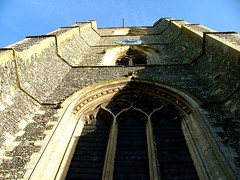
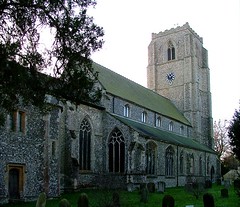
larger in Norfolk. The vast, blockish tower is a landmark
for miles around, and the church itself is more than
fifty metres long. In East Anglia, it is not unusual to
find a huge church which was all built in one campaign.
Perhaps the most famous are Salle, Lavenham and
Southwold. This is true here too, but Hingham is
different in that it dates from a century earlier than
those other great churches. It is possible to date the
building quite precisely. We know that the bulk of it was
in place before the death of Remigius de Hethersett in
1359, but there are elements of the emerging
Perpendicular style among the otherwise Decorated
features, telling us that it was probably after the Black
Death had dispatched more than half the Norfolk
population in the late 1340s. We can reasonably assume
that most of what we see here then dates from a single
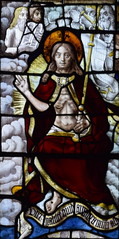
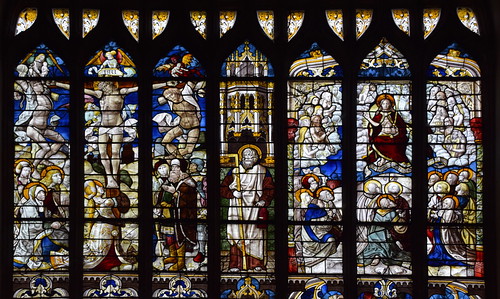
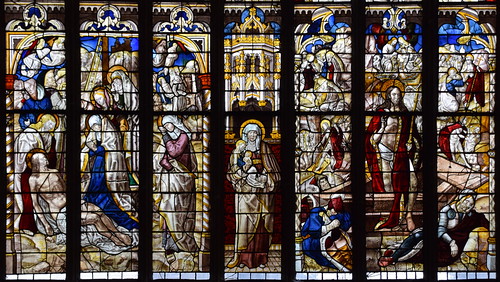
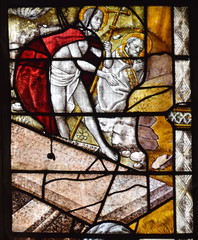
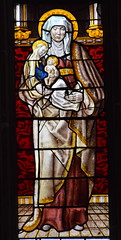
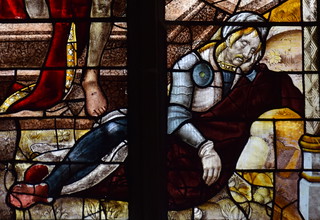
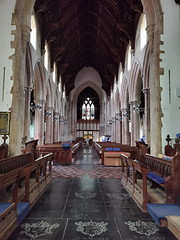
decade, the 1350s. You step into a wide interior which can feel a bit gloomy on a dark day despite the aisles and clerestories. The eyes are inevitably drawn towards the east, and one of Norfolk's largest windows. It is not only remarkable for its size, for it contains what Birkin Haward thought the very best collection of Continental glass in the whole of Norfolk. It is German, and dates from around 1535 for, as Pevsner points out, one of the cartoons was also used at Scheiden near Cologne and dated so. The glass was the gift of the Wodehouse family of Kimberley, who filled the chancel windows there with more of the same. It was bought in 1813 from the Norwich stained glass merchant JC Hampp who specialised in fragments of medieval glass from English churches and often larger schemes of continental glass from European churches and monasteries closed by war and revolution in Europe. There was a great fashion for this kind of thing in the early years of the 19th Century before the Victorian stained glass industry got going, and it was often installed for purely decorative reasons, although there appears to be something more of an antiquarian and aesthetic motivation here. The glass is essentially in two registers. The upper register has a central figure identified as St Andrew, holding a bag and a stringed tri-square, and in the register below him is St Anne holding the Blessed Virgin and Christ child. The four major scenes in the window revolve around them. They are, anti-clockwise from top left, The Crucifixion, the Deposition, the Resurrection and the Ascension. There are smaller scenes flanking the major subjects, including an unusual one of the Risen Christ consoling St Peter. Figures in the upper lights include two donors, one of which was identified by the glass expert David King as Willem, Duke of Jülich & Berg, leading him to the conclusion that the glass originally came from Mariawald Abbey. The window tracery was made specially when the glass was installed at Hingham in 1825 by Samuel Yarrington, who often worked with Hampp. Yarrington was responsible for the small amount of decorative glass used to fill in spaces.
The most memorable medieval feature
of Hingham church is the large Morley tomb in the north
wall of the sanctuary, a great towering edifice that
incorporates an Easter sepulchre at the base. It dates
from the middle of the 15th Century, a period we know
well in East Anglia; and yet the red stone from which it
is carved creates an unfamiliarity. Despite its size, it
is not an arrogant piece. The Morleys kneel facing
outward in relief among the weepers, with the saints
above. Pevsner thought it was the finest of its type in
England, and went further. He thought it was exactly like
a gateway, and suggested that if one thinks away the
tomb-chest and back wall the monument is palpably based
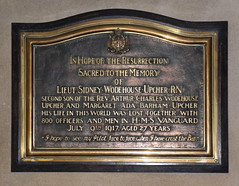
on Erpingham Gate in Norwich. The most famous person commemorated at Hingham is not from the village at all. In a reconstructed alcove in the north aisle there is a bust of Abraham Lincoln. The Lincolns left Hingham in the middle of the 17th Century, but his origins are remembered here. Also remembered is Sidney Wodehouse Upcher, who in 1917 was a victim of a terrible yet now little-remembered incident during the First World War when his life in this world was lost along with 800 officers and men in HMS Vanguard. The Vanguard was anchored in Scapa Flow after the Battle of Jutland when on the night of 9th July a series of chain explosions set off the entire magazine on board, and 834 of the 836 men on board were killed. Several possible causes were suggested for the explosions, but it was never definitely resolved. Upcher's memorial includes the lines I hope to see my Pilot face to face, when I have crost the bar from one of the most moving of Tennyson's poems, but which was perhaps small comfort for his family. Simon Knott, May 2021 Follow these journeys as they happen at Last Of England Twitter.
|
|
|||||||||||||||||||||||||||||||||||||||||||||||||||||||
|
|||||||||||||||||||||||||||||||||||||||||||||||||||||||
home I index I latest I introductions I e-mail I about
this site I glossary
Norwich I ruined churches I desktop backgrounds I round tower churches
links I small
print I www.simonknott.co.uk I www.suffolkchurches.co.uk