home I index I latest I glossary I introductions I e-mail I about this site
All Saints, Hilborough



Follow these journeys as they happen at Last Of England Twitter.
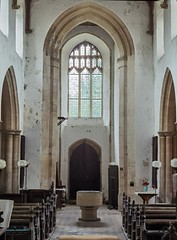
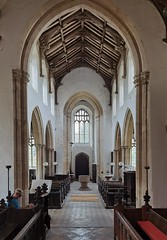
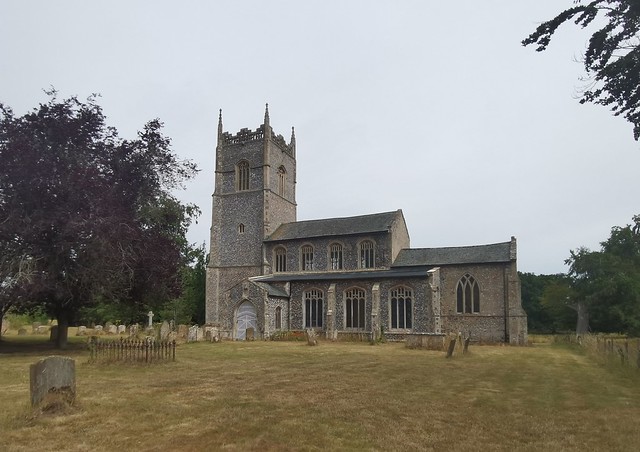
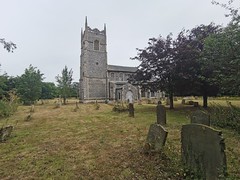
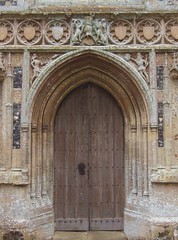
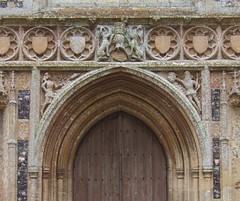
All Saints, Hilborough The small parish of Hilborough lies in the sleepy and slightly sad north Breckland, a place that traffic hurries through on the busy Thetford to Swaffham road and probably doesn't even notice. The church too is not easily spotted unless you know to look for it, for it sits beyond trees about a quarter of a mile from the road, and the track up to it, almost opposite the lane to Foulden, is not signposted. It comes as something of a surprise then to reach the end of the track, for here stands a grand late medieval Perpendicular tower which rises high above the wide churchyard. To its east, the tall near-contemporary nave, aisles and clerestories are curious in proportion, as if two giant hands had squeezed them. The chancel of perhaps two hundred years earlier is wedged between the aisles beyond. Today, the track sets you down by a meadow to the south of the churchyard, but it's obvious that this building was intended to be approached and seen from the west. Above the west doorway are the arms of the de Clifton family who presumably bankrolled the rebuilding of the tower and nave in the late 15th Century. Below in the spandrels of the doorway are two memorable figures, a Saracen with a curved sword and a wild man of the woods holding up a severed head. The tower and the south porch both have flushwork symbols around their base course, and both make use of flint chequerwork, although Pevsner thought that the tower became very casual above the ground stage as if carelessly restored. When the nave was rebuilt the chancel arch was moved back one bay westwards through the 14th Century arcades, making the chancel longer than it appears from the outside. The church you enter
through the south porch is strikingly tall and wide. Sam
Mortlock described it as a calm interior, and this is
exactly right, although there is also something rather
sad about it. The overwhelming impression is of dust
gently settling through creamy light onto old woodwork, a
slight air of neglect contributing something to the
atmosphere of the place. There are no Victorian dramas,
no stained glass apart from the banding in the east
window. The hefty font is 14th Century, presumably a
survival from the earlier nave before it was rebuilt. The
tall tower arch behind it makes it seem smaller than it
is. The nave's one great excitement is above the south
doorway now. This is the early 17th Century tympanum
which once fitted into the top of the chancel arch, and
bears a spectacular royal arms to James I, dated 1611 and
bearing one of James I's memorable mottos, Exurgat
Deus Dissipentur Inimici, 'Rise up oh God and
Scatter my Enemies', a Latin phrase satisfying to mutter
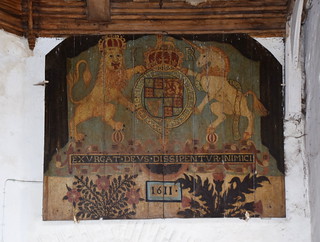
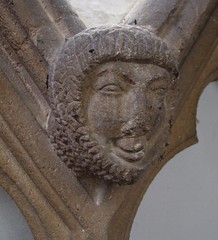
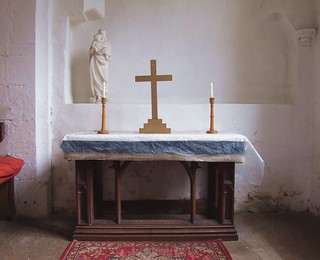
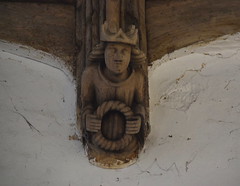
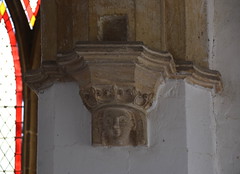
under your breath at fraught moments. The piscina and sedilia survive from the early 14th Century with characterful faces at the intersections, including a tonsured monk and a soldier wearing chain mail. It's easy to see looking back towards the nave how the chancel was extended westwards into it in the late 15th Century. A crowned female head at the eastern end of the south arcade has a rebated hole above it, and would have supported the screen that divided the chancel from the south aisle chapel. This chapel is of interest today because its furnishings came from the church at West Tofts, restored by Pugin in the 19th Century, but marooned for eighty years now within the Battle Training Area, and normally inaccessible to the public. The statue of the Blessed Virgin and Christchild here once graced the lady chapel there. The sense of this place being a backwater is perhaps something of an illusion, because on several occasions in history this parish has touched the national consciousness. For almost two centuries the rectors here were members of the Nelson family, including the Admiral's father, who left here for Burnham Thorpe shortly before Horatio was born. However, on the occasion of the bicentenary of Trafalgar in 2005, the otherwise enthusiastic Norfolk County Council guide almost completely neglected to mention Hilborough, stating simply that Horatio Nelson spent some of his holidays here. The parish, it must be said, were not unhappy with this, preferring to stay out of the limelight, but the rector of the day was most indignant, even going as far as appearing on BBC Radio Norfolk to state Hilborough's case. As he said to me at the time, 'Barsham have got his mum, he was born at Burnham Thorpe - but we've got seven Nelson bodies in the graveyard, what more do they want?!' And curiously, the Nelsons were not the only famous military family of the 19th Century to touch this place, for resident in the Hall next door in the 1840s was Arthur Richard Wellesley, MP for Norwich, and, more significantly, the eldest son of the Duke of Wellington. We may suppose that his father visited him here and attended Divine Service in All Saints. Wellesley the younger had to resign from parliament and leave Norfolk when his father died in 1856, to become the second Duke. This was the occasion on which he wrote in a letter the immortal line Think what it will be when the Duke of Wellington is announced, and only I come in. Simon Knott, July 2022 Follow these journeys as they happen at Last Of England Twitter.
|
|
|||||||||||||||||||||||||||||||||||||||||||||||||||||||
home I index I latest I introductions I e-mail I about
this site I glossary
Norwich I ruined churches I desktop backgrounds I round tower churches
links I small
print I www.simonknott.co.uk I www.suffolkchurches.co.uk