home I index I latest I glossary I introductions I e-mail I about this site
St Remigius, Hethersett


Follow these journeys as they happen at Last Of England Twitter.
St Remigius, Hethersett Hethersett is a large,
suburban village between Norwich and Wymondham, and its
parish church of St Remigius is a large urban church,
sitting on the edge of the village beside the old road to
London. Its setting is deceptively rural, backing on to
the fields that separate the village from the A11, and to
reach it from across its car park you cross a bridge over
a wide channel. I took this to be the bed of a dried up
stream, but I'm told that it is in fact the remains of a
sunken turnpike road. And the church, which you approach
from the north, is also something of a curiosity. The
tall north porch has two image niches set either side of
a window into an upper room, and the line of the nave
drops suddenly to flatten about two thirds of the way
along, before another lesser drop to the chancel. The
reason for this appears to be that the building was
originally cruciform, the lower eastern third of the nave
roof marking the place where the crossing was. After the
Reformation, the chancel fell into disuse and decay, and
was taken down, as was not unusual in English churches.
In the 1870s a new chancel was built on a grand scale,
and the transepts were truncated and harmonised as
eastward extensions of the nave aisles.
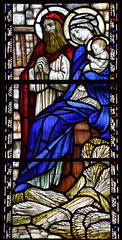
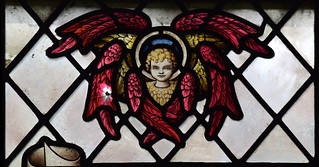
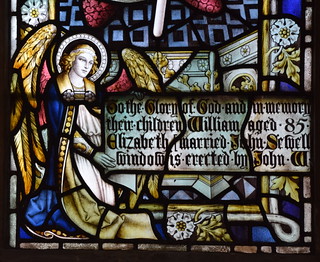
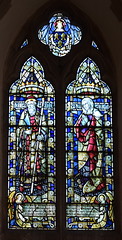
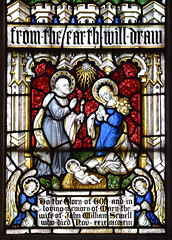
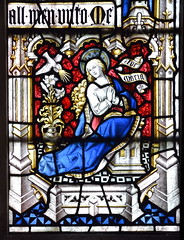
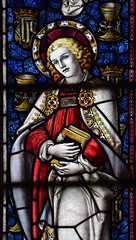
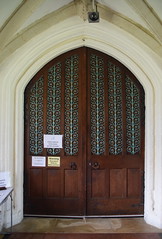
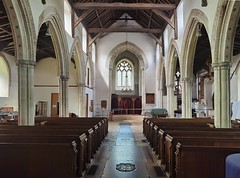
The 1870s restoration here was extensive, but it has been ameliorated in the years since. The south doors are filled with a delightful Art Nouveau grill, a first sign of a number of adornments that the early 20th Century brought here, and you step into a nave which is dramatically large, wide as well as long. The west end of the south aisle has been converted into a kitchen space and toilets by a discrete boxing in of the most westerly bay, and wheelchair access to the church is by a long slope leading in front of the tower arch. Despite its size, the church can be a little dark on a gloomy day, but this is offset by an excellent collection of late 19th and early 20th Century glass. The best known is Robert Anning Bell's 1911 Adoration of the Shepherds in the north aisle. Details of it may be familiar from Christmas cards, and the cartoons for it are occasionally on display in the Victoria and Albert Museum in London. The main figures of the shepherds and the Holy Family are topped and tailed by angel musicians and worshippers based on small children, which some will find mawkish rather than charming, but they are typical of their period. This is the only window which is signed, and Birkin Haward scratched his head in frustration at identifying the artists of any of the others. I think that the 1930s glass of St Michael and St Gabriel may be by Horace Wilkinson, who made a contemporary piece of St Walstan for neighbouring Great Melton. I'd like to know who made the Abraham and Sarah window in its jewel-like blues and purples. Could it have been Clayton and Bell? The Angel at the Empty Tomb looks to be by Heaton, Butler & Bayne, and Birkin Haward was confident that the Feeding of the Five Thousand was by Lavers, Barraud and Westlake. The east window depicts the Crucifixion flanked by the Blessed Virgin and St John with scenes of the Annunciation and Nativity below. It is very good of its kind, and again it would be interesting to know who the workshop was.
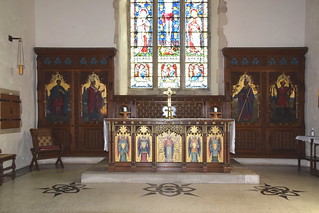
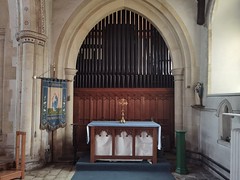
Given the size of the church there are few medieval survivals. The late 14th Century font, with eight unique floriated crosses on an octagonal bowl, is set on nine columns in an Early English style. Behind the organ Pevsner recorded a decayed 15th Century memorial to the Berneys, the figures of a knight and his lady. However, to visit St Remigius is to have an overwhelming impression of the last decades of the 19th Century, and the first few of the 20th. The chancel is furnished in the triumphalist Anglo-Catholic style of the time, a real period piece. Angels bear passion symbols and flank a curiously truncated Risen Christ on the front panels of the altar. Behind the altar the reredos runs the width of the chancel and continues the theme, garish saints in languid poses that seem a million miles away from the simplicity of modern Anglican spirituality.
For such a large church there are surprisingly few memorials. Isaac and Elizabeth Motham's is in the south aisle. He departed this life on ye 10th March 1703/4, a reminder that until later that century New Years Day was celebrated on the 25th of March. She had died in 1699, and by her he had issue five sons but all dead, and one daughter still liveing. Nearby is the memorial to John Ambrose Barrett, a 2nd Lieutenant in the 16th Battalion the Rifle Brigade, who was Killed in Action in Flanders on the 31st July 1917. Simon Knott, September 2021 Follow these journeys as they happen at Last Of England Twitter. |





|
|||||||||||||||||||||||||||||||||||||||||||||||||||||||
home I index I latest I introductions I e-mail I about
this site I glossary
Norwich I ruined churches I desktop backgrounds I round tower churches
links I small
print I www.simonknott.co.uk I www.suffolkchurches.co.uk