home I index I latest I glossary I introductions I e-mail I about this site
All Saints, Hethel





Follow these journeys as they happen at Last Of England Twitter.
| All
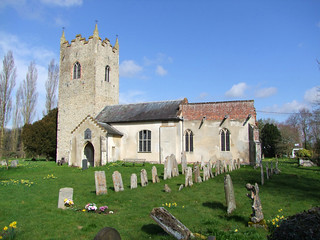
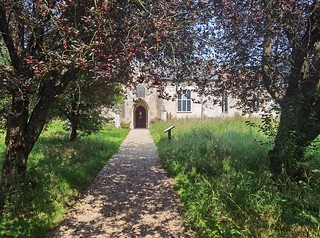
Saints, Hethel Hethel is less than ten miles from Norwich, and its name is associated with the Lotus car factory, so you might think you will find yourself in industrialised suburbia. But this is an area of narrow lanes and woodlands, bypassed by the traffic on the main London and Ipswich roads. And the church itself is remote from its houses, set at the end of a rough road which peters out into a track. In the distance, you can see the famous Hethel thorn, said to be a thousand years old, and the tower of All Saints is probably as ancient, or at least its lower half, which may be a rare example in Norfolk of a Saxon square tower. The top stage is 14th Century I should think, although the pinnacles may be even later, an 18th Century confection. If the tower is striking, then the east end of the chancel is even more so. The Branthwaite family chapel, built on to the north side of the chancel in the early 18th century (the 1819 date on the end presumably refers to the doorway) was built large and square from red brick, and the chancel was squared off, also in brick, to match it. It is as if two outhouses had been built on to the end of the church. This church is always a favourite
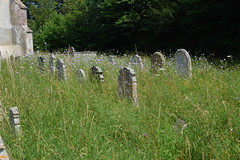
of mine to visit, and in recent years the churchyard has
been managed delightfully as a nature conservation area.
I have heard moans about such things, that the wild
growth makes it hard for family history hunters to read
the headstones, that it allows dangerous ticks to thrive,
and even that it is disrespectful to the dead. But a
well-managed churchyard is cut back in early autumn, when
in any case inscriptions are easier to read in the
slanting light, and if you are worried about ticks then
wear thick trousers, and don't allow your dog to go
romping through the graves. And if you think wild nature
is disrespectful to the dead, then perhaps an English
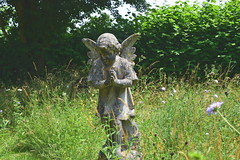
country churchyard is not for you. For Hethel churchyard
is one of the most beautiful places in all Norfolk in the
summer, the wild flowers and grasses swaying gently in
the bright light like a warm sea washing against the 18th
and 19th Century headstones. This light makes its way
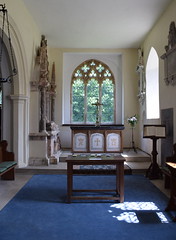
into the church with you, for there is no coloured glass
and the windows are large and elegant. There was a very
simple 19th Century restoration, without trimmings or
excesses, and the benches are now arranged at angles
facing into the chancel. Simon Knott, August 2021 Follow these journeys as they happen at Last Of England Twitter. |









|
|||||||||||||||||||||||||||||||||||||||||||||||||||||||
|
|||||||||||||||||||||||||||||||||||||||||||||||||||||||
home I index I latest I introductions I e-mail I about
this site I glossary
Norwich I ruined churches I desktop backgrounds I round tower churches
links I small
print I www.simonknott.co.uk I www.suffolkchurches.co.uk