home I index I latest I glossary I introductions I e-mail I about this site
All Saints, Hempstead



Follow these journeys as they happen at Last Of England Twitter.
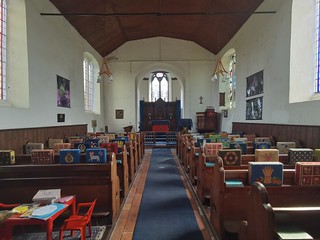
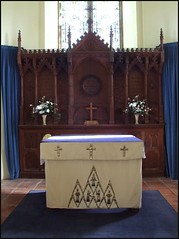
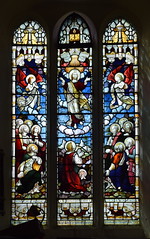
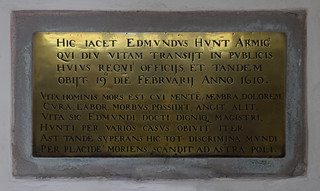
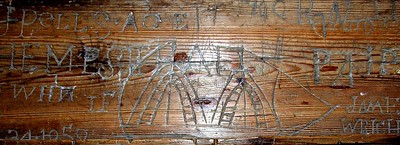
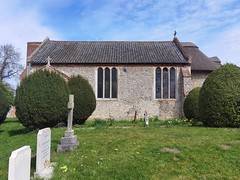
All Saints, Hempstead There's a Hempstead out on the east coast with a fascinating rugged old rood screen, but this is the other Hempstead, in one of the pretty villages that sit in the secretive green lanes of north Norfolk, and at its heart is this curious building set in a small churchyard, as if it were a cottage in its garden. You approach the church from the east, and your first sight of its thatched round apse, as pretty as if Hansel and Gretel were imprisoned inside. Walking around the church presents a building which is no less odd in other aspects, with a functional red brick tower of the 18th Century offset so far in the north-west corner that it is barely attached, and a nave, or, more precisely, the former south aisle now serving as the nave, which looks as if it was also refurbished at this time. The apse dates from the 1920s reusing the former east window of the aisle, but the nave and chancel of the original church have completely disappeared. There is always going to be a bit of an anticlimax when you step inside a building which is externally so quirky, but the interior is pleasant enough, and welcoming. The apse at the east end is furnished for the High Anglican piety that was in the ascendant at the time of its construction. The lovely Art Nouveau lectern is probably contemporary with it. I was reassured to see that it is bolted firmly to the floor. The decorative glass of about 1880 in the east window is by WH Constable and was also reused. A couple of curiosities predate all this later enthusiasm. At the west end is a rustic gallery, and if you climb up to it you not only get a view of the interior, but you can see the graffiti cut here, probably by the musicians in the 18th and early 19th Centuries before the revivial in the use of organs in churches made such players redundant. One appears to show a ship, perhaps in imitation of the same thing at Salthouse away to the north. Down in the nave, a brass inscription of 1610 for Sir Edmund Hunt is a grandiloquent valediction in Latin, which is helpfully translated on a notice below it. Simon Knott, May 2022 Follow these journeys as they happen at Last Of England Twitter.
|
|
|||||||||||||||||||||||||||||||||||||||||||||||||||||||
home I index I latest I introductions I e-mail I about
this site I glossary
Norwich I ruined churches I desktop backgrounds I round tower churches
links I small
print I www.simonknott.co.uk I www.suffolkchurches.co.uk