home I index I latest I glossary I introductions I e-mail I about this site
St Gregory, Heckingham


Follow these journeys as they happen at Last Of England Twitter.
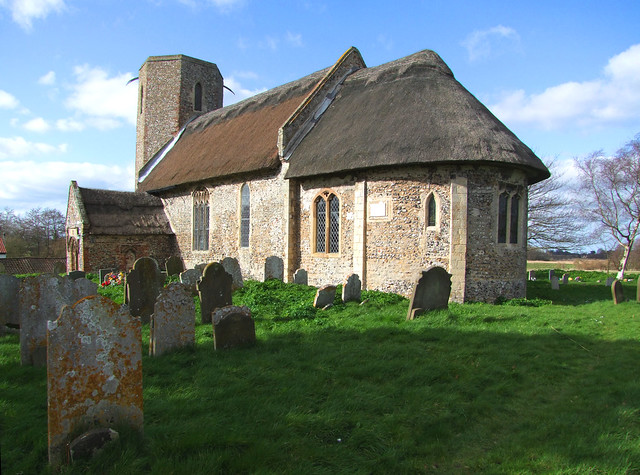
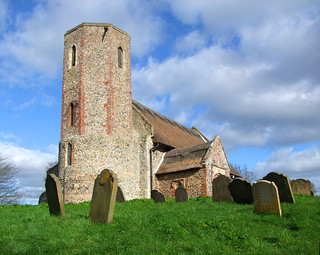
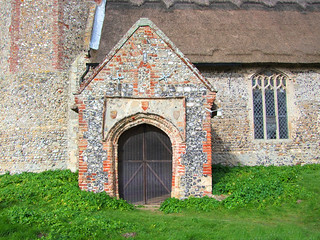
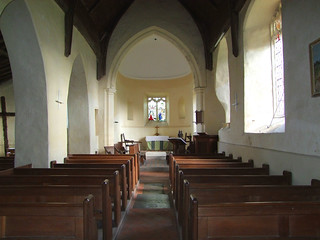
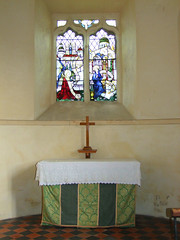
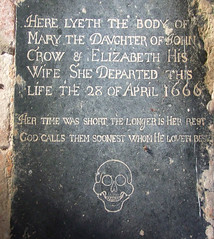
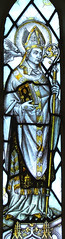
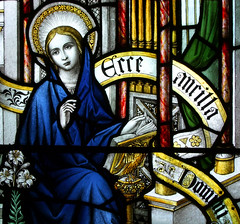
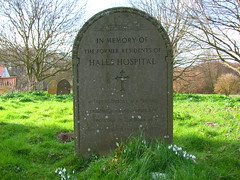
St Gregory, Heckingham Here we are in south-east Norfolk, and a mile or so to the north of the justifiably famous Norman church at Hales sits another delightful Norman church at Heckingham. It perhaps isn't so well-known, although the two are sometimes spoken of together, and not just because this was once a joint parish (both are now redundant and in the care of the Churches Conservation Trust). They are probably the two best examples of small, rural Norman churches in this part of Norfolk. As often in this area the most obvious evidence of the work of the Normans is the grand south doorway, which Pevsner thought likely to be by the same mason as the north doorway at Hales. But in a number of other ways the two churches are quite different. Heckingham's church sits alone among narrow lanes on an overgrown mound with only the old rectory, the sound of the birds and the wind in the trees for company, quite different in atmosphere to the flat open churchyard and noise from the busy Norwich to Beccles road you get at Hales. The 18th and 19th Century headstones wash higgeldy-piggeldy around St Gregory, and far more happened here in the years that followed the Norman building than at its neighbour, the passing centuries conspiring to alter the appearance of the little church giving it an idiosyncratic character and begging a number of questions from us. The north aisle was added in the early 14th Century, and at the west end only the circular base of the tower is Norman. The rest was rebuilt to an octagonal plan as the 15th Century became the 16th, the upper part allowing a more ambitious bell arrangement. Pevsner notes bequests of 1486 and 1507 to the makyng of the stepille. You step into a church which has a quite different atmosphere to the cool white ancient light of Hales. Here, the nave and aisle feel contained by the low 19th Century roofs, the interior spreading rather than rising. You can see that the early 14th Century builders of the north aisle simply cut through the original wall of the Norman church to create an arcade rather than build one for themselves. Was this an expedient measure? Was a proper arcade planned, but the Black Death intervened and it was never built? Unlike Hales, Heckingham retains a Norman font, a large square bowl set on a sturdy stem and four corner columns. However, all may not be as it seems, for an engraving of the 18th Century shows a late medieval font. Was this artistic licence, or did late 19th Century diocesan architect Herbert Green, a known Norman enthusiast, find it elsewhere and replace it to make the church more Norman than it was already? The Crowe family left some memorable ledger stones in the 17th Century, the fierce puritanism of the earliest giving way to a more gentle sentimentality in the later ones. A small 15th Century brass inscription in the nave asks us in Latin to pray for Augustus Wood's soul and also commends it to God's attention. To the east, the interior of the apse was redone by the Victorians, and the chancel arch is perhaps unfortunate and not really sympathetic. However, the good early 20th Century glass in the apse distracts attention from these minor faults of half a century earlier, particularly the lovely Annunciation of 1910. There appears to be no record of the workshop. Birkin Haward would only commit himself to saying that it was in the Webb manner. Fragments of 15th Century glass remain in the upper lights of a window on the south side of the nave. Outside in the churchyard is a modern headstone in memory of the former residents of Hales Hospital. This was the workhouse. It was built in Heckingham parish in 1764 as a House of Industry by the Ipswich architect John Harris, thus making it the first House of Industry in Norfolk. Houses of Industry were designed to provide useful work for the parish poor, and would become common features of England's rural landscape over the next half century, but under 1830s reform acts these schemes were cruelly consolidated, the larger buildings becoming Union Workhouses to house the poor from over a wider area. Here, the architect John Brown expanded the workhouse to accommodate more than four hundred inmates, though in hard winters it is likely that there were far more people living in it than this. Inmates who died in the workhouse were buried 'on the parish', which is to say in an anonymous common pauper grave without a headstone in Heckingham churchyard. It is worth adding that it was not just inmates of the workhouse who ended up like this, but any of the parish poor whose families could not afford an individual grave site. I know that many of my own ancestors ended in common pauper graves, and not just those who died in workhouses. The surviving 18th and 19th Century headstones in any English churchyard remember only a tiny fraction of the people of the parish buried there. As was common, the workhouse became a hospital in the years after the First World War and remained so until closure in the 1990s. For many years it lay derelict, but it has recently been converted into housing. This stone remembers the hundreds of its former inmates who might otherwise have been completely forgotten. Simon Knott, November 2020 Follow these journeys as they happen at Last Of England Twitter. |






|
|||||||||||||||||||||||||||||||||||||||||||||||||||||||
|
|||||||||||||||||||||||||||||||||||||||||||||||||||||||
home I index I latest I introductions I e-mail I about
this site I glossary
Norwich I ruined churches I desktop backgrounds I round tower churches
links I small
print I www.simonknott.co.uk I www.suffolkchurches.co.uk