home I index I latest I glossary I introductions I e-mail I about this site
St Margaret, Hardwick

Follow these journeys as they happen at Last Of England Twitter.
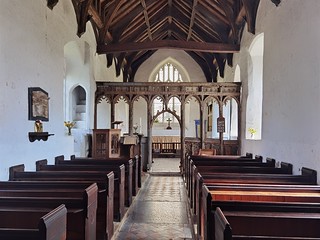
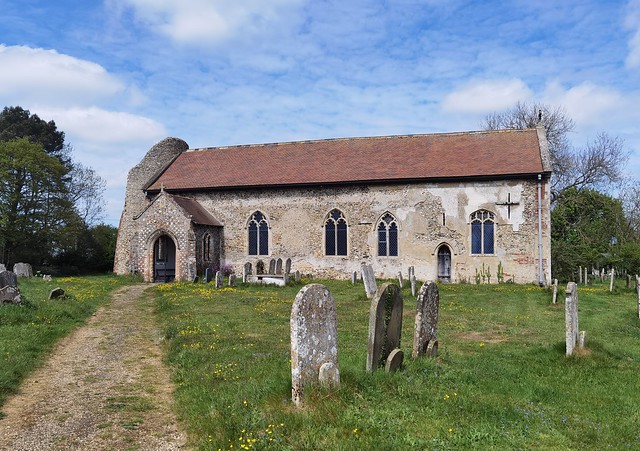
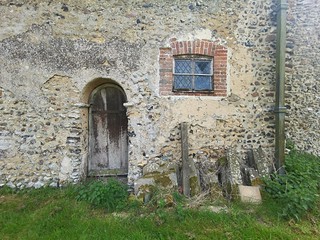
St Margaret, Hardwick This delightful little church sits just to the south of its more famous neighbour, the grand church of St Mary at Shelton, one of Norfolk's best-known churches. Both Shelton and Hardwick are lost in the lanes, but if you can find Shelton then it is worth coming a mile down the road to find Hardwick as well. Here is another church full of interest, and yet quite different from its neighbour. It is one of those churches that sticks like a burr in the memory, as the late Sam Mortlock famously observed of one of his favourites. Here is a church that is the organic result of centuries of both care and neglect. The round tower collapsed in the great storm of 1770, and the little brick structure built into the ruins operates as both belfry and cleaning cupboard. The church is narrow, all of a late Norman piece, and it retains its original doorways. There is a curious redbrick window at the west end of the north wall, and a decent little porch doing service on the south side. You step into a
atmospheric little space, with the smell of ancient stone
and wood, a milky light filling a simple, rural church.
And this is not a large church. The incumbent of Hardwick
failed to make a return for the 1851 Census of Religious
Worship, so we can't know how many people attended the
morning service or the afternoon sermon on that day.
However, as almost half the population of the parish
tipped up at the Wesleyan Methodist chapel in the village
that day, we can assume that it wasn't very many. The
district registrar thought that there was seating for
about eighty people, which looking around today seems to
have been a generous estimate. At the west end of the
church, doing service as a vestry, is the squire's family
pew, which was originally wedged into the chancel. It
dates from the early 17th century, and has something of
the character of a small caravan, with a roof and high
walls. The panelling is plain, but the balusters are
richly carved. Turning east, Hardwick's rood screen is exquisite. It can never have been very grand, and apart from the rail along the top it is as much air as it is wood. In the late 17th Century this upper part was remodelled and built up, and this seems to be so that it was able to support the Royal Arms, the Lord's Prayer and Commandments boards, for above the archway is an inscription reading John Ebbets, Joseph Cock, Church Wardens 1661. The furnishings they proudly placed there are now gone, probably taken down by the Victorians. The panels of the screen dado are decorated with floral patterns, and there are gilded carvings in the spandrels.
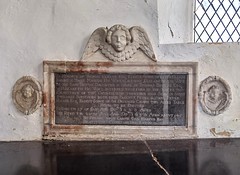
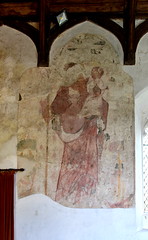
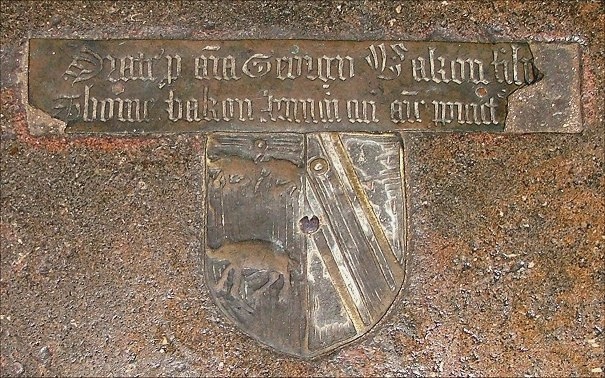
As you might expect in this part of Norfolk, a wall painting of St Christopher survives opposite the south doorway. It is a particularly interesting one, for either side of the saint are what appear to be crabs swimming in the river, and then on the bank on either side are trees with birds in. A drawing made in the 19th Century when it was first uncovered shows the bird in the tree to the east of the saint as an owl being mobbed by other birds, and an angler sitting on the bank. A scroll above the saint's head may be a dedication or, more excitingly, the same Latin inscription as at Creeting St Peter in Suffolk which translates roughly as Whosoever regards this image shall feel no burden in his heart today. This refers to St Christopher's role as the patron saint of travellers. In the years after the Black Death there was an urgency to the need not to die unconfessed, and St Christopher was asked for protection from sudden death while away from home on a journey. The fact that he stands opposite the main entrance in so many churches suggests that it was common practice to stop and renew this plea at churches the traveller passed along the way, which he could do simply by standing in the church doorway. There are fragments of old glass collected in the upper lights of two windows, including a heraldic shield. The former rood loft stairway climbs up in the north side window embrasure before disappearing into the wall, only to emerge at the place where the rood loft must have been. Just inside the chancel, a brass to George Bacon asks us for prayers for his soul. The Bacons were a significant East Anglian family, and their shield here depicts the little pigs that were their symbol. Four hundred years later, the same symbol was used in the floor tiles of Richard Phipson's St Mary le Tower, Ipswich, the restoration of which was paid for by the Bacon family. A mile or so to the west of Hardwick, at Long Stratton, rests one of the political architects of the 17th Century Puritan project in England, Sir Edmund Reeve. Here at Hardwick lies one of his adversaries. Up in the chancel is the brightly coloured memorial to Sir Peter and Lady Penelope Gleane. His inscription tells us that he served the Crown faithfully above 40 yeares... in which several services for his King and country he spent his strength and weakened his fortunes, and the wounds which that received were not healed... Sir Peter's parents Sir Thomas and Lady Elizabeth Gleane are on the opposite side of the sanctuary. Their inscription tells us that Peter Gleane Esq eldest sonne of the deceased caused this alter table here to be erected, and the use of the word alter is a curious one in this context. Presumably Sir Peter was also responsible for the final words of the inscription, which remind us that no person upon Earth can happye bee, Beatitude comes after Exequie. Simon Knott, August 2022 Follow these journeys as they happen at Last Of England Twitter.
|
|
|||||||||||||||||||||||||||||||||||||||||||||||||||||||
home I index I latest I introductions I e-mail I about
this site I glossary
Norwich I ruined churches I desktop backgrounds I round tower churches
links I small
print I www.simonknott.co.uk I www.suffolkchurches.co.uk