home I index I latest I glossary I introductions I e-mail I about this site
St George, Hardingham



Follow these journeys as they happen on X/twitter.
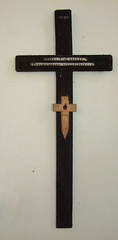
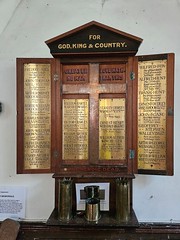
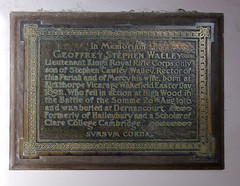
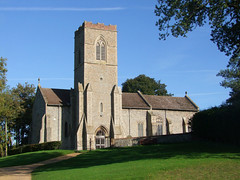
St George, Hardingham The landscape between Wymondham and Dereham is intensely rural, the fields and copses scattered across a patchwork of small agricultural parishes, each with its generally scattered village and small church. But Hardingham bucks the trend. Its imposing church sits away from its village on a rise above the lane, beside the delicious late 16th Century Old Hardingham Hall. In the old days you used to get the key to the church from there, which was an excuse for a bit of a poke around, but that's no longer the case. I must tell you though that this church is still one of very few in this part of Norfolk that is kept locked. Be that as it may, the building is still a fine sight. It's one of about a dozen churches in Norfolk with a late 13th Century tower on the south side, serving double duty as a porch. There are about thirty of these altogether, most of them in Suffolk, and the theory is that they are all the work of the same master mason, probably based in Ipswich but working out of Norwich too, for almost all the churches are set in navigable river valleys to the west of those urban centres. Incidentally, an idea of how parochial Norfolk is may gained from knowing that an old local I met in the church at nearby Whinburgh claimed that the church there had the only south tower in England. When I told him that there were many more, and in fact there was one on church at Hardingham, less than five miles off, he admitted that he'd never been there. The rest of the church is broadly 13th Century as well, a general rebuilding at that time. The tower was completed with its parapet in the late medieval period, a result of John Cushings bequest of 1523 to cover the steeple, mend sollars and bell frame. The long chancel seems to have been given a going over at about the same time. There's a north transept and a kitchen extension on the same side which has been done well. The imposing position and overall rugged appearance of the church makes it seem larger than it actually is. However, when you walk beneath the tower and step into the nave, it feels a more intimate space than you might have expected. The overall feel is very much of the late 19th Century , and not much appears to have happened since. However, the west wall of the nave is a testimony to dreadful events of the following century. At the centre of the wall is the parish war memorial. It opens like a dartboard, and on the wings and below the cross are some twenty names from two World Wars, sixteen of them from the First, a horrendous number for such a scattered and sparsely populated parish. Flanking the memorial are four battlefield crosses, brought back to the parish from Flanders and the Somme. John Thomas Abel was the son of Henry and Annie Elizabeth Abel, of the Old Bird in Hand public house here in Hardingham. The pub has long since closed of course, though the building survives. John Abel was a Lance Corporal in the 4th Battalion Machine Gun Guards, and he died of his wounds on the 27th March 1918. He was just 22 years old. His body was buried at the Cabaret-Rouge cemetery at Souchez, near Arras in northern France, but the cross that marked his original grave is here. The other field crosses are to Private Wilfrid Fox of the 4th Bedfordshires who died on the 30th September 1918, Private Harry Arthur Egle of the 8th Norfolks, who died on the 1st of March 1917, and to Lieutenant Geoffrey Stephen Walley of the 2nd Kings Royal Rifles who was killed on 20th August 1916.
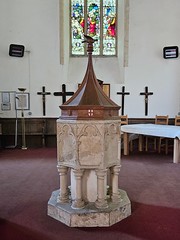
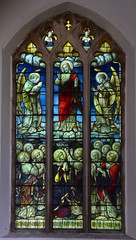
Below the memorial board is a brass shell case converted into a vase, which when I first visited some twenty years ago was home to four Remembrance Day poppies. It is inscribed FROM HIGH WOOD AUG 1916, and I wondered if this has any particular significance. It didn't take me long to find out. A stroll up to the chancel completes the story, for there, on a brass plaque, is the agonising coda. Walley was the only son of Stephen Cawley Walley, Rector of this Parish, and Mercy, his wife. He was 24 years old. The boy was killed in the Battle of the Somme at High Wood on the 20th August 1916, and his parents must have been given the shell case from the battle site as a keepsake. I found this particularly moving, because my great-grandfather Arthur Page, a serjeant in the 2nd Suffolks, was killed in the same place on the same day. A memorial to a later parishioner to die in battle is the imposing glass depicting St George on his horse trampling a dragon. It dates from the late 1940s and I think it may be by GER Smith, although he usually signed his work and this glass is unsigned. BIrkin Haward commented that it was out of scale with the church. It remembers William Edwards, killed in action in Tunisia in 1943. The rest of the glass is earlier, from the last decade of the 19th Century and the first of the 20th Century, and all of it is by the firm of Lavers and Westlake. None of it is particularly memorable and must have seemed already old-fashioned at the time. How much better the beautifully reticulated tracery of the east window would look with clear glass in it! The best glass here is in the small window in the transept, depicting the Annunciation. I wondered if it had been intended to back a side altar. The chancel itself
weeps substantially to the north, and its most impressive
feature is the 13th Century double piscina in the
south-east corner, its arch intersected by two other
arches. The font back at the west end of the nave is
probably contemporary with it, imposing and octagonal
with arcaded panels, its splendour somewhat neutered by
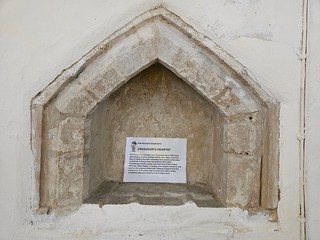
its setting in pink carpet. There is a most curious
alcove in the south wall. It has two raised gothic
crosses in its sill, and the parish claim it is, or may
be, the last resting place of the hearts of two
crusaders, which doesn't strike me as terribly likely,
but it is hard to think exactly what it might be. Simon Knott, January 2024 Follow these journeys as they happen on X/twitter.
|
|
||||||||||||||||||||||||||||||||||||||||||||||||||||||
home I index I latest I introductions I e-mail I about
this site I glossary
Norwich I ruined churches I desktop backgrounds I round tower churches
links I small
print I www.simonknott.co.uk I www.suffolkchurches.co.uk