home I index I latest I glossary I introductions I e-mail I about this site
St Peter and St Paul, Halvergate
Follow these journeys as they happen at Last Of England Twitter.
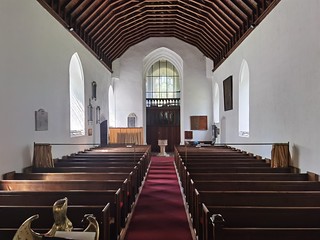
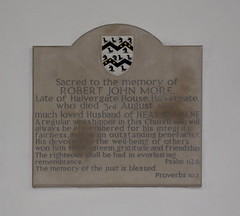
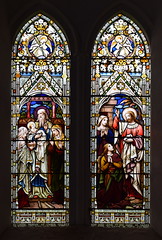
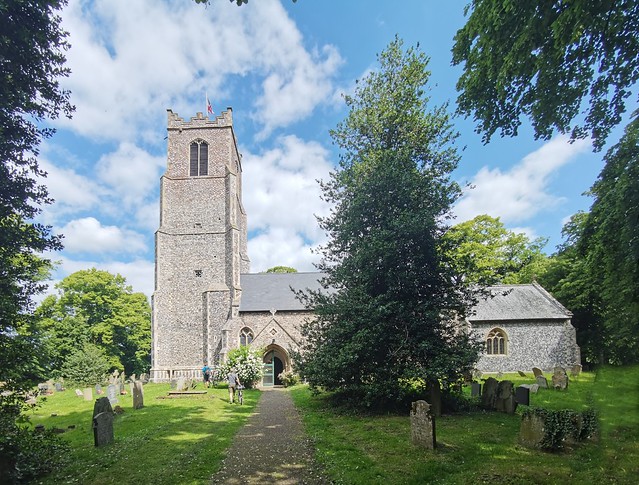
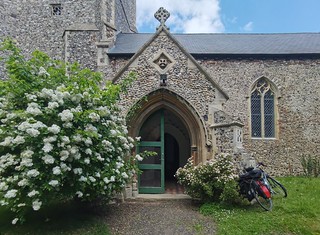
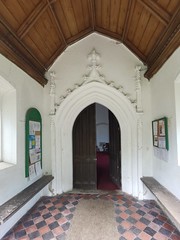
St Peter and St Paul, Halvergate A surprisingly large and comfortable village given that we are out on the edge of the marshes which stretch eastwards of Halvergate. They were once under the great estuary formed by the meeting of the rivers Yare, Bure and Waveney, and because of this, St Peter and St Paul was a coastal church. It is easy to imagine, given its unusually tall tower which must once have been a beacon for shipping. In this landscape of mostly small churches, many of them Norman in character, this was a big rebuilding of the 14th Century. And yet, there is a homeliness to it, for there are no aisles or clerestories, just a long, wide nave and chancel. There were several significant 19th Century restorations here, the first in 1852 before the Ecclesiological movement really got going in out of the way places like this. It was probably then that four earlier figures were placed as pinnacles on the tower. As Pevsner observes, they were rustic work with a Baroque overhang, folk art of a kind one expects to find in Bohemia or Brazil rather than in England. He thought they were probably late 17th Century. They were taken down in 1958, and Bill Wilson saw them in the churchyard when revising the Buildings of England volumes for Norfolk in the 1990s, although as Pevsner also notes, they were not intended for outside. Their pedestals survive on the tower. The substantial restoration here came at the hands of diocesan surveyor Richard Phipson in the 1870s, when he rebuilt the chancel, reroofed the nave and refurnished the interior. The south porch and much of the nave window tracery had been replaced in between times, and so although this is in essence a medieval church, its character is almost all of the late 19th Century. Given this, it is a surprise to discover that the porch conceals a very fine early 14th Century doorway with rising pinnacles as if it were a grand tomb canopy, and it is through this that you step into the church. Phipson's interior is typically calm and rustic, a world away from his urban extravaganzas at St Peter Mancroft in Norwich and St Mary le Tower in Ipswich. The font is Phipson's, with deeply cut roses and monograms set in the tracery panels of an octagonal bowl, presumably intended as a late 14th Century style. John Bateley would have known the church before the 19th Century well, for his 1799 memorial on the south wall tells us that he was 90 years old when he died, and that plain in form but rich he was in mind. There is thankfully very little coloured glass, but Henry Hughes' two lancets depicting the Presentation in the Temple and Christ with Mary and Martha at Bethany came as part of Phipson's restoration, and are good of their kind. The one medieval survival here is also in glass, and unusually is set in a wooden frame above the altar as if it were a relic. Of the 15th Century, it depicts St Christopher carrying the Christchild across the river, with an eel emerging from the depths beneath his feet. It was taken down from the upper light of a window on the north side of the nave in the 1980s and repaired. It is curious to think that at the time it was made Halvergate was a coastal parish, although of course there is no way of knowing if it came from this church originally. It is worth adding that Halvergate was one of a number of churches that were kept locked when I first explored this part of Norfolk in 2007, but today they are nearly all open daily. Halvergate's church may not be the most exciting or interesting of them, but it is a calm and welcoming place, and worth a visit for that alone. Simon Knott, July 2022
Follow these journeys as they happen at Last Of England Twitter. |
|
|||||||||||||||||||||||||||||||||||||||||||||||||||||||
home I index I latest I introductions I e-mail I about
this site I glossary
Norwich I ruined churches I desktop backgrounds I round tower churches
links I small
print I www.simonknott.co.uk I www.suffolkchurches.co.uk